
Story of Hongdu Sword (Sharp Sword)
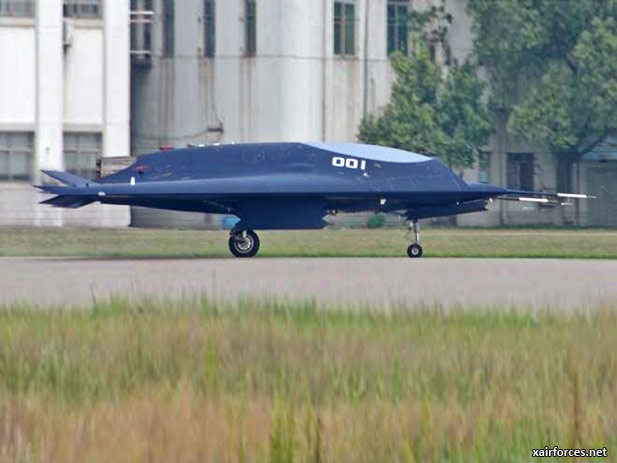
China, along with other military powers in the world, lifted the veil of the Hongdu Lijian (Sharp Sword). The aircraft represents China's first official foray into jet-powered, low-profile unmanned aerial vehicles (UAVs) and is expected to serve as a technology demonstrator in a possible future combat system.
The design was photographed during a takeoff in May 2013, officially marking its entry into the Chinese aircraft inventory. The "Sharp Sword" is one of several full-wing designs derived from the AVIC 601-S UAV project. These include "Wind Blade", "Cloud Bow" and "War Eagle".
Externally, the vehicle takes the form of the competing (and in-development) Northrop Grumman X-47B, with frontal air intakes and a tailless profile.
Life Fitness completed a development phase that lasted about three years, involving the Hongdu and Shenyang aircraft manufacturers. The end result is a flying wing with a turbofan sunk into the bulbous fuselage. The plane's overhead profile is reminiscent of Northrop Grumman's B-2 "Spirit" stealth bomber, and it lacks any vertical stabilizers. It is believed to contain a gun bay for ammunition.
The tricycle landing gear is fully retractable and consists of two single-wheeled main legs and a front leg.
For now, the Lijian is believed to be powered by the same Shenyang WP7 series engine as the J-7 fighter series. Estimated specs include a range of up to 80 miles and a payload capacity of no more than 4,000 pounds. The structure has a wingspan of about 46 feet.
Specification
Basic
Production
Roles
- Ground Attack
- driverless
Dimensions
45.93 ft (14 m)
Weight
Production model)
Performance
Performance
Production mode;
Armor
Assumes support for precision-guided bombs, conventional bombs, and built-in air-to-air missiles/air-to-surface missiles.
Assuming a payload of 4,500 lbs or less.
Changes
Lijian ("Sharp Sword") - The name of the base series.
 Argentina
 Armenia
 Australia
 Austria
 Austria-Hungary
 Belgium
 Brazil
 United Kingdom
 United States
 Brunei
 Bulgaria
 Canada
 Chile
Chile Colonial America
 Colombia
 Confederate States
 Croatia
 Czech
Czech Denmark
 Egypt
Egypt Finland
 France
 Georgia
 Germany
 German Imperial
 Greece
 Holland
 Hungary
 India
India Indonesia
 Iran
Iran Iraq
Iraq Ireland
 Israel
 Italy
Italy Japan
Japan Japan (1940)
 Jordan
 Kingdom of Italy
 Malaysia
 Mexico
 Myanmar
 Nazi Germany
 Netherlands
 New Zealand
 North Korea
 Norway
 Pakistan
 Peru
Peru Philippines
 Poland
 Portugal
 Prussia
 Romania
 Russia
 Saudi Arabia
 Serbia
 Singapore
 Slovakia
 Slovenia
 South Africa
 South Korea
 Soviet Union
 Spain
Spain Sweden
 Switzerland
 Syria
Syria Taiwan
 Thailand
 Turkey
 UAE
UAE Ukraine
 Vietnam
 Yugoslavia