
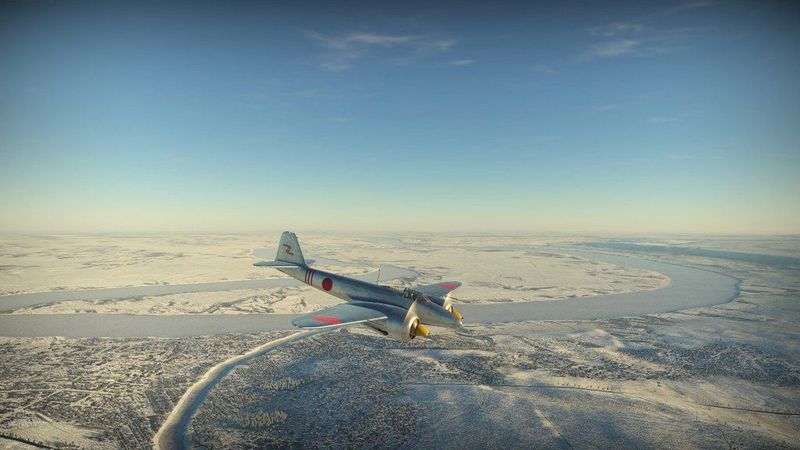


Kawasaki Ki-96 History
Following the success of the German twin-engine, two-seat heavy fighter Messerschmitt Bf 110 in Europe, a similar design was requested by Imperial Japan. Kawasaki delivered their Ki-48 "Sokei" as a light fast bomber in 1940, followed by the excellent Ki-45 "Toryu" in 1941.
Although limited in some areas, the Ki-48 performed well until the end of the war, and the Ki-45 ended the conflict as the best twin-engine heavy fighter of WWII.
With the Ki-45 proving itself in actual combat from 1942 onwards, Kawasaki began private adventures in August with improved replacements. The new design incorporates essential features of the Ki-45, including its two-seat crew layout, a streamlined fuselage with a single vertical stabilizer, and a twin-engine configuration. The cockpit is designed behind a short nose cone. The fuselage tapers towards the vertical stabilizer, and the horizontal stabilizer is mounted low on the rudder. The engines are air-cooled radials, each driving a three-bladed propeller.
The landing gear is fully retractable, including two main monowheel legs and a rear monowheel leg under each engine nacelle - also retractable. Power is provided by 2 x Mitsubishi Ha. Series 112-II 14-cylinder radial piston air-cooled engines rated at 1,500 hp each - more than 102 1,050 hp radials in the Ha. Ki-45. The show has a top speed of 373 mph, a range of up to 995 miles, and a service ceiling of 37,700 feet.
The aircraft recorded a rate of climb of 16,400 feet in six minutes, making it a strong interceptor. Armament consists of 1 x 37mm Ho 203 cannon, supplemented by 2 x 20mm Ho 5 cannons.
The aircraft received the company model designation Ki-96 and was classified as the same heavy fighter as the German Bf 110 - destined to perform the same battlefield functions.
After their product was submitted to the authorities, attention was paid to this type, and requests were made to convert the design into a single-seat heavy fighter form, perhaps to support the increasingly small number of qualified pilots. Changes were made soon, and the form was put on display and flew for the first time in September 1943. The conversion wasn't quite complete, however, as the prototype still had the full-length two-seat canopy of the now single-seat cockpit. Nonetheless, performance was maintained, and the genre proved important enough for Japan's developmental range to push the envelope.
Two more prototypes followed, and although these were completed from the start, their single-seat canopies showed more of the final Ki-96 form.
For whatever reason, Japanese authorities returned to Kawasaki and ordered the design reverted to two-seat fighter form, causing significant delays to the program. At this point, the situation throughout Japan and its territories had deteriorated to the point where the development of the Ki-96 was completely halted. Only three prototypes were counted as part of the project, and no pre-production or production quality tables were followed.
The war ended in August after the Allies dropped the atomic bomb on Japan, followed by the official surrender in September, marking the official end of World War II.
Ki-102 is another possible replacement for Ki-45, successfully completed in 238 production forms. It had a similar twin-engine, twin-crew design, was classified as a heavy fighter and was produced in three different versions - fighter, ground attack and night fighter. The line was commissioned in 1944 and remained in service until the end of the war in 1945.
The Ki-102 originated from the incomplete Ki-96 design, detailed elsewhere on this page.
Specification
Basic
Production
Roles
- Fighter
- Intercept
- X-Plane / Development
Dimensions
11.45m
51.08 ft (15.57 m)
3.7m
Weight
10,031 lbs (4,550 kg)
6,000 kg
Performance
Performance
373 mph (600 km/h; 324 knots)
37,730 ft (11,500 m; 7.15 mi)
994 miles (1,600 km; 864 nautical miles)
2,733 ft/min (833 m/min)
Armor
Suggestions:
1 x 37mm Ho-203 Cannon
2 x 20mm Ho-5 cannons
Changes
Ki-96 - name of the basic series
 Argentina
 Armenia
 Australia
 Austria
 Austria-Hungary
 Belgium
 Brazil
 United Kingdom
 United States
 Brunei
 Bulgaria
 Canada
 Chile
Chile China
China Colonial America
 Colombia
 Confederate States
 Croatia
 Czech
Czech Denmark
 Egypt
Egypt Finland
 France
 Georgia
 Germany
 German Imperial
 Greece
 Holland
 Hungary
 India
India Indonesia
 Iran
Iran Iraq
Iraq Ireland
 Israel
 Italy
Italy Japan
Japan Jordan
 Kingdom of Italy
 Malaysia
 Mexico
 Myanmar
 Nazi Germany
 Netherlands
 New Zealand
 North Korea
 Norway
 Pakistan
 Peru
Peru Philippines
 Poland
 Portugal
 Prussia
 Romania
 Russia
 Saudi Arabia
 Serbia
 Singapore
 Slovakia
 Slovenia
 South Africa
 South Korea
 Soviet Union
 Spain
Spain Sweden
 Switzerland
 Syria
Syria Taiwan
 Thailand
 Turkey
 UAE
UAE Ukraine
 Vietnam
 Yugoslavia