


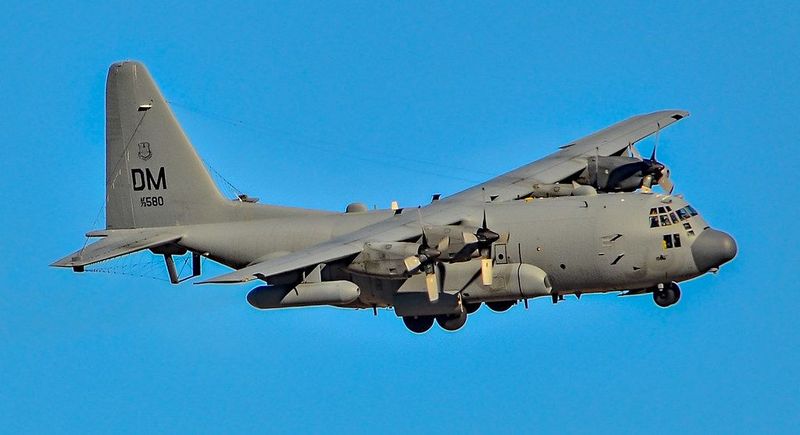
Lockheed EC-130H Compass Call Log
The EC-130H "Compass Call" is a dedicated electronic warfare aircraft (EWA) platform based on the highly successful Lockheed C-130 Hercules transport aircraft. The modified aircraft retains the basic look of the original, but is equipped with cutting-edge technology that allows the United States Air Force (USAF) to jam or cut off enemy communications.
In addition to basic EWA capabilities, the EC-130 can be used to suppress enemy air defense networks and provide "counterintelligence" when needed. The net effect is to severely constrain the enemy's communications infrastructure, severely impair coordinated action against friendly forces, and eliminate possible advantages the enemy may have. The modernization program continues to expand the capabilities of the base EC-130 system to meet the demands of the modern battlefield.
The EC-130H can be clearly identified by the numerous antenna mounts and cables on the sides of the fuselage, roof and tail.
The EC-30H first flew in 1981, entered service with the U.S. Air Force in 1982, cost $65 million per aircraft, and achieved operational capability in 1983. Only 14 of these very specialized airframes have been in service to date and all remain active in the USAF's inventory???.
They are deployed outside Davis-Monthan Air Force Base, but serve with the 55th Wing at Offutt Air Force Base, Nebraska. While Lockheed is the prime contractor for the EC-130, BAe Systems provides primary mission equipment, while L-3 Communications is responsible for aircraft integration and hangar maintenance.
The design of the EC-130H naturally follows the original C-130. The fuselage is a stout, somewhat cylindrical design with the recognizable C-130 raised monoplane wings. Each wing is equipped with two bottom nacelles housing powerful turboprop engines, giving the fuselage the STOL (short take-off and landing) qualities inherent in the original C-130. Optional underwing equipment pods can be installed between each engine nacelle or externally if desired.
The cockpit flight deck is well maintained in the design, and the mission area is located within the fuselage itself. The tail is controlled by a large vertical tail and two horizontal tails.
The aircraft consisted of no less than 13 personnel, including two pilots, a flight engineer, a navigator, two professional electronic warfare officers, a mission crew supervisor and procurement operator, a maintenance technician and four Cryptolinguist. Although the EC-130H itself does not provide offensive or defensive attack against conventional weapons, it manages "non-kinetic waveforms" as its primary weapon.
Power is still provided by an efficient arrangement of 4 Allison T56-A-15 series turboprop engines, delivering up to 4,910 hp to a four-blade propeller system. Top speed is around 300 mph and service is capped at 25,000 feet. The internal fuel capacity is 62,000 pounds and the range is 2,295 miles.
The maximum takeoff weight (MTOW) is listed at 155,000 pounds, and the aircraft has a wingspan of 132 feet 7 inches.
The EC-130H has been upgraded through the Block 30 and Block 35 programs. The former introduces a new, improved task area as well as an updated operating system.
The latter enhances the performance and range of the airborne early warning and acquisition radar suite and introduces improved navigation and digital signal processing.
The EC-130H is deliberately designed to be a highly flexible combat unit, enabling it to be deployed anywhere in the world and at all levels of operations as needed, while maintaining very short lead times. The EC-130H works synergistically with other existing USAF special aircraft, such as the Northrop Grumman EA-6B Prowler and General Dynamics F-16CJ Fighting Falcon, to form a powerful suppression and Jamming the service triangle to maximize every possible advantage to score USAF and friendly forces during a given operation.
To date, the EC-130H Compass Call Platform has been in service in Kosovo, Haiti, Panama, Iraq, Serbia and Afghanistan, proving its worth time and time again.
Specification
Basic
Production
Roles
- Electronic Warfare (EW)
Dimensions
29.3m
130.25 ft (39.7 m)
37.40 ft (11.4 m)
Weight
101,000 lbs (45,813 kg)
69,750 kg
Performance
Performance
300 mph (483 km/h; 261 knots)
25,000 ft (7,620 m; 4.73 mi)
2,295 miles (3,694 km; 1,995 nautical miles)
Armor
Not carrying conventional weapons or ammunition.
Changes
EC-130H - Designation of the basic series; a total of 14 examples were made, all of which are actively in inventory of the US Air Force.
EC-130H Block 30 - Program Upgrade; Revised Mission Area; Updated Software.
EC-130H Block 35 - Program upgrades; additional jamming capabilities; improved early warning and detection systems; extended frequency range; digital signal processing.
 Argentina
 Armenia
 Australia
 Austria
 Austria-Hungary
 Belgium
 Brazil
 United Kingdom
 Brunei
 Bulgaria
 Canada
 Chile
Chile China
China Colonial America
 Colombia
 Confederate States
 Croatia
 Czech
Czech Denmark
 Egypt
Egypt Finland
 France
 Georgia
 Germany
 German Imperial
 Greece
 Holland
 Hungary
 India
India Indonesia
 Iran
Iran Iraq
Iraq Ireland
 Israel
 Italy
Italy Japan
Japan Japan (1940)
 Jordan
 Kingdom of Italy
 Malaysia
 Mexico
 Myanmar
 Nazi Germany
 Netherlands
 New Zealand
 North Korea
 Norway
 Pakistan
 Peru
Peru Philippines
 Poland
 Portugal
 Prussia
 Romania
 Russia
 Saudi Arabia
 Serbia
 Singapore
 Slovakia
 Slovenia
 South Africa
 South Korea
 Soviet Union
 Spain
Spain Sweden
 Switzerland
 Syria
Syria Taiwan
 Thailand
 Turkey
 UAE
UAE Ukraine
 Vietnam
 Yugoslavia