


History
While the West seemed to be the only country working on the fantastic "X-plane" during the decades of the Cold War, Soviet engineers were constantly developing their own technology. Following the success of the Mikoyan-Gurevich MiG-21 "fish bed", OKB's engineers continued to develop the line with a series of test objects mainly for experimental purposes. One of the test subjects became Ye-8, which was heavily based on Fishbed and intended to be the next incarnation of the series.
However, engine problems marred the end of the project, and in the end there were only two completed prototypes - one of which was lost in an accident.
In 1961, Moscow authorities requested a new MiG-21 supersonic interceptor/fighter for day/night/all-weather interception scenarios. The aircraft will retain its single-seat/single-engine configuration, and its primary armament will be 2 x Vympel K-13 air-to-air missiles, guided by RP-22 (Volkov "Sapfir-21") radars. Increased performance will come from improved engine matching.
The original intention of the new design was to carry the designation "MiG-23" once it entered service, and to exist as "Ye-8" during its development phase. The former was eventually reassigned to another Mikoyan-Gurevich product, "Flogger".
The engine chosen was the Tumansky R-21F-300 turbojet based on the RD-11F series. Airflow is significantly increased thanks to a larger compressor intake, and a new afterburner assembly provides better short-term high-speed performance.
This single installation will power the new design and provide the capability needed to launch the aircraft and push the system to the intended target area in the short term.
Broadly speaking, the airframe will be faithful to the original MiG-21. The carry mass is a single vertical tail with a low-mounted tail, a delta configuration and a tubular fuselage. The aircraft retains sharp lines along all wing surfaces.
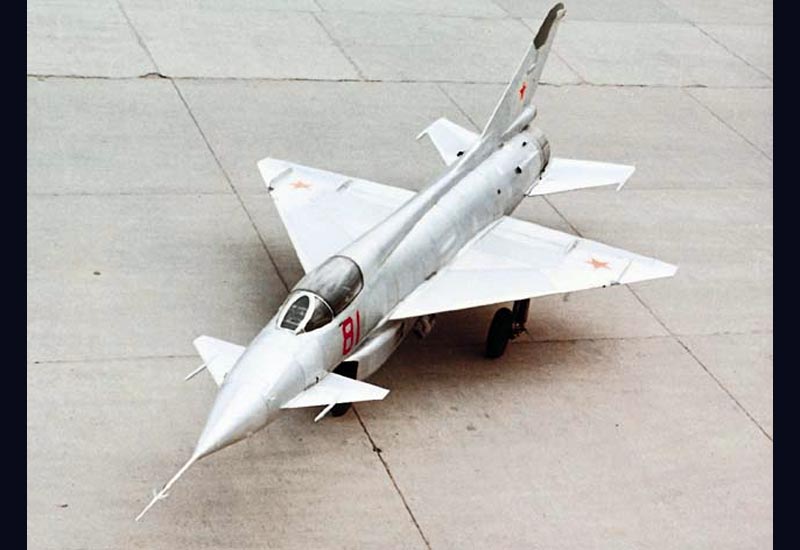
However, the similarities end there, as the Ye-8 features an all-new nose section, a new air intake layout, and additional attachments to the wing surfaces to improve stability and control. The original MiG-21 featured the iconic nose-type air intake, common on post-World War II jets, from which its shock cone emerged. The Ye-8 introduced a full nose cone assembly in front of the cockpit to accommodate the new radar.
The engine is sucked in through a bifurcated (split) air intake under the cockpit (actually very similar to a modern Euro Typhoon), and nine fuel tanks are linked together for more efficient fuel delivery. The canard front wings were then added to the sides of the nose in front of the cockpit, while the raised dorsal ridge of the MiG-21 remained, limiting rear visibility somewhat. Compared to the MiG-21, the lower position of the tail unit is slightly more pronounced. In addition, a sizable pelvic fin was added under the tail and folded sideways on landing (a feature that was later standardized on the final MiG-23 "Flogger" design).
The tricycle landing gear is equipped with a longer front axle than the MiG-21, giving the aircraft a distinct "nose-up" appearance on the ground.
Factory 155 was contracted to manufacture two Ye-8 prototypes (Ye-8/1 and Ye-8/2) until June 1961, the first of which was delivered as early as March 5, 1962 Ready to exhibit. Testing began in April of this year, and after several flights the design sounded. However, from the fifth flight onwards, there was an engine problem that nearly killed the test pilot. Ye-8/1 disappeared on September 11, 1962.
Prototype Ye-8. 2 began its flight phase in June 1962. The two prototypes were slightly different from each other, but neither came with the expected radar kit.
Engine reliability issues with the Tumansky R-21F-300 continued to plague the program throughout development, eventually leading to the cancellation of the program despite the promising nature of the basic design. Radar and weapons were never installed.
All was not lost, however, as experience and data from the Ye-8 test phase helped influence the aircraft, which would become the official MiG-23 "Flogger" aircraft in the Mikoyan-Gurevich lineup.
When completed, the Ye-8 will have an overall length of 14.9 meters and a wingspan of 7.15 meters. The R-21F-300 turbojet produced 10,330 lbf in dry thrust and 15,820 lbf with the afterburner on. Performance specs include a top speed of 1,385 mph and a service cap of 65,600 feet.
Specification
Basic
Production
Roles
- Fighter
- Intercept
- X-Plane / Development
Dimensions
48.88 ft (14.9 m)
7.15m
14.27 ft (4.35 m)
Weight
5,200 kg
8,200 kg
Performance
Performance
1,386 mph (2,230 km/h; 1,204 knots)
65,617 ft (20,000 m; 12.43 mi)
Armor
Proposed (never installed):
2 x Vympel K-13 air-to-air missiles
Changes
Ye-8 - Base series name
Ye-8/1 - First prototype; accidentally lost.
Ye-8/2 - Second prototype; testing aborted.
 Argentina
 Armenia
 Australia
 Austria
 Austria-Hungary
 Belgium
 Brazil
 United Kingdom
 United States
 Brunei
 Bulgaria
 Canada
 Chile
Chile China
China Colonial America
 Colombia
 Confederate States
 Croatia
 Czech
Czech Denmark
 Egypt
Egypt Finland
 France
 Georgia
 Germany
 German Imperial
 Greece
 Holland
 Hungary
 India
India Indonesia
 Iran
Iran Iraq
Iraq Ireland
 Israel
 Italy
Italy Japan
Japan Japan (1940)
 Jordan
 Kingdom of Italy
 Malaysia
 Mexico
 Myanmar
 Nazi Germany
 Netherlands
 New Zealand
 North Korea
 Norway
 Pakistan
 Peru
Peru Philippines
 Poland
 Portugal
 Prussia
 Romania
 Russia
 Saudi Arabia
 Serbia
 Singapore
 Slovakia
 Slovenia
 South Africa
 South Korea
 Spain
Spain Sweden
 Switzerland
 Syria
Syria Taiwan
 Thailand
 Turkey
 UAE
UAE Ukraine
 Vietnam
 Yugoslavia