
History
Japanese engineers developed many excellent fighter designs during World War II, including the famous "Zero", a carrier-based naval fighter - formally known as the Mitsubishi A6M. The model entered service in 1940, with nearly 11,000 produced, it spearheaded most air-navy operations in the Asia-Pacific region due to its outstanding maneuverability and operational range. However, as American technology and tactics improved, the A6M's natural limitations gradually emerged - lack of effective armor protection for pilots and fuel tanks, limited engine power, and limited firepower. The Americans fought back with the top-notch F6F Hellcat, F4U Corsair, P-38 Lightning, P-51 Mustang, and P-47 Thunderbolt to retake the skies over the Pacific Theatereach mount that stood out from the many who flew it.
American aircraft retained good armor protection, ample firepower, and powerful engines to handle the mission. With the improvement of air tactics, the Allies defeated the Japanese enemy in time.
However, the successor to the A6M was assigned as early as late 1940 (the A6M had just entered service in July 1940). Several key qualities of the limited design will be addressed, including firepower, speed, and armor protection. Progress was slow at first, and an acceptable rate was not reached until 1942. In July, the Imperial Japanese Navy officially released specifications for a carrier-based aircraft capable of speeds approaching 400 mph, operating at altitudes up to 20,000 feet, and equipped with a cannon/machine gun combination.
The task of developing the aircraft was given to Mitsubishi, and the engine could be chosen between the Mitsubishi development (Ha-43) or the Nakajima version (Ha-45, which later became the Homare series). The body is designed around these two accessories, as both can provide the required performance specifications.
The resulting prototype - known as the A7M1 - flew for the first time on May 6, 1944. The installed Nakajima Homare 22-series engine (2,000 hp) was underwhelming, but control and agility proved solid. Ultimately, three A7M1 prototypes were built.
While IJN stopped development of the A7M in July, Mitsubishi made progress with the 2,200 hp Ha-43 engine, and testing of the A7M2 system completed on 30 October 1944 exceeded all expectations, leading to As for the IJN's interest in the aircraft is rekindled. A total of five A7M2 prototypes were built, and successful testing saw IJN officially enter service with the aircraft. It was envisaged that the A7M could also be deployed from a land base under the A7M3 (equipped with a supercharged Ha-43 engine), as the Japanese carrier force was largely destroyed and thus limited by this point of the war.
One of the prototypes was later lost in an accident.
After approval for serial production, the production line was reworked for the production of promising fighter jets. However, a major earthquake in Nagoya severely disrupted work, forcing shutdowns and repairs. Once the Allies gained air superiority over the Japanese mainland, the situation worsened, leading to a relentless bombing campaign that further destabilized wartime capabilities and limited the open flow of resources and required supplies. The main threat to Japan at the time was the high-flying four-engine American Boeing B-29 Superfortress capable of outflanking Japanese defenses. Three other A7M prototypes were lost in U.S. airstrikes.
Overall, strategic bombing and natural disasters ended Japan's A7M production program, which was officially abandoned on August 15, 1945, and surrendered on September 2. As the war ended, so did many projects like the A7M. As such, the A6M will never see its successor, and the A7M will never see combat, as its remaining airframe and parts will be scrapped at the end of the war.
The A7M was nicknamed "Reppu" by the Japanese, meaning "strong storm", while the Allies codenamed it "Sam". In practice, the A7M was comparable to the Republic P-47 Thunderbolt, Vought F4U Corsair, and Grumman F6F Hellcat (Japan's main fighter foe in the Pacific) in range, performance, and functionality.
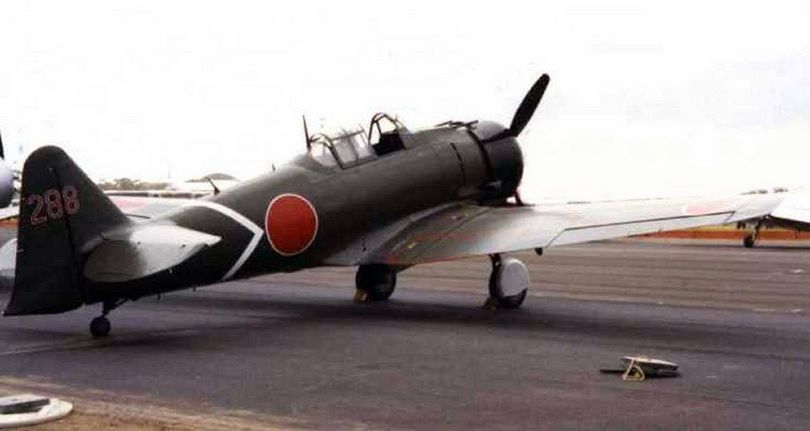
Overall, the A7M shares some visual similarities with the previous A6M. The hull has a long design, the engine is located forward of the design, and the cockpit is located forward of the midship. The engine is an air-cooled radial type engine that provides the horsepower and power increases required by the new carrier-based fighter jets while driving the standard three-bladed propeller arrangement. The cockpit sits beneath a glassed, three-piece assembly with a middle section that slides back along rails for boarding and disembarking.
Wings are straight attachments mounted under the bottom of the fuselage, with rounded wing tips. The landing gear has a typical "tail" arrangement, with a single-wheel main leg retracted under each wing root and a positioning tail wheel under the tail. The rear is conventional, with a short circular vertical fin and a pair of horizontal fins. The landing gear will be strengthened to deal with the violent force inherent in carrier operations. Proposed armament for the A7M series would consist of 2 x 20mm Type 99 cannons and 2 x 3 heavy machine guns (some sources say 4 x 20mm cannons, all in the wings).
The A7M has a top speed of 390 mph, a range of 770 miles, and a service ceiling of 35,700 feet.
Specification
Basic
Production
Roles
- Fighter
- Naval/Navigation
- X-Plane / Development
Dimensions
36.09 ft (11 m)
45.93 ft (14 m)
14.04 ft (4.28 m)
Weight
3,220 kg
10,362 lb (4,700 kg)
Performance
Performance
391 mph (630 km/h; 340 knots)
35,761 ft (10,900 m; 6.77 mi)
771 miles (1,240 km; 670 nautical miles)
664 m/min (2,180 ft/min)
Armor
Default:
2 x 20mm Type 99 guns
2 x 13.2mm Type 3 machine guns
Changes
A7M - Base Series Name
A7M1 - Initial variant; with 2,000 hp Nakajima Homare 22 series engine; made in three copies.
A7M2 - Improved A7M1; equipped with 2200 hp Mitsubishi Ha-43 series engines; built five prototype-quality aircraft.
A7M3 - Land-based variant with supercharged Mitsubishi Ha-43 engine; never produced.
A7M3-J - Proposed land-based variant; never produced.
 Argentina
 Armenia
 Australia
 Austria
 Austria-Hungary
 Belgium
 Brazil
 United Kingdom
 United States
 Brunei
 Bulgaria
 Canada
 Chile
Chile China
China Colonial America
 Colombia
 Confederate States
 Croatia
 Czech
Czech Denmark
 Egypt
Egypt Finland
 France
 Georgia
 Germany
 German Imperial
 Greece
 Holland
 Hungary
 India
India Indonesia
 Iran
Iran Iraq
Iraq Ireland
 Israel
 Italy
Italy Japan
Japan Jordan
 Kingdom of Italy
 Malaysia
 Mexico
 Myanmar
 Nazi Germany
 Netherlands
 New Zealand
 North Korea
 Norway
 Pakistan
 Peru
Peru Philippines
 Poland
 Portugal
 Prussia
 Romania
 Russia
 Saudi Arabia
 Serbia
 Singapore
 Slovakia
 Slovenia
 South Africa
 South Korea
 Soviet Union
 Spain
Spain Sweden
 Switzerland
 Syria
Syria Taiwan
 Thailand
 Turkey
 UAE
UAE Ukraine
 Vietnam
 Yugoslavia