


History of the North American XB-70 Valkyrie
The decades after World War II (1939-1945) saw a period of great achievement related to supersonic flight. The first duel between fighter jets and fighter jets took place during the Korean War (1950-1953), when a whole new generation of jet heavy bombers emerged to replace propeller-powered classics like the Boeing B-29/B. 50 "Superfortress".
The typical United States Air Force (USAF) heavy bomber was later turned into the eight-engine Boeing B-52 "Stratofortress", which brought a very high altitude (50,000 ft) anti-bomb capability. In response to this threat, the Soviets introduced a series of advanced interceptors until their anti-missile network eventually became a real threat to American bomber crews.
North American Airlines
North American Aviation - established in 1928, best known for developing the P-51 "Mustang" won in WWII and the F-86 Sabre in the Korean War - has been a prominent defense player over the years and continues to produce the FJ "Frenzy" series, the F-100 Super Sabre, and the record-breaking X-15 rocket research aircraft. By the late 1950s, his A-5 "Vigilante" was adopted by the United States Navy (USN) and used in the Vietnam War (1955-1975).
Requires high-altitude bombers
One of the company's key developments in the second half of the 1950s was the XB-70 "Valkyrie", a supersonic strategic bomber designed to penetrate enemy airspace using Mach 3+ speeds while carrying a nuclear warhead and Exits take out the danger zone before the enemy has had time to react adequately. The aircraft was designed to replace the venerable B-52 in the high-altitude bomber role and was in service with the U.S.
Strategic Air Command (SAC) as part of North American/European defenses against a full-scale Soviet nuclear attack. The main quality of the new aircraft is its inherent speed, which would theoretically allow it to surpass any interception of airborne enemies or ground threats.
However, Soviet advances in missile technology meant that the aircraft became moot in the 1960s - such as the 1960 Gary Powers incident where the Lockheed U-2 was shot down over the Soviet Union.
However, until missile technology dominated the dreams of war planners, the concept of a high-altitude bomber remained a viable tool on the battlefield. During this period, defense contractors continued to work on a variety of nuclear delivery methods - at the time the U.S. nuclear defense network focused on a "three-in-one" approach, in which aircraft (strategic bombers), submarines (SLMB = "submarine-launched ballistic missiles") and Ground-based launchers (ICBMs = "ICBMs") collectively fire nuclear ballistic missiles at the enemy.
If one corner of the triad failed in the initial Soviet attack ("First Strike"), the other two acted as failsafes to ensure the elimination of the enemy.
In the 1940s, the concept of nuclear-powered bombers was explored, but these designs ultimately failed as overly complex efforts and a renewed focus on conventionally-powered jet bombers. Progress is also still being made in the field of supersonic flight, furthering the idea of ??a hypervelocity bomber, and from this requirement, both Boeing and North America are advancing internal designs, with an emphasis on large, multi-engine layouts that focus on a delta-wing plan.
With the help of NAA (the predecessor of today's NASA), North American Products continued to test the reliability of several of its concepts.
US Air Force and Valkyrie
In August 1957, the US Air Force promoted direct competition between Boeing and North American companies. Basic requirements for the new USAF bomber include a Mach 3 cruise speed above 70,000 feet. Range is a key quality because bombers have to cover great distances, so this number is centered around 10,500 miles.
Structurally, the aircraft will not be larger than the B-52 already in service, so that existing facilities can be reused for new products. The total aircraft weight will be limited to 490,000 pounds. Four crew members were provided, including the pilot, co-pilot, navigator and bombardier. The North American submission, which best met the USAF's requirements, was named the winner in December of the same year, and the contract was announced in January.
From another aircraft naming competition held in early 1958, the winning entry "Valkyrie" was selected. It received the official development designation of the US Air Force "XB-70".
Work began to accelerate, but budget problems slowed the program during 1958 and 1959. In the latter March, the U.S. Air Force was given clearance to review the XB-70 model aircraft, which of course included some new requirements, as well as changes in the industry.
In 1960, the design was officially shown to the American public (albeit in drawn form).
XB-70 Tour
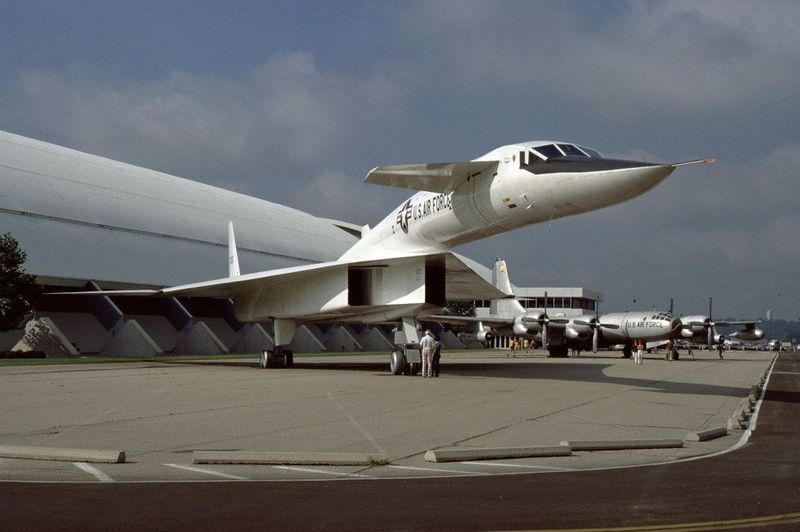
The XB-70 was a technological marvel of the 1950s. As mentioned, in its originally envisioned bomber form, it was designed to carry a crew of four, and with its tubular fuselage, large delta-wing layout, and bottom-mounted engines, the aircraft demonstrated the most probable performance of any aircraft in history. One of the forms of recognition.
The cockpit remains in its traditional position at the front of the fuselage, with large forward canards spanning the crew area. The six engines are arranged horizontally and are drawn in through two large angled air intakes below the aircraft. The main wing aircraft is located below the fuselage but above the engines and applicable intake ducts etc. Two vertical ribs are located on the outside of the six engine exhaust ports at the rear.
Main-wing planes also have wingtips that change their angle during flighttilting down as much as 65 degrees for added stability at supersonic speeds. The landing gear consists of two main legs, each with four wheels and a two-wheeled front leg.
All legs are located in the substructure of the aircraft.
The engine of choice for the XB-70 became the General Electric YJ93-GE-3 turbojet, which provided afterburner capability (at the expense of better fuel economy). Dry thrust is 19,900 lbf (per engine) and afterburner thrust is 28,800 lbf (per engine).
Overall, performance includes a top speed of 2,056 mph (up to Mach 3.1), a cruising speed of 2,000 mph (Mach 3.0), a service ceiling of 77,250 feet, and a range of up to 4,288 miles in tow combat burden.
The fuselage structure of the Valkyrie consists of a "honeycomb" core (sandwich arrangement) wrapped by stainless steel panels, while titanium is used for a high temperature finish (which generates a lot of heat given the speed/altitude required by the aircraft). The overall design of the aircraft was to take advantage of "compression lift", a naturally occurring by-product of flying at high speed/altitude that could use some of the shock waves created by the high pressure air to generate additional lift.
Compared to other aircraft of the time, this was A way to give the XB-70 a completely unique look (its sharp angles, the location of the air intakes, etc...). Dropped wingtips are another high-speed design feature designed to aid directional stability in flight.
The XB-70 should have individually enclosed seats for emergency ejection. The entire cab ejection system was also tested.
The development of rocket technology
Anti-missile systems have been deployed since the 1950s, and by the 1960s, available technology had begun to obsolete high-flying supersonic bomber products such as the XB-70. This led authorities to request in late November 1959 that the XB-70 be modified as an attack reconnaissance platform to attack Soviet rocket launchers. However, this move was not adopted, and the XB-70 project was instead reduced in development due to a rapid decline in initial value.
The rise of America's own ICBM program has also helped to further undermine the development of the XB-70. In late 1959, funding for the XB-70 program covered only one prototype.
Popular support for the XB-70 began to grow due to public mentions during the 1960 presidential campaign. The XB-70 was given so much new life that the U.S.
Air Force commissioned a prototype XB-70, followed by 11 improved development vehicles known as the "YB-70." Funding followed in November 1960.
Following John F. Kennedy's victory over Richard Nixon in March 1961, Kennedy's new administration began to cancel the XB-70 bomber program entirely and shift American priorities to missiles. It was decided to keep the XB-70 in service as an R&D product to study Mach 3 flight.
The brief move to restore the XB-70 as a missile-carrying reconnaissance aircraft (known as the "RS-70") was not enough to revive the XB-70 bomber program. The revision is designed to retain its four crew members and provide in-flight refueling facilities.
Regardless, the XB-70's reduced research role will continue, with modifications to the original design to better suit the new use.
XB-70 as a research platform
Although three XB-70s were planned for the new program, the purchase was later reduced to two, codenamed "XB-70A". The aircraft were identified as "AV-1" and "AV-2" (AV = "Air Vehicle)". The AV-1 arrived in May 1964 and the AV-2 in October.
The AV-1's first flight took place on September 21, 1964, although the event was marred by engine failure and a landing gear warning, forcing the crew to fly the large aircraft with their legs down. In addition, the rear wheels along the plane's port side were locked on landing, and this friction then caused their rubber to crack and ignite flames -- an ominous start to a long-term plan.
Promising results
The XB-70 did not fly Mach 1 until October 1964, and did not finally achieve Mach 3 flight (70,000 ft) until October 1965. Improvements discovered during testing of the AV-1 were incorporated into the AV-2, which recorded its first flight on July 17, 1965.
Further work developed the AV-2 for sonic boom testing on aircraft appropriately equipped with specialized components and systems.
The tragedy happened in the program
On June 8, 1966, the AV-2 was used in a photo ad for General Electric (for a company brochure) in an attempt to show all GE-engined US Air Force aircraft at the time (four in total flying in formation) .However, the formation shook when the accompanying Lockheed F-104 "Starfighter" was pulled into the turbulent airflow from the XB-70, sucking the F-104 into the XB-70's wing and into the larger aircraft The vertical stabilizer (tail) of the . ). The F-104 caught fire, while the XB-70 (which initially remained level for about 16 seconds without the crew noticing the contact) became unstable, began to turn uncontrollably (flat) and went into descent trajectory. The incident tarnished the career of the expensive bomber program, which got off to a good start in the late 1950s.
Of the three pilots involved - Al White and Joe Cross of the XB-70 and Joe Walker of the F-104 - only White survived after using his escape pod to counteract the large plane's increasing G-forces.
GE certainly got publicity from the accidentthough not the kind it hoped for.
End of the road
The AV-1 served as a test vehicle until 1969. After a total of 83 flights (the last to Wright-Patterson Air Force Base), the fuselage was officially retired as a protected exhibit at the National Museum of the United States Air Force in Dayton, Ohio.
Despite being a failed bomber program, the data collected by Valkyrie as a research platform became invaluable for next-generation bomber programs and supersonic flight in general. In fact, these results were used to develop the USAF/SAC Rockwell B-1 Lancer low-altitude penetration bomber. The Mach 3-capable XB-70 also forced the Soviet Union to develop the Mach-2.5-capable Mikoyan-Gurevich MiG-25 "Foxbat" as the XB-70 counter. While the B-70 never saw the light of day in service, Foxbat has given Russians and other nations a long flying career.
The Tupolev Tu-144 supersonic airliner is also said to have benefited from the stolen XB-70 data - it certainly incorporates some design cues from the XB-70 prototype as well as the European Aerospace/BAC Concorde. Another North American project - the retired XF-108 "Rapier" supersonic interceptor - is also planned to use the GE engine developed for the XB-70 (two side by side).
The XB-70 also failed as the successor to the legendary B-52, while the Boeing product survived the B-1 Lancer as its other intended replacement. The B-52 has been in service with the U.S.
Air Force because of the acquisition and operating costs of the B-1 bomber and the Northrop B-2 Spirit stealth bomber all three at the same time.
 Argentina
 Armenia
 Australia
 Austria
 Austria-Hungary
 Belgium
 Brazil
 United Kingdom
 Brunei
 Bulgaria
 Canada
 Chile
Chile China
China Colonial America
 Colombia
 Confederate States
 Croatia
 Czech
Czech Denmark
 Egypt
Egypt Finland
 France
 Georgia
 Germany
 German Imperial
 Greece
 Holland
 Hungary
 India
India Indonesia
 Iran
Iran Iraq
Iraq Ireland
 Israel
 Italy
Italy Japan
Japan Japan (1940)
 Jordan
 Kingdom of Italy
 Malaysia
 Mexico
 Myanmar
 Nazi Germany
 Netherlands
 New Zealand
 North Korea
 Norway
 Pakistan
 Peru
Peru Philippines
 Poland
 Portugal
 Prussia
 Romania
 Russia
 Saudi Arabia
 Serbia
 Singapore
 Slovakia
 Slovenia
 South Africa
 South Korea
 Soviet Union
 Spain
Spain Sweden
 Switzerland
 Syria
Syria Taiwan
 Thailand
 Turkey
 UAE
UAE Ukraine
 Vietnam
 Yugoslavia