

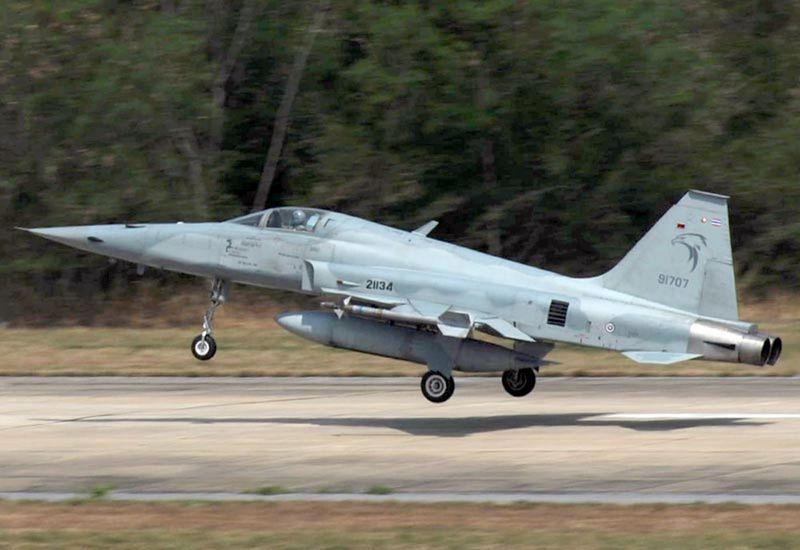


History of Northrop F-5 Freedom Fighter / Tiger / Tiger II
The Northrop F-5 Freedom Fighter/Tiger/Tiger II family was designed from the start as a cost-effective, lightweight, versatile Mach 1 combat platform. While the fighter was developed in the United States by Northrop, it has also achieved quantitative success abroad, with more than half of the 2,246 aircraft completed globally in service with foreign militaries.
All told, at least 30 U.S. allies use this type, many of which are still in service today. While the F-5 didn't have the true "all-weather" capability of the more mature fighter jets of the time, it made up for its inherent limitations with its excellent maneuverability, ease of maintenance, and inexpensive features - all of which were compact fighters The advantages.
Budget military buyer.
F-5 Origins
The F-5 grew out of the US Navy's need for a small light jet fighter in the 1950s that could operate from the decks of its escort carriers. The escort carrier was born in the naval battles of World War II. Escort carriers, however, were not designed for the newer, larger types of fighters that later entered service with the U.S.
Navy. Therefore, Northrop proposed its own light twin-engine jet fighter "N-156". The project is to use GE's J85 turbojet engine -- the same engine used in the Boeing B-52 Stratofortress-launched McDonnell ADM-20 Quail subsonic decoy cruise missile -- and it turns out that the unit is here Ideal for use in class applications. The engine's small airframe design provides a strong thrust-to-weight ratio for its size.
However, the U.S. Navy lost interest soon after its escort carrier class was retired, leaving the future of the N-156 in doubt.
Regardless, Northrop engineers continued to improve and bring the N-156 into two different aircraft forms - the single-seat "N-156F" fighter and the two-seat "N-156T" fighter-trainer.
The USAF became aware of the two-seat design of the N-156T. While it wasn't directly looking for a new front-line fighter at the time, it was looking for a drop-in replacement for its aging family of Lockheed T-33 Meteor jet trainers, whose origins date back to the 1940s. The U.S.
Air Force officially selected the N-156T as the basis for its next-generation jet trainer, a design that eventually evolved into the YT-38 Talon and eventually the famous Northrop T-38 Talon production model. A total of 1,187 prototypes of the aircraft were built and entered service with the U.S.
Air Force in 1961.
While the government-funded two-seat N-156T now finds a sizable presence in the USAF's inventory, the single-seat N-156F was not a completely forgotten endeavor for Northrop. Conversely, Northrop has been slower to grow as a privately invested company.
Fate finally knocked on the door of the N-156F at the height of the Cold War. To keep up with Soviet military influence around the world, the U.S. created the Military Assistance Program (MAP) to help these price-conscious U.S. allies provide combat military hardware. The N-156F's promising low-cost, easy-to-use features appeared to meet well-known requirements, and Northrop was awarded a government contract to produce three working prototypes for official evaluation by the U.S. Air Force. The first of these made its maiden flight from Edwards Air Force Base on July 30, 1959.
Remarkably, in the first run, the prototype broke the sound barrier with no problem - proving that the design is inherently robust and efficient. The N-156F prototype also displayed strong qualities associated with air-to-air and ground-attack roles, making it a truly versatile platform.
New Northrop Fighter Named
Despite promising early results, the USAF lazily pushed the N-156F program to 1960. The project did not interest the U.S. Army until 1961, which had been looking for a close support and reconnaissance platform, but the move was derailed in favor of keeping the U.S.
Air Force as the only "true" fixed-wing air combat weapon in the U.S. military middle. The N-156F struggled again for a while, until an initiative by then-President John F. Kennedy sparked new demands for budget-exported aircraft under the "F-X" program to serve U.S. allies around the globe.
On April 23, 1962, the N-156F was officially declared the winner of the F-X, and on August 9, 1962, the N-156F prototype was stripped of its designation and was accordingly modified to "F-5" "United States Air Force - Designated System September 1962 (Old system ended with General Dynamics' F-111 Aardvark, so the new Northrop fighter was given the smaller designation "F-5"). So their first production model was called the "F-5A".
Nicknamed the "Freedom Fighter" due to its export-oriented presence, the F-5A was scheduled to begin production in October 1962, and the first flight of the production-grade F-5A was recorded in May 1963. The -5A model operated until 1972.
F-5A "Freedom Fighter" and two F-5B
The F-5A is a basic aircraft design optimized for air-to-ground operations with limited air-to-air maintainability. This is mainly due to the lack of an airborne fire control radar system capable of identifying, tracking and striking air targets with its own guidance/homing missiles. The F-5A is powered by a pair of General Electric J85-GE-13 turbojets with 2,720 pounds of standard thrust and 4,080 pounds of afterburner thrust (pumping raw fuel into the engines to generate short bursts of power to increase speed and performance). Top speed is Mach 1.4/925 mph (36,000 ft) and service is capped at up to 50,500 ft. The maximum range on internal fuel is approximately 1,387 miles.
Standard armament consists of 2 x M39 20mm cannons flanking the nose assembly. Two AIM-9 Sidewinders are mounted exclusively on the wingtips. There are four under-wing and one under-fuselage hardpoints for carrying bombs, rocket pods and missiles - guns up to 6,200 lbs.
External fuel depots can replace some weapon stations.
Down from the previous F-5A, the development of the F-5B was nothing more than a two-seat "combat trainer" designed to train future F-5 pilots while retaining some inherent combat value. With the addition of a second trainer cockpit, one of the M39 guns and some interior space was lost, while a new, improved, longer nose assembly was introduced.
F-5 Production
Northrop produced 636 F-5A variants and 200 F-5B prototypes. Both are purchased in bulk from U.S. allies through MAP. The single-seat F-5A production model further branched into a dedicated reconnaissance mount in the RF-5A "Tiger Eye" capable of holding up to four KS-92A series still cameras in a slightly redesigned nose assembly, of which 86 were built Example. Also, Canadaair in Canada produced locally licensed CF-5A and CF-5B models from 1965 to 1970.
These differ from their American sisters with the addition of an on-board refueling probe and a more powerful CAN0-15 series Orenda J85 engine to meet Canadian requirements. Air Canada also supplied these mounts to the Dutch Air Force, which were further designated NF-5A and NF-5B, respectively.
Air Canada has produced at least 240 F-5 prototypes. Spain also began licensed production of the fighter jet, with CASA taking care of the local program, with 70 airframes eventually delivered.
F-5 in Vietnam - "Skoshi Tigers"
With the United States involved in the Vietnam War, the USAF selected a squadron of F-5As for combat evaluation in October 1965. The rating ran from October 1966 to March 1967 under the name "Skoshi". Tiger (little tigers) were assigned to these F-5 programs.
At least 12 initial airframes were requisitioned and deployed to the 4503rd TFS, with a few others joining the effort soon. Modifications included better gauges in the cockpit, increased armor protection, and support for aerial refueling using "probes and cones." These changes required a new designation, resulting in the F-5C branding.
These F-5Cs were The flag of the 3rd Tactical Fighter Wing from Bien Hoa and Da Nang air bases, which flew some 2,600 missions in Vietnam and Laos, with only one airframe lost in action.
The USAF still has no interest in procuring Northrop products despite its outstanding performance during conflicts (in both air-to-air and air-to-ground engagements). However, the combat assessment, which serves political motives, "remains on the sidelines" as it demonstrates to interested countries the viability of the F-5 as a multi-role platform. After completing the USAF program in Vietnam, the modified F-5C was delivered to the South Vietnamese Air Force.
With the fall of Bien Hoa in southern Vietnam, some of these F-5Cs were sent back to the Communist North for service, and samples were shipped to the Soviet Union for further study.
It is worth noting during the F-5 tenure that the "Skoshi Tigers" in Vietnam gave rise to the F-5's nickname "Tiger", just like the "F-5 Tiger".
International Combat Aircraft Program (IFA)
By 1970, the United States was looking for an export-oriented replacement for the F-5A to keep up with the continued development of Soviet fighter jets, and had established requirements for the new International Fighter Aircraft (IFA) program. The goal behind the The plan was to use a powerful air-to-air fighter against the ubiquitous Mikoyan-Gurevich MiG-21 "Fishbed" family, which was deployed in large numbers to the Warsaw Pact countries and interested Soviet Union states. Once again, Northrop put the He threw his hat into the ring and developed a variant of the single-seat F-5A that became the new "F-5A-21" model.
5E" production variant.
Northrop F-5E Tiger II
The F-5E model retains many of the features that made the previous F-5A a global market success. Special attention was paid to enhancing performance by installing a pair of General Electric J85-21/21A series engines, each rated at 5,000 thrust. The service ceiling is slightly increased to 51,800 feet and the range is increased to 1,543 miles.
The fuselage was therefore enlarged and lengthened to accommodate new engines and additional internal fuel storage to increase range. The avionics were upgraded with Emerson Electric's AN/APQ-153 series of radars, and a variety of other customer-requested systems could be further installed as neededin a sense, the F-5E is a modular platform.
Maneuverability is improved by increasing the extension along the leading edge of the wing, thereby increasing the surface area of ??the wing. The two M39 guns were retained, but were upgraded to the M39A2 series, and the ammunition load was increased to 7,000 lbs.
The first flight of the F-5E model, officially designated the F-5E Tiger II, took place on August 11, 1972.
Like the previous F-5A development, the F-5E was expanded into a two-seat version called the "F-5F". With the addition of a second cockpit (instructor), one of the M39A2's internal guns was removed and the nose lengthened. The Emerson Electric AN/APQ-157 radar (based on the AN/APQ-153 series above) is standard equipment.
Later versions were offered with Emerson Electric's updated AN/APG-69 series of radar systems, but this modernization proved too expensive for all customers except the US Air Force. Like the earlier F-5A, the F-5E was developed into the RF-5E Tiger Eye, a single-seat photographic reconnaissance aircraft.
The U.S. Air Force received the first F-5E variants at the 425th Tactical Fighter Squadron, although it was mainly foreign interest in acquiring the Tiger II, which is used by about 20 Air Forces worldwide. The 425th TFS uses their new F-5E to train foreign troops.
A total of 792 F-5E models were built at Northrop. Northrop also increased production of 140 F-5F two-seat fighter trainers and 12 RF-5E Tigereyes. Taiwan mass-produced the F-5E/F-5F, with a total of about 308 delivered. Switzerland also took over local licensed production of these new versions, producing 91 F-5E and F-5F variants.
South Korea adds 68 local examples.
 Argentina
 Armenia
 Australia
 Austria
 Austria-Hungary
 Belgium
 Brazil
 United Kingdom
 Brunei
 Bulgaria
 Canada
 Chile
Chile China
China Colonial America
 Colombia
 Confederate States
 Croatia
 Czech
Czech Denmark
 Egypt
Egypt Finland
 France
 Georgia
 Germany
 German Imperial
 Greece
 Holland
 Hungary
 India
India Indonesia
 Iran
Iran Iraq
Iraq Ireland
 Israel
 Italy
Italy Japan
Japan Japan (1940)
 Jordan
 Kingdom of Italy
 Malaysia
 Mexico
 Myanmar
 Nazi Germany
 Netherlands
 New Zealand
 North Korea
 Norway
 Pakistan
 Peru
Peru Philippines
 Poland
 Portugal
 Prussia
 Romania
 Russia
 Saudi Arabia
 Serbia
 Singapore
 Slovakia
 Slovenia
 South Africa
 South Korea
 Soviet Union
 Spain
Spain Sweden
 Switzerland
 Syria
Syria Taiwan
 Thailand
 Turkey
 UAE
UAE Ukraine
 Vietnam
 Yugoslavia