



History
Northrop Grumman's E-2D Hawkeye twin-engine turboprop is a special mission platform primarily operated by the United States Navy (USN) on its powerful aircraft carriers. This type is a state-of-the-art Improved Airborne Early Warning and Control (AEW&C) platform and represents the fourth major iteration of the Hawkeye series, which began in the 1960s with the 1962 E-2A (59 to be built). These followed It was replaced by the E-2B, which was largely based on the A model, but these conversions differed in that they were done with an upgraded computer processing system and a modified (enlarged) external tail.
The E-2C production run became the E-2B platform with upgraded electronics and improved search/surveillance capabilities. The brand built a total of 63, some of which received upgraded turboprops.
Despite its Cold War origins, the Hawkeye platform remains the focal point of the U.S. Navy's air defense capabilities associated with its carrier groups.
The E-2D model completed its maiden flight in March 2007 - the beginning of a long development phase. Key changes to its design include new avionics for the new battlefield, a new digital "glass" crew cockpit, a more powerful upgraded turboprop, and built-in air-to-air refueling capability.
The radar features a 360-degree all-weather scanning capability (electronic and mechanical), as well as an improved Identification Friend or Foe (IFF) system. Electronic support measures have also been expanded, and data/communication links have been modernized to go hand in hand with network compatibility ensured by the open architecture.
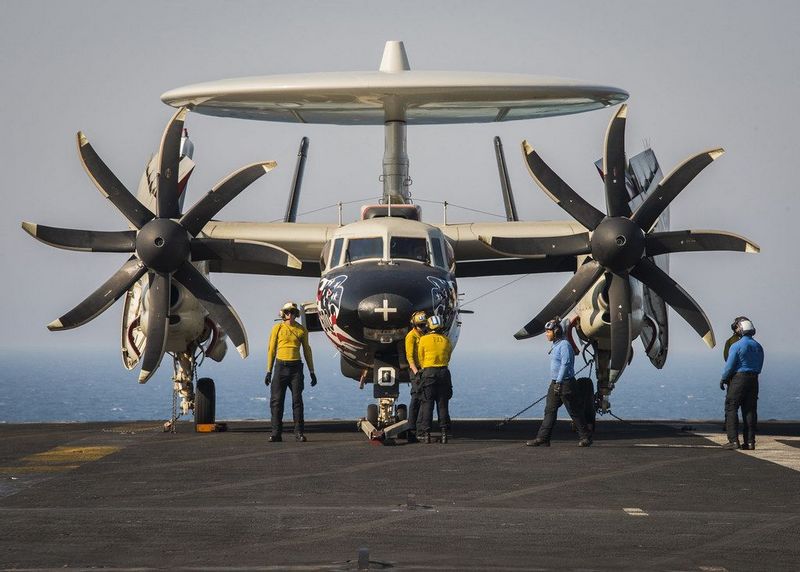
Physically, the appearance of the aircraft has not changed much: its layout is still dominated by a large radome located above the rear ridge of the fuselage. The pilots sat side by side in the cockpit behind the short nose cone. The main wings are shoulder-mounted and linear in design, each with a bottom-mounted turboprop driving an eight-bladed propeller unit. The tail contained a quadcopter arrangement with the horizontal section cranked upwards. Tricycle undercarriage (retractable) is used for deck operation and there are common USN aircraft fixtures such as searing hooks and wing flaps.
Like other U.S. Navy carrier-based combat platforms, the E-2D is launched using a catapult and retrieved using a tether.
In service with the U.S. Navy, Hawkeye continues to provide real-time battle management command (BMC)/battlespace awareness capabilities in the maritime environment and lead assessments ahead of forces and provide a defensive buffer against potential planned attacks against aircraft carriers.
Experts on the aircraft manage the various consoles and rely on a powerful suite of systems installed on the aircraft.
The E-2D series was introduced to the U.S. Navy by VAW-125 Squadron on March 27, 2014. This was followed by initial operational capability (IOC) in October and first deployment from the USS Theodore Roosevelt in 2015.
In total, about 75 Model Ds are planned to be procured, with four to five examples aboard each major U.S. Navy aircraft carrier.
Specification
Basic
Production
Roles
- Airborne Early Warning (AEW)
- Naval/Navigation
Dimensions
17.6m
24.56m
5.58m
Weight
18,100 kg
26,100 kg
Performance
Performance
404 mph (650 km/h; 351 knots)
34,777 ft (10,600 m; 6.59 mi)
1,684 miles (2,710 km; 1,463 nautical miles)
Armor
No. Mission equipment, with an emphasis on radar, IFF systems, transponders, radio and satellite communications.
Changes
E-2D "Hawkeye" - designation for base variant; state-of-the-art avionics suite with new engines and digital glass cockpit instrumentation; inherent air-to-air refueling capability.
 Argentina
 Armenia
 Australia
 Austria
 Austria-Hungary
 Belgium
 Brazil
 United Kingdom
 Brunei
 Bulgaria
 Canada
 Chile
Chile China
China Colonial America
 Colombia
 Confederate States
 Croatia
 Czech
Czech Denmark
 Egypt
Egypt Finland
 France
 Georgia
 Germany
 German Imperial
 Greece
 Holland
 Hungary
 India
India Indonesia
 Iran
Iran Iraq
Iraq Ireland
 Israel
 Italy
Italy Japan
Japan Japan (1940)
 Jordan
 Kingdom of Italy
 Malaysia
 Mexico
 Myanmar
 Nazi Germany
 Netherlands
 New Zealand
 North Korea
 Norway
 Pakistan
 Peru
Peru Philippines
 Poland
 Portugal
 Prussia
 Romania
 Russia
 Saudi Arabia
 Serbia
 Singapore
 Slovakia
 Slovenia
 South Africa
 South Korea
 Soviet Union
 Spain
Spain Sweden
 Switzerland
 Syria
Syria Taiwan
 Thailand
 Turkey
 UAE
UAE Ukraine
 Vietnam
 Yugoslavia