
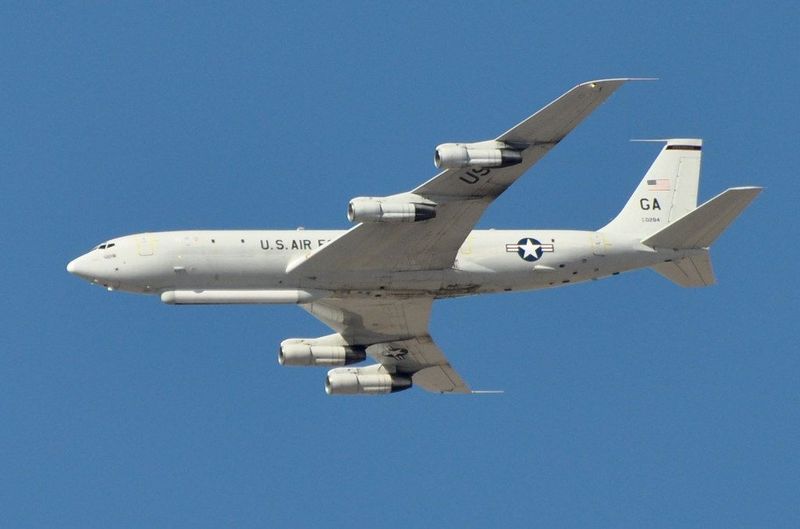

History of Northrop Grumman E-8 Joint STARS (JSTARS)
A Northrop Grumman product, the E-8 "Joint Star" family of aircraft, provides the USAF with electronic "eyes" on the battlefield in the form of aerial surveillance. The aircraft is based on a heavily modified version of the Boeing 707 civilian transport aircraft, retaining the basic fuselage shape and four-engine wings with low-mounted monoplanes. The system was deployed in a limited capacity in 1991, became fully operational in 1996, and continues to play an important role in the U.S.
Armed Forces through the 116th ACW, which retains 17 such aircraft.
The E-8 Joint Stars system was developed to meet the requirements of the U.S. Army and U.S. Air Force for an aircraft platform capable of tracking enemy ground targets along the front line. The contract was awarded to Grumman and two Boeing 707-300s were selected for extensive modification.
The platform will be powered by four Pratt & Whitney TF33-102C turbofan engines and will carry a variety of specialized detection, communications and radar equipment to assist ground commanders in providing them with near real-time intelligence, but with limited threat detection capabilities from the air.
The most notable design feature of the E-8 is the long fuselage bracket located below the front of the aircraft. The package contains a Northrop Grumman (North) APY-3 positioned lateral phased array antenna that provides aircrew and commanders with varying fields of view and target detection over 250 kilometers. The system can track up to 1,000,000 km in an 8-hour mission (the aircraft has a 9-hour mission endurance). A pulsed Doppler mode is also available, helping the crew track moving targets.
The information gathered by the E-8 units was then forwarded to the ground control link, from where the information was evaluated by the appropriate officers. Crew accommodation includes 4 flight crew members and an additional 14 Air Force specialists and 3 US Army specialists.
Of course, this may vary by task type.
The E-8 was basically developed during the 1991 Gulf War, during which the two aircraft flew a total of 49 sorties. It was later used in support of NATO during the Bosnia/Kosovo war and more recently in Operations Enduring Freedom (Afghanistan) and Iraqi Freedom (Iraq).
Specification
Basic
Production
Roles
- Reconnaissance (RECCE)
Dimensions
152.89 ft (46.6 m)
145.67 ft (44.4 m)
42.65 ft (13 m)
Weight
336,004 lb (152,409 kg)
Performance
Performance
587 mph (944 km/h; 510 knots)
42,001 ft (12,802 m; 7.95 mi)
Armor
No.
Changes
E-8A - Prototype converted from a Boeing 707-300 aircraft; two such models were made.
E-8B - Proposed new production aircraft model; USAF ordered 22 but later abandoned the used E-8C model.
E-8C - The latest production model, 17 of which were produced for the US Air Force.
 Argentina
 Armenia
 Australia
 Austria
 Austria-Hungary
 Belgium
 Brazil
 United Kingdom
 Brunei
 Bulgaria
 Canada
 Chile
Chile China
China Colonial America
 Colombia
 Confederate States
 Croatia
 Czech
Czech Denmark
 Egypt
Egypt Finland
 France
 Georgia
 Germany
 German Imperial
 Greece
 Holland
 Hungary
 India
India Indonesia
 Iran
Iran Iraq
Iraq Ireland
 Israel
 Italy
Italy Japan
Japan Japan (1940)
 Jordan
 Kingdom of Italy
 Malaysia
 Mexico
 Myanmar
 Nazi Germany
 Netherlands
 New Zealand
 North Korea
 Norway
 Pakistan
 Peru
Peru Philippines
 Poland
 Portugal
 Prussia
 Romania
 Russia
 Saudi Arabia
 Serbia
 Singapore
 Slovakia
 Slovenia
 South Africa
 South Korea
 Soviet Union
 Spain
Spain Sweden
 Switzerland
 Syria
Syria Taiwan
 Thailand
 Turkey
 UAE
UAE Ukraine
 Vietnam
 Yugoslavia