


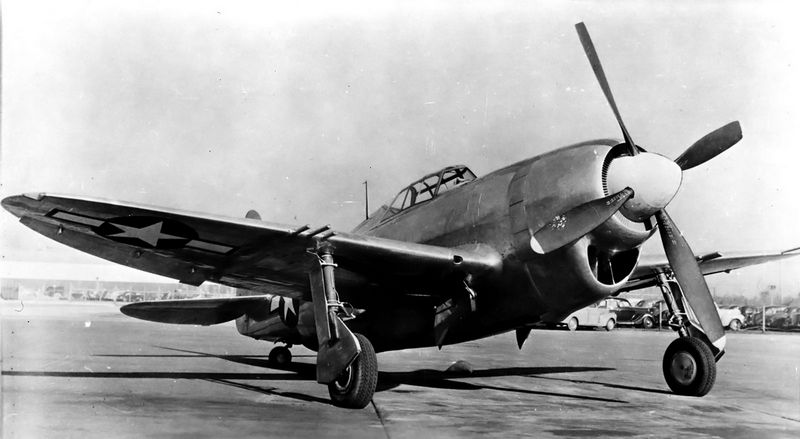
History of the Republic XP-47J (Superbolt)
The classic WWII Republic P-47 Thunderbolt fighter underwent multiple modifications during its flight. Derived from the company's work on the P-43 "Lancer", the P-47 had the same "razor" back and large nose-mounted air-cooled radial engines. Over time, the "Jug" evolved to accommodate a bubble canopy and higher performance. Some become true thoroughbreds and are good at interception missions, while others are good at ground attack.
As a fighter or fighter-bomber, few war designs can match the return on investment of the American P-47, and Alexander Kartveli's design owes it to it.
Throughout the process, the U.S. Army was looking for more and contacted the Republic in November 1942 to develop a lighter, more powerful version of the P-47 (which entered service around the same month ). The new aircraft will feature upgraded engines in the nose with additional cooling and water injection for optimal performance at high altitudes. Reduce weight as much as possible, including weapons and fuel.
An Army contract issued on June 18, 1943 included two XP-47J prototypes.
The engineers returned with their improved P-47, dubbed the "XP-47J". The hood of the design was improved with a smaller frontal area, and this narrow hood houses the Pratt & Whitney R-2800-57(C) engine. The engine produces 2,800 horsepower and drives a standard four-bladed propeller unit. Both the engine and propeller units are off-the-shelf products that are already in service and will support mass production of the aircraft.
To save weight, the wing main aircraft was reworked into a lighter design, and one of the four machine guns in each wing was removed (like some internal fuel reservoirs, which in turn reduced range ). In addition, some cockpit equipment was removed and the rear area behind the cockpit was shortened. There's no real bubble canopy in the game yet - instead, a revised version of the basic P-47 frame canopy has been added, which helps improve the pilot's view outside the cockpit.
The first XP-47J had the R-2800 engine mounted further forward in the fuselage, which was forcibly cooled by an intake fan built into the propeller spinner. The exhaust injection system is designed to extract extra thrust from the airflow, and the turbocharger is drawn from a new air intake mounted under the plane's chin.
The second prototype should have a real bubble roof and maybe a counter-rotating propeller unit to squeeze more speed out of the design. However, budget problems limited its development and production was discontinued in March 1944.
The first flight of the XP-47J prototype took place on 26 November 1943. It didn't take off again until March 1944, by which time it proved to be one of the fastest propeller planes of the time (and of the war), flying horizontally at 500 mph. During a test on August 4, 1944, the aircraftnow equipped with a GE CH-5 turbochargerachieved a top speed of 505 miles per hour at an altitude of over 34,500 feet, which was propeller-driven the fastest speed reached by the aircraft.
This capability earned the XP-47J the nickname "Super Bolt".
It is worth noting that the XP-47J in the hands of the USAAF is said to have never exceeded 493 mph during testing.
The XP-47J was a viable fighter development until another Republican product, the XP-72 "Ultrabolt" (detailed elsewhere on this page) proved more promising and more company personnel were properly distributed to Superbolt Corporation. In addition, Army authorities were baffled by the fact that the Republican production line would need to undergo a major overhaul to accommodate the proposed mass production of the XP-47J -- only about 30 percent of the parts commonality and recommendations among P-47s in service at the base The XP-47J.
As a result, this fast fighter prototype, derived from the P-47 series, died before the war ended in 1945.
Specification
Basic
Production
Roles
- Fighter
- Intercept
- X-Plane / Development
Dimensions
10.15m
40.78 ft (12.43 m)
14.21 ft (4.33 m)
Weight
4,383 kg
7,615 kg
Performance
Performance
505 mph (813 km/h; 439 knots)
44,997 ft (13,715 m; 8.52 mi)
1,072 miles (1,725 ??km; 931 nautical miles)
4,900 ft/min (1,494 m/min)
Armor
Suggestions:
6 x .50 caliber Browning heavy machine guns (three per wing).
Changes
XP-47J "Superbolt" - Base project name; two prototypes have been commissioned although only one airworthy example has been completed.
 Argentina
 Armenia
 Australia
 Austria
 Austria-Hungary
 Belgium
 Brazil
 United Kingdom
 Brunei
 Bulgaria
 Canada
 Chile
Chile China
China Colonial America
 Colombia
 Confederate States
 Croatia
 Czech
Czech Denmark
 Egypt
Egypt Finland
 France
 Georgia
 Germany
 German Imperial
 Greece
 Holland
 Hungary
 India
India Indonesia
 Iran
Iran Iraq
Iraq Ireland
 Israel
 Italy
Italy Japan
Japan Japan (1940)
 Jordan
 Kingdom of Italy
 Malaysia
 Mexico
 Myanmar
 Nazi Germany
 Netherlands
 New Zealand
 North Korea
 Norway
 Pakistan
 Peru
Peru Philippines
 Poland
 Portugal
 Prussia
 Romania
 Russia
 Saudi Arabia
 Serbia
 Singapore
 Slovakia
 Slovenia
 South Africa
 South Korea
 Soviet Union
 Spain
Spain Sweden
 Switzerland
 Syria
Syria Taiwan
 Thailand
 Turkey
 UAE
UAE Ukraine
 Vietnam
 Yugoslavia