
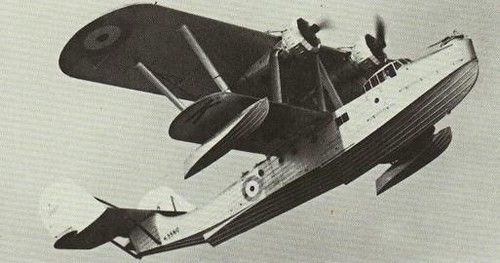
Saunders-Roe A. 27 History of London
SARO London draws heavily on British airship designs from the 1920s, and in many ways its retirement marks the end of that era the golden age of aviation, if you will. Forced into service during World War II, London served only for a limited time in an equally limited number, while being tasked with monitoring the waters around England and the Mediterranean.
Like many other advanced aircraft that emerged in the mid-1930s and were drafted into combat, the Saro London goes down in aviation history as one of many unsung heroes who played a role in the early days of the war.
London's origins lie in a pre-war British Air Force specification called R24/31, which called for the use of multi-role flying boats. The Saunders-Roe ("SARO") company offered a design based on their earlier failed attempt on the Saunders A.7 "Severn", a three-engine airship designed for maritime patrol missions, of which only the one. The new design was named the A. 27 London, and the first prototype was completed and test-flyed sometime in 1934. The aircraft was equipped with a pair of Bristol Pegasus II radial piston engines mounted on a non-uniform span biplane wing assembly (sesquiplane).
This single prototype was active until 1936, after which production form officially emerged from the assembly line in March. The first production models were designated the London Mk. 1. The main difference is that the 820-horsepower Bristol Pegasus III series radial piston engine is used.
Ten of these examples were built before the 915 hp Bristol Pegasus X engine forced the new London "Mk. II" designation. All Mk. I models have been upgraded to the new Mk. The second is to standardize and change its name to a new brand. About 20 Mk. II aircraft were eventually built. A total of 30 London Saros were built and delivered (excluding individual prototypes).
The Saro London was piloted by six people. It has a wingspan of 80 feet and a barrel length of over 56 feet. She is almost 19 feet tall. The total winning area is 1,425 square feet. London weighs 11,100 pounds empty and about 18,400 pounds fully loaded.
Her maximum takeoff weight (MTOW) is listed as approximately 22,000 pounds. Top speed is 155 mph, while cruising speed is 128 mph. The range is approximately 1,100 miles, and its service is limited to less than 20,000 feet. She maintained a climb rate of 1,180 feet per minute.
The exterior design of the SARO London was typical of a mid-sized airship at the time. The most distinctive feature of this class of aircraft is the boat-shaped fuselage, which extends from the nose of the fuselage to the bottom of the tail (tail).
It is this design element that allows the London to conduct landings and takeoffs through water, but at the same time restricts such activities to water - meaning that the London does not retain landing gear for land-based operations. While her lower half retains the appearance of an ocean-going ship, her upper half consists entirely of aircraft. She has a slightly curved nose section with panels and pronounced ribbed siding.
The cockpit is located at the rear of the nose assembly, raised from the fuselage to provide good all-round visibility through a framed glass enclosure. Access is through a rectangular hatch along the starboard fuselage side, just below and aft of the flight deck. The plate-side fuselage tapers into a large T-tail consisting of two large vertical tails placed on the horizontal plane. The wing arrangement of a biplane consists of a lower span fixed to the shoulder fuselage and an upper span fixed by high angle struts.
Each lower wing assembly contains a float to control the roll of the aircraft on the water. The wings pass through two elevated nacelles that house the engines. The engines are raised some distance from the fuselage and mounted above and aft of the flight deck to protect the engines from spray corrosion during take-off and landing activities.
The fuselage structure is all-metal, while the wings are fabric-covered.
As reconnaissance platforms, airships like SARO London are prime targets for patrolling enemy fighter jets. While this class of aircraft maintains a healthy operational range, it targets a large, slow-moving target. As such, she was armed with up to three 7.7mm Lewis-brand machine guns for defensive purposes. One is located in front of the bow and the other is located in the stern, both positions are outdoors, the guns are mounted on ring mounts. The third machine gun is located amidships.
When engaged with surface ships, her attack power is limited to 2,000-pound gunswhether depth charges, conventionally thrown bombs, or minesmounted near the lower span wing roots. An optional rear fuel tank can be fitted to improve range (many existing photos from SARO London show this elongated fuel tank structure just aft of the cockpit).
Ultimately, the operators included the 201st, 202nd, 204th, 209th, 210th, 228th and 240th Squadrons of the Royal Canadian Air Force and the Royal Air Force. Apart from these users, London has never served in any other country during her tenure, let alone exported to a client.
At the start of World War II, Londoners were forced to operate with RAF Coast Command, eventually seeing action over the North Sea and the Mediterranean. They excel at conducting active reconnaissance patrols and are prepared to attack surface ships if necessary. Despite their ancient appearance, many biplanes functioned in the early days of World War II, serving heroically when needed. They maintain the wartime status quo until a newer and better system is ready and available.
The London tour began and ended sometime in 1940, and the last active group operated in Gibraltar until June 1942.
Saunders-Roe A. 27 London Code
Basic
Production
Roles
- Naval/Navigation
- Reconnaissance (RECCE)
Dimensions
56.79 ft (17.31 m)
24.38m
18.73 ft (5.71 m)
Weight
5,035 kg
22,000 lbs (9,979 kg)
Performance
Performance
142 mph (228 km/h; 123 knots)
19,898 ft (6,065 m; 3.77 mi)
1,740 miles (2,800 km; 1,512 nautical miles)
360 m/min
Armor
Default:
1 x 7.7mm Lewis machine gun in bow position
1 x 7.7mm Lewis machine gun amidships
1 x 7.7mm Lewis machine gun in rear position
Up to 2,000 lb (907 kg) of externally transported supplies, including bombs, depth charges, or mines.
Changes
London A. 27 - Example of a single prototype
London Mark. I - Bristol Pegasus III series engines with 820 hp each; two-bladed propeller system; 10 copies made; later upgraded to Mk II standard.
London Mark. II - Equipped with Bristol Pegasus X-Series engines, each producing 915 hp; four-blade propeller system; 20 copies made.
 Argentina
 Armenia
 Australia
 Austria
 Austria-Hungary
 Belgium
 Brazil
 United States
 Brunei
 Bulgaria
 Canada
 Chile
Chile China
China Colonial America
 Colombia
 Confederate States
 Croatia
 Czech
Czech Denmark
 Egypt
Egypt Finland
 France
 Georgia
 Germany
 German Imperial
 Greece
 Holland
 Hungary
 India
India Indonesia
 Iran
Iran Iraq
Iraq Ireland
 Israel
 Italy
Italy Japan
Japan Japan (1940)
 Jordan
 Kingdom of Italy
 Malaysia
 Mexico
 Myanmar
 Nazi Germany
 Netherlands
 New Zealand
 North Korea
 Norway
 Pakistan
 Peru
Peru Philippines
 Poland
 Portugal
 Prussia
 Romania
 Russia
 Saudi Arabia
 Serbia
 Singapore
 Slovakia
 Slovenia
 South Africa
 South Korea
 Soviet Union
 Spain
Spain Sweden
 Switzerland
 Syria
Syria Taiwan
 Thailand
 Turkey
 UAE
UAE Ukraine
 Vietnam
 Yugoslavia