

The story of the sea machete
For its history, the Super Scimitar served with the British Fleet Aviation (FAA) as a carrier-based jet single-seat fighter. The aircraft had a number of "firsts" while in service with the Royal Navy - becoming its first swept-wing single-seat fighter and the first FAA aircraft approved for nuclear use.
The Scimitar can be called upon for multi-role missions involving long-range reconnaissance, high-altitude interception and low-altitude bombardment, making her an ideal and lethal addition to the Royal Navy and aircraft operating in these varied capabilities for a decade.
The Scimitar's legacy stems from a long development period for single-seat naval fighters starting with the Vickers-Supermarine Type 508. V-shaped tail.
Another prototype with straight wings soon appeared, designated Type 529, while another research prototype, this one with swept wings, was designated Type 525.
Attention quickly turned to the Type 525 prototype, a design that showed promise. The first flight of the prototype took place on April 27, 1954.
Although later lost in an accident (and somewhat a harbinger of the future), the Type 525 was designed to withstand even in a modified form of the Type 544. Three slightly different Type 544 prototypes were then produced. Under the N113 specification, the revised Royal Navy changed the Type 544's requirements from a dedicated combat platform to a low-altitude attack aircraft.
The Type 544 then completed its maiden flight on January 19, 1956, and soon 100 were ordered under the final designation "Scimitar F.1". The Scimitar F.1 made its first flight on January 11, 1957. Initial production orders were quickly reduced to just 76.
The design of this rather large aircraft is rather conventional. As part of the shortened nose arrangement, the cockpit is well maintained in the circular fuselage.
The air intakes are located on the sides of the fuselage, occupying about 80% of the length of the aircraft, and are eventually covered by exhaust nozzles in front of the tail. The rear wing is also conventional, matching a single vertical rear wing to a raised horizontal plane. All rear surfaces are swept.
The main wing is mounted low on the side of the fuselage and has a high degree of swept, especially on the leading edge. The landing gear is a tricycle arrangement with two single-wheel main landing gear struts and a single-wheel nose landing gear strut.
The main gear is retracted towards the centerline, while the nose gear is retracted aft, just below the cockpit floor and aft. A grappling hook is attached to the bottom of the rear wing.
The Scimitar F.1 is powered by two Rolls-Royce Avon 202 Series turbojets, each delivering up to 11,250 lbf of thrust. Performance specs include a sea level top speed of 736 mph and a range of 1,422 miles. The aircraft has a service ceiling of 46,000 feet.
Total weight at launch is approximately 34,200 pounds.
Standard armament revolves around an impressive quad 30mm Ayton cannon turret. This can be supplemented by external ordnance spread across four mount points.
The hardpoints can be equipped with American-made air-to-air missiles in the form of the AIM-9 Sidewinder or air-to-surface missiles in the form of the AGM-12 Bullpup. In addition, the Scimitar can deploy up to 4 x 1,000 conventionally dropped bombs or 4 x rocket pods with 2- or 3-inch unguided rockets as needed.
The fact that the Scimitar's legacy is limited is reflected in the only production form that exists as the Scimitar F.1. Of the 76 production planes delivered, about 39 were killed in accidents at least a staggering rate.
Scimitars are prone to accidents, as the Royal Navy's small aircraft carriers combine well with the power of advanced aircraft. While pilots and aircrews appreciate the sophistication of the Scimitar, it was ahead of its time and required a lot of focus and skill - both in the air and on the ground.
At one point, a single machete was said to require about 1,000 hours of maintenance to keep it functioning properly.
The Scimitar was used by the 736th, 800th, 803rd, 804th and 807th Naval Air Squadrons after serving in the Royal Navy's Fleet Air Forces, replacing the more vanilla coloured single seater Hawker Seahawks. Its first users were Boy 803 from Loussiemouth in June 1958.
The Scimitar was eventually replaced in the ground attack role by the Blackburn Pirates and was removed from front-line service as early as 1966, but did not retain its nuclear role until 1969. Ironically, the Scimitar Corsair once served as an air fuel tank.
Although the Scimitar also retained some air-intercept properties, she was also hired for the role by the unique de Havilland Sea Fox, which entered service in July 1959.
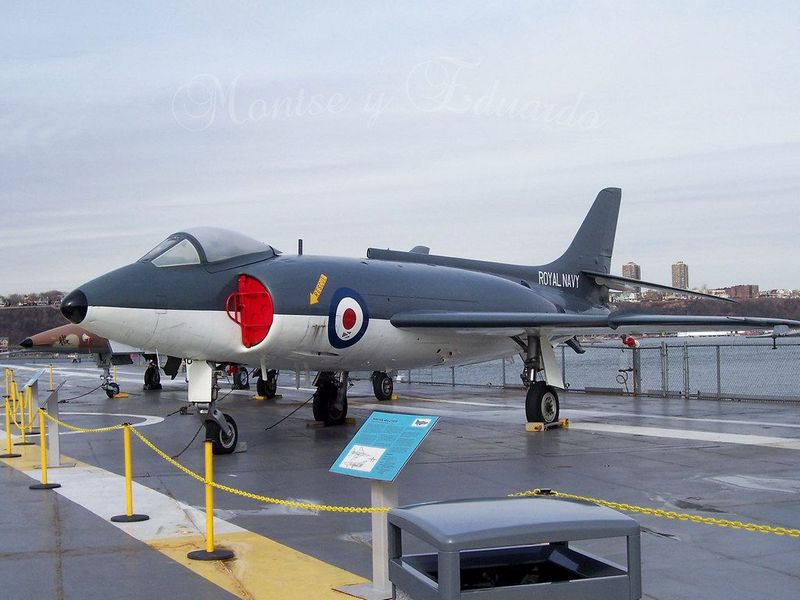
A Supermarine Scimitar F.1 (serial number XD220) on the deck of the Intrepid Sea-Air-Space Museum in New York City. This particular example is on loan from the FAA Museum.
All in all, Scimitar lives a sort of "invisible" existence, albeit briefly. The aircraft was also the last product of the legendary Supermarine company responsible for the brilliant, war-winning Supermarine Spitfire of World War II.
Specification
Basic
Production
Roles
- Fighter
- Intercept
- Close Air Support (CAS)
- Naval/Navigation
- Air refueling
- Reconnaissance (RECCE)
Dimensions
55.35 ft (16.87 m)
11.33m
17.32 ft (5.28 m)
Weight
10,869 kg
34,200 lbs (15,513 kg)
Performance
Performance
710 mph (1,143 km/h; 617 knots)
45,997 ft (14,020 m; 8.71 mi)
1,422 miles (2,288 km; 1,235 nautical miles)
12,000 ft/min (3,658 m/min)
Armor
Default:
4 x 30mm ADEN internal automatic cannons.
4 x missile pods and 8 x 3" air-to-air missiles (AP or HE).[??/p]
4 missile pods with 16 x 3" air-to-air missiles (AP or HE).
4 missile pods with 24 x 3" air-to-air missiles (AP or HE).
4 x 1,000 lb conventional bombs.
4 x AGM-12 "Bullpup" air-to-surface missiles.
4 x AIM-9 Sidewinder air-to-air missiles.
Changes
Type 508 - Prototype model; has straight wings.
Type 529 - Prototype model; has straight wings.
Type 525 - Prototype model; swept back with wings.
Type 544 - first prototype fighter model; 3 copies made; will be the production model for the F.1 fighter series.
Scimitar Mk. F. 1 - Base production fighter model; single seater; 76 copies produced.
Type 565 - proposed two-seat twin-engine tactical bomber/nuclear bomber in 1961; seats next to each other; possibility of in-flight refueling; additional internal fuel storage; 2?RA. 24 Mk. II Avon turbojet.
 Argentina
 Armenia
 Australia
 Austria
 Austria-Hungary
 Belgium
 Brazil
 United States
 Brunei
 Bulgaria
 Canada
 Chile
Chile China
China Colonial America
 Colombia
 Confederate States
 Croatia
 Czech
Czech Denmark
 Egypt
Egypt Finland
 France
 Georgia
 Germany
 German Imperial
 Greece
 Holland
 Hungary
 India
India Indonesia
 Iran
Iran Iraq
Iraq Ireland
 Israel
 Italy
Italy Japan
Japan Japan (1940)
 Jordan
 Kingdom of Italy
 Malaysia
 Mexico
 Myanmar
 Nazi Germany
 Netherlands
 New Zealand
 North Korea
 Norway
 Pakistan
 Peru
Peru Philippines
 Poland
 Portugal
 Prussia
 Romania
 Russia
 Saudi Arabia
 Serbia
 Singapore
 Slovakia
 Slovenia
 South Africa
 South Korea
 Soviet Union
 Spain
Spain Sweden
 Switzerland
 Syria
Syria Taiwan
 Thailand
 Turkey
 UAE
UAE Ukraine
 Vietnam
 Yugoslavia