



History
Many of the aircraft developed by Japan when it surrendered in 1945 were retired in their state (if they had not been destroyed by ruthless air strikes by the Japanese themselves or by the Allies). Tachikawa conducted two postwar programs under the name "Ki-94" to provide the Army with interceptor bombers.
When the American Boeing B-29 "Superfortress" heavy high-altitude bomber became the main focus of the Japanese mainland, a high-altitude fighter capable of intercepting these machines came into being.
The original Ki-94 product, later designated "Ki-94-I", was a unique twin-arm, single-engine/twin-prop fighter design with a central fuselage nacelle to accommodate Cockpit, weapons and engines. The wing main aircraft is mounted low with outriggers extending from its trailing edge. The single-seat cockpit is mounted in the center of the fuselage nacelle, and the engine is located in the nose. The aircraft will be powered by one engine - an air-cooled Nakajima Ha-211 18-cylinder radial-piston engine - which simultaneously drives a twin-propeller arrangement: a four-bladed propeller unit in the nose and a second unit at the tip of the fuselage The nacelle, which has an extended shaft to be driven (called a "push-pull" configuration).
Proposed weapons include 2 x 37mm guns and 2 x 30mm guns - a massive frontal "strike" against any Allied bomber in the war.
This design was too complicated for the Army and passed on by the authorities.
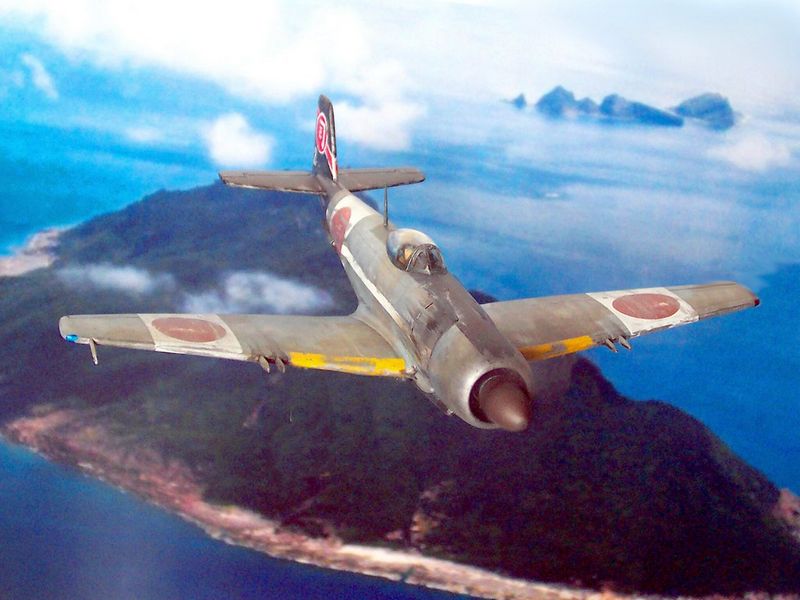
The successor Ki-94-II adopted a more traditional design arrangement. A low wing plane was used, with the wings forward amidships and the cockpit above. The rear wing uses a vertical plane and two lower horizontal planes. The engine is fixed in the nose, and there is a trailing undercarriage.
A pressurized cockpit should be used to meet altitude requirements. Power comes from a Nakajima Ha-219 (Ha-44-12) 18-cylinder engine producing 2,461 horsepower driving a six-blade propeller unit. The armament is centred on 2 x 30mm Ho-155 series guns and 2 x 20mm Ho-5 guns - all mounted on the wings.
If desired, it will be used to carry 2 x 550lb Drop Bombs for attacking characters.
This is the second product supported by the Army and further development will take place through three prototypes and a static test airframe. In addition, about 18 pre-production aircraft will provide useful operational experience. The first prototype appears to be powered by a 2,541-horsepower Nakajima Ha-219 engine, although only a four-bladed propeller is available to accompany it.
Due to the end of the war in August 1945, the prototype did not make its first flight. The second prototype was still under construction at the time and had not yet been completed. After the war, all jobs were cancelled.
Specification
Basic
Production
Roles
- Fighter
- X-Plane / Development
Dimensions
39.37 ft (12 m)
45.93 ft (14 m)
15.26 ft (4.65 m)
Weight
10,229 lbs (4,640 kg)
6,450 kg
Performance
Performance
442 mph (712 km/h; 384 knots)
48,163 ft (14,680 m; 9.12 mi)
1,305 miles (2,100 km; 1,134 nautical miles)
1,880 ft/min (573 m/min)
Armor
Standard (recommended Ki-94-I):
2 x 37mm guns
2 x 30mm guns
Default (Ki-94-II):
2 x 30mm Ho-155 wing guns
2 x 20mm Ho-5 wing cannons
Optional (Ki-94-II):
2 x 550 lb bombs
Changes
Ki-94 - name of the basic series
Ki-94-I - Dual-arm, push-pull configuration; Nakajima Ha-211 engine; equipped with 2 x 37mm guns and 2 x 30mm guns; sample table only.
Ki-94-II - conventional fighter design; Nakajima Ha-219 engine, 2,461 hp, driving a six-blade propeller; 2 x 30mm and 2 x 20mm wing guns and 2 x 550lb bomb magazines.
 Argentina
 Armenia
 Australia
 Austria
 Austria-Hungary
 Belgium
 Brazil
 United Kingdom
 United States
 Brunei
 Bulgaria
 Canada
 Chile
Chile China
China Colonial America
 Colombia
 Confederate States
 Croatia
 Czech
Czech Denmark
 Egypt
Egypt Finland
 France
 Georgia
 Germany
 German Imperial
 Greece
 Holland
 Hungary
 India
India Indonesia
 Iran
Iran Iraq
Iraq Ireland
 Israel
 Italy
Italy Japan
Japan Jordan
 Kingdom of Italy
 Malaysia
 Mexico
 Myanmar
 Nazi Germany
 Netherlands
 New Zealand
 North Korea
 Norway
 Pakistan
 Peru
Peru Philippines
 Poland
 Portugal
 Prussia
 Romania
 Russia
 Saudi Arabia
 Serbia
 Singapore
 Slovakia
 Slovenia
 South Africa
 South Korea
 Soviet Union
 Spain
Spain Sweden
 Switzerland
 Syria
Syria Taiwan
 Thailand
 Turkey
 UAE
UAE Ukraine
 Vietnam
 Yugoslavia