
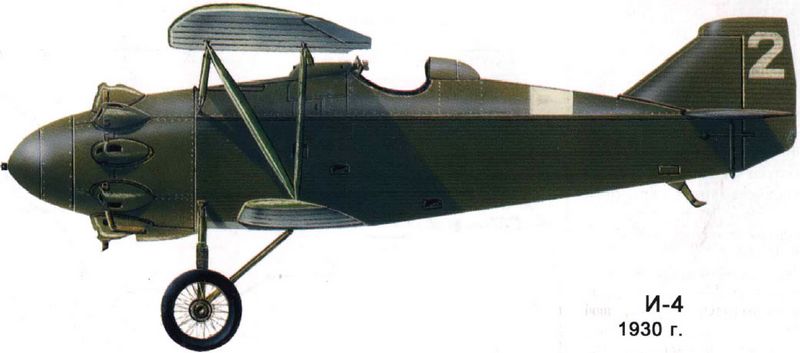


History of Tupolev I-4 (ANT-5)
Long before the Russian-focused Tupolev OKB developed the famous Soviet Cold War bomber, it dabbled in fighter design with the I-4 (ANT-5) biplane in 1928. This model became the Soviet Union's first all-metal fighter and grew to produce hundreds of them during the interwar period.
A handful of variants welcome the service career of this oft-forgotten fighter. The hunter's design is credited to Pavel Sukhoi.
In addition to the all-metal design, the I-4 has traditional physical characteristics consistent with the mid-term. The lone pilot sits in the open-air cockpit behind the upper wing. The upper and lower parts are connected to each other by V-shaped struts.
The span of the lower assembly was also shorter, allowing the biplane wing to be arranged as a "half-wing". The landing gear rolls on two main legs below the center mass, and a slide is added below the tail for ground operation.
The rear wing is conventional, with a single rear wing, and the level is set low.
Engineers selected a 420 hp air-cooled 9-cylinder radial piston engine for the French Gnome-Rhone Jupiter and installed it in the bow section. The engine drives a two-bladed propeller with a large-diameter spinner in the center for aerodynamic efficiency.
The proposed weapon became a 2 x 7.62mm machine gun, firing synchronously via rotating propeller blades. Later during testing, provisions were added to carry missiles along the upper wings, increasing the fighter's attack rating.
The first flight (prototype form "ANT-5") was recorded in August 1927. This resulted in some design revisions, including a new fairing and a revised tail unit. The ANT-5 was subsequently commissioned as "I-4".
In terms of performance, the I-4 has a top speed of 160 mph, a range of up to 525 miles, and a service ceiling of up to 25,100 feet. The climb rate is 1,820 feet per minute. Curb weight is 2,155 lbs and maximum takeoff weight (MTOW) is 3,155 lbs.
The improved model of the first series was equipped with a 460-480 hp Mikulin M-22 engine (licensed manufactured copy of the Gnome-Rhone "Jupiter" 9ASB). The "I-4Z" followed, a version that introduced a smaller lower wing.
After the complete removal of the lower wing and thus a true monoplane, the aircraft was modified to the developed form "I-4bis". "I-4P" became a modified seaplane derivative.
A total of 369 I-4s were completed by 1934, the last of which had been withdrawn from front-line service as early as 1933though the I-4s continued to serve as training vehicles for a time. The I-4 series was also briefly tried as a "parasite fighter" in experiments in the 1930s (which included firing 76mm Kurchevsky recoilless guns from aircraft), in the new Tupolev TB- 1/TB-3 was coupled to a serial mothership (described elsewhere on this page) in experiments conducted.
Specification
Basic
Production
Roles
- Fighter
Dimensions
7.25m
11.42m
2.82m
Weight
980 kg
1,430 kg
Performance
Performance
160 mph (257 km/h; 139 knots)
25,115 ft (7,655 m; 4.76 mi)
522 miles (840 km; 454 nmi)
555 m/min
Armor
Default:
2 x 7.62mm machine guns are mounted on the nose and fired synchronously via rotating propeller blades.
Rail mounted missile on upper wing assembly.
Changes
I-4 - Name of base series; original production model.
ANT 5 - Development Designation.
I-4Z - Reduced span lower wing element.
I-4bis - monoplane wing form (without lower span).
I-4P - Seaplane/Seaplane Derivative.
 Argentina
 Armenia
 Australia
 Austria
 Austria-Hungary
 Belgium
 Brazil
 United Kingdom
 United States
 Brunei
 Bulgaria
 Canada
 Chile
Chile China
China Colonial America
 Colombia
 Confederate States
 Croatia
 Czech
Czech Denmark
 Egypt
Egypt Finland
 France
 Georgia
 Germany
 German Imperial
 Greece
 Holland
 Hungary
 India
India Indonesia
 Iran
Iran Iraq
Iraq Ireland
 Israel
 Italy
Italy Japan
Japan Japan (1940)
 Jordan
 Kingdom of Italy
 Malaysia
 Mexico
 Myanmar
 Nazi Germany
 Netherlands
 New Zealand
 North Korea
 Norway
 Pakistan
 Peru
Peru Philippines
 Poland
 Portugal
 Prussia
 Romania
 Russia
 Saudi Arabia
 Serbia
 Singapore
 Slovakia
 Slovenia
 South Africa
 South Korea
 Spain
Spain Sweden
 Switzerland
 Syria
Syria Taiwan
 Thailand
 Turkey
 UAE
UAE Ukraine
 Vietnam
 Yugoslavia