

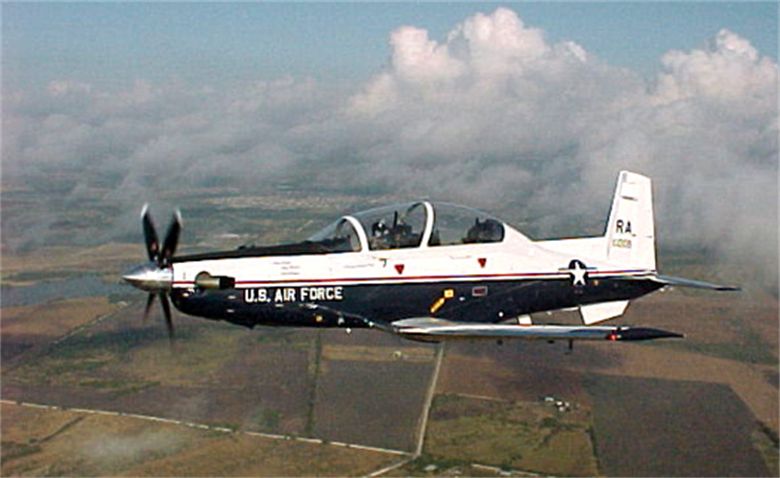


History of Beechcraft / Raytheon T-6 Texan II
Beechcraft/Raytheon T-6 "Texan II" is a light, high performance, turboprop basic/intermediate trainer based on the Swiss Pilatus PC-9 series. The aircraft was born through an initiative of the U.S.
Department of Defense to consolidate pilot training in the Air Force and Navy while phasing out the older generation T-34 and T-37 aircraft in service at the time. Launched in 1991, the JPATS (Joint Primary Aircraft Training System) program is a combination of resources designed to reduce the overall cost of pilot training.
The T-6 Texan II was the adopted aircraft, beating out about half a dozen other admirers and becoming the namesake of the WWII-era T-6 "Texan" in North America in its starring role. The Texas II, which was exported to other countries, was also equipped with ammunition for light attack roles.
The T-6 Texan II series is based primarily on the Pilatus PC-9 Mk II variant, the first prototype flight of which took place in December 1992. Deliveries then began in 2000, and the service officially launched in 2001. Although there are some obvious similarities between the Swiss version and the American brand, the T-6 Texan II has beefed up internals and a more powerful engine.
Due to the common militarization of aircraft inherited from civilian models, the Texas II received an increased maximum takeoff weight (MTOW) and ejection seats for two pilots. The two pilots sit side by side under a one-piece canopy that opens to the side.
The typical layout puts students in the front and coaches in the back, while in-game visibility remains excellent for both seats thanks to the raised bubble-like canopy.
Propulsion is provided by a Pratt & Whitney Canada PT6A-68 series turboprop engine producing 1,100 hp while driving the forward four-bladed Hartzell propeller. Speeds can reach 365 mph, while cruising typically handles in the 320 mph range. Range is up to 1,035 miles and service is capped at 31,000 feet.
The body is designed for G-limits up to 7.0 g and -3. 5g
Carriers outside the US now include Canada (CF-156 "Harvard II"), Greece, Iraq, Israel, Mexico, Morocco and New Zealand. The Canadian aircraft adopted the original World War II designation "Harvard" based on the original North American T-6 trainer. To date, the Iraqi Air Force has received about 36 AT-6B Texan II light attack variants, while the New Zealand variant is scheduled for delivery in 2016.
Mexico received its aircraft in 2012-2013, which are in service with both the Air Force and the Navy.
Current brands include the standard T-6A trainer, the T-6A NTA light attack model for the Hellenic Air Force, the improved T-6B with glass cockpit and HOTAS (HOTAS). AT-6B Light Attack, T-6C Modification, and Canadian CT-156 "Harvard II" based primarily on the USAF/USN model.
Specification
Basic
Production
Roles
- Ground Attack
- Close Air Support (CAS)
- Education
Dimensions
33.46 ft (10.2 m)
10.21m
10.70 ft (3.26 m)
Weight
2,087 kg
2,858 kg
Performance
Performance
320 mph (515 km/h; 278 knots)
31,004 ft (9,450 m; 5.87 mi)
979 miles (1,575 km; 850 nautical miles)
945 m/min (3,100 ft/min)
Armor
Usually not used for training. However, the armed version can be fitted with rocket pods, cannon pods, conventional bomb-dropping, and external fuel tanks for light combat missions.
Changes
T-6 "Texan II" - name of the base series; based on the Swiss Pilatus PC-9 series.
T-6A - Basic trainer aircraft used by the US Air Force, US Navy and Greek Air Force.
T-6A NTA - Armed variant of the Hellenic Air Force; based on the T-6A model; provisions for dropping bombs, gun pods, rocket pods and external fuel tanks.
T-6B - Updated Texas II; Digital Cockpit; HOTAS.
AT-6B - Armed light attack variant based on the T-6B model.
CT-156 "Harvard II" - Canadian T-6A export version
 Argentina
 Armenia
 Australia
 Austria
 Austria-Hungary
 Belgium
 Brazil
 United Kingdom
 Brunei
 Bulgaria
 Canada
 Chile
Chile China
China Colonial America
 Colombia
 Confederate States
 Croatia
 Czech
Czech Denmark
 Egypt
Egypt Finland
 France
 Georgia
 Germany
 German Imperial
 Greece
 Holland
 Hungary
 India
India Indonesia
 Iran
Iran Iraq
Iraq Ireland
 Israel
 Italy
Italy Japan
Japan Japan (1940)
 Jordan
 Kingdom of Italy
 Malaysia
 Mexico
 Myanmar
 Nazi Germany
 Netherlands
 New Zealand
 North Korea
 Norway
 Pakistan
 Peru
Peru Philippines
 Poland
 Portugal
 Prussia
 Romania
 Russia
 Saudi Arabia
 Serbia
 Singapore
 Slovakia
 Slovenia
 South Africa
 South Korea
 Soviet Union
 Spain
Spain Sweden
 Switzerland
 Syria
Syria Taiwan
 Thailand
 Turkey
 UAE
UAE Ukraine
 Vietnam
 Yugoslavia