
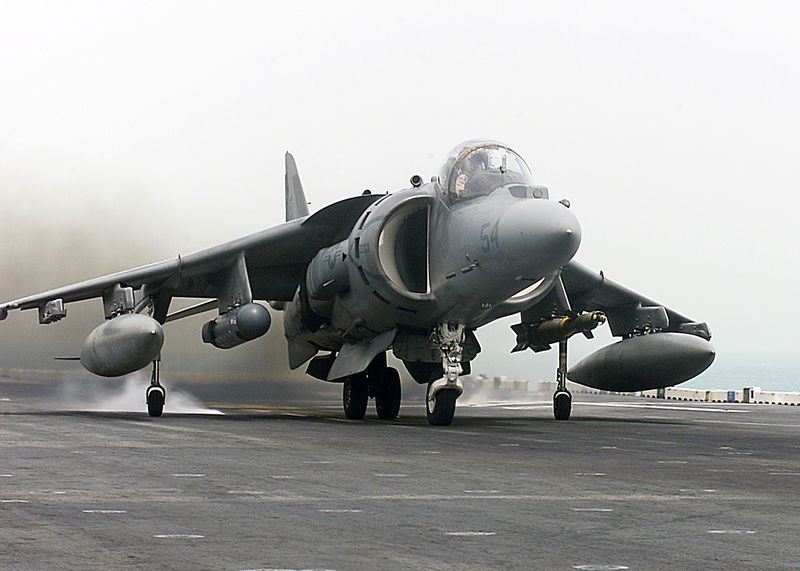


History of the Boeing AV-8B Harrier II (BAe Systems / McDonnell Douglas)
While the original Hawke Sidley Harrier proved revolutionary at the time, the successor BAe Systems Sea Harrier improved upon the type's original design by incorporating radar and improving external cockpit visibility, vertical controls and armament , the aircraft still has a firm origin anchored in the 1960s. By the mid-1970s, it was clear that the aircraft had reached its full potential, and limitations were apparentespecially in terms of range, avionics, and payload capabilities. What started and ended was basically a joint venture between British and American air carriers (the British quit early and rejoined later) to produce the ultimate Harrier in the "AV-8B Harrier II".
The AV-8B (and the British named Harrier GR) saw combat operations in Iraq, Kosovo, and now Afghanistan, and remains the Harrier version of choice for the US Marine Corps and the RAF/RN.
Harrier family tree breakdown
The Harrier range consists of four main versions including the Hawker Siddeley Harrier, British Aerospace (BAe) Sea Harrier, Boeing/BAe AV-8B Harrier II and BAe Systems/Boeing Harrier II Each model differs from the others in some way Way. The original production model and the start of the Harrier series was the Hawker Siddeley Harrier. The Sea Harrier (as the name suggests) became a dedicated naval version of the Base Harrier, used primarily for air defense and secondarily for ground attack.
The Sea Harrier also uses the powerful Blue Fox radar, a direct development of the ground-based RAF Harrier GR. 3. The Boeing/BAe AV-8B Harrier II became a "second generation" Harrier, a heavily modified version of the original Harrier used by the USMC, while the BAe Harrier II was a British modified strike version of the USMC Harrier II. /p]
Hawker Aircraft Limited was acquired by the Hawker Siddeley Group in the late 1950s and renamed British Aerospace (BAe) in 1977. In 1999, British Aerospace became BAe Systems following the acquisition of Marconi Electronic Systems.
Added ALR-67 radar warning receiver, and two ALE-29 chaff/flare dispensers, mounted under the hull, just aft of the airbrake. Two ALE-39 distributors were also mounted on the upper side of the rear fuselage, greatly increasing the survivability of the Harrier II.
Additionally, the centerline mount point can now deploy ALQ-164(V) countermeasure pods. Later, the AAR-44(V) was mounted on the tail to warn enemy missiles coming from behind.
The first 12 AV-8Bs were equipped with F402-RR-404A turbofan engines, while the more recent F402-RR-406A series (similar to the Pegasus Mk 105) series later became the mainstay of the Harrier II series. The Mark 105 engine originated as a Rolls-Royce project in 1980 and was first tested on the Harrier GR. Mk 3 airframe from 1982. Despite using the same engines in the new Harrier, the aircraft is still able to achieve a larger payload and an impressive 70 percent increase in transport capacity.
Internal fuel storage has been addressed and range has been increased by 50%. In addition to these benefits, maintenance time required to keep birds aloft is reduced by 60%.
The first AV-8B first flew on August 29, 1983, and was officially handed over to Training Squadron VMAT-203 on January 12, 1984 at Cherry Point, NC. The first operational squadron became VMA-331 in March 1987 and eventually had 20 aircraft. The new system proved to be beyond the capabilities of the original AV-8A pilots, so a production order for eight AV-8Bs was placed.
Development of the most important two-seat TAV-8B Harrier II. The TAV-8B entered Navy hands on July 24, 1987.
The differences between the production AV-8B and the TAV-8B are subtle. The TAV-8B naturally required a larger cockpit to accommodate two pilots, so the fuselage was lengthened. This is offset by longer tail spines and higher vertical tail fins.
Unlike future British trainers, the TAV-8B did not retain its combat capabilities, but was a true trainer with only a pair of underwing mounts for fuel and practice guns.
The second combat squadron of the USMC became VMA-231 in July 1986, with a combat force of 15 AV-8Bs. Before the end of 1986, the VMA-457 squadron was next on the line.
The two squadrons were subsequently commissioned by VMA-513, which, incidentally, was the last operator of the original first-generation AV-8A Harriers.
The British took the American-modified AV-8B Harrier II and initially produced a pair of GRs. The Mk 5s were equipped with Pegasus Mk 105 engines as well as British avionics, radios, countermeasures and applicable weapons. The first flight was on April 23, 1985, and the first GR was achieved.
The Mk 5 entered service in July 1987.
Ultimately, Harrier has evolved into a more specialized fighting platform. No longer a concept that has simple close support missions as its sole advantage, the Harrier II has developed combat capabilities that make it a first-class ground attack aircraft with unparalleled gunship-like capabilities unmatched by other conventional aircraft.
The new Harrier can also defend itself by using internal cannons or externally mounted short-range air-to-air missiles.
McDonnell Douglas Corporation is acquired as a subsidiary of The Boeing Company and BAe is renamed BAe Systems. Each company now manages the AV-8B Harrier II and Harrier GR series in current and future service.
AV-8B Tour
To the casual observer, it's fair to say that the AV-8B hasn't changed much since the days of the first Harrier/Sea Harrier. A closer look, however, will quickly reveal the larger, raised cockpit - a key differentiating feature of the new Harrier - and the larger wing area with its additional attachment points. The wing retains its distinctive underside corners, and while new, the nose cone assembly largely maintains the same shape as the previous Sea Harrier.
The AV-8B's air intakes are significantly larger, spanning both sides of the cockpit. The rear of the fuselage tapers to a vertical tail. The stern has a pair of horizontal stabilizers, also with reverse corners. The landing gear is essentially the same as the earlier Harrier, including a single-wheel front strut and a two-wheel main landing gear strut. The two outriggers that were originally on the wingtips are now brought inboard for better ground tracking.
The AV-8B is equipped with a UPC/Stencel type 10B series ejection seat. The onboard refueling probe is hidden on top of the port air intake.
American Harrier II avionics consist of Collins RT-1250A/ARC U/UHF radio system, Bendix RT-1157/APX-100 IFF system and Litton AN/ASN-130A INS (Inertial Navigation System). With the introduction of the APG-65 radar from the USMC McDonnell Douglas F/A-18 Hornet, some Harrier IIs were also fitted with the unit and were referred to as "Harrier II Plus". The first Harrier II Plus entered service with the VMA-542 in 1993, and by 2003 all other AV-8Bs in service with the USMC were appropriately upgraded.
The Harrier II Plus model is expected to continue through 2025.
Weapons
The US AV-8B features standard armament, including a 20mm General Electric GE GAU-12A "Equalizer" five-barreled Gatling cannon in the left fuselage fairing. About 300 rounds of ammunition were contained in a similar panel on the starboard side.
The British GR version originally had 2 x 30mm ADEN guns mounted in a pod fairing under the fuselage.
The American Harrier II used 7 hardpoints (6 underwing; 1 centerline) and was able to accommodate guns up to 13,200 lbs. Options include AGM-65 Maverick air-to-surface missiles, AGM-84 Harpoon anti-ship missiles, up to 4 x AIM-9 Sidewinder short-range or AIM-120 AMRAAM medium-range air-to-air missiles, conventional air-delivered bombs, laser-guided bombs, cluster bombs , napalm, and Joint Direct Attack Munitionsthe latter of which lethally utilize GPS guidance.
Target and reconnaissance compartments and up to 4 auxiliary fuel tanks can replace weapons.
External ammunition options for the Harrier GR mainly include the LAU-5003, BL775 and Matra missile pods. Other options include deploying American-made AGM-65 Maverick air-to-surface missiles, MBDA Brimstone anti-tank missiles, CBU-87 cluster bombs and conventional or Paveway series laser-guided bombs (LGBs) over nine hardpoints. The AIM-9 Sidewinder short-range air-to-air missile is used for self-defense, as the GR does not have an internal cannon.
External hardpoints can also make room for additional drop tanks for improved range and hold time, or for reconnaissance pods as needed. Later GR models can name their targets themselves.
Variations
The YAV-8B was designated for the above two development prototypes using the existing USMC AV-8A airframe (there was also a USMC C model in the original Harrier crop). Thus, a production model followed, designated "AV-8B", although in many respects the Harrier II was essentially a "like new" aircraft.
The AV-8B was the original Harrier II model produced by the USMC and was classified as a day fighter. They were in service for a while before being completely replaced or phased out by newer AV-8B variants. The Italian Navy has received similar AV-8Bs, and as of early 2009, 15 of them are believed to be still in service with the Gruppo Aerei Imbarcati.
Italy began delivering the first nine aircraft (including a trainer) in 1994.
The AV-8B(NA) "Night Attack" Harrier II variant (originally known as the AV-8D) began development in 1984 and implemented the NAVFLIR (Navigation Forward Looking Infrared Camera, including the airborne GEC-Marconi FLIR -system). nose) for night operation. Additionally, pilots are provided with GEC Cat's Eye night vision goggles, as well as an improved cockpit with a new color MFD, wider field of view HUD display, digital moving map with color CRT and full "head down" maneuverability.
Mounted on top of the nose assembly, the FLIR helps casual observers identify the type of Harrier in photos. The Night Attack Harrier II is equipped with four Tracor ALE-39 countermeasure launchers at the top of the rear of the fuselage in addition to the two ALE-39 launchers at the rear and bottom of the fuselage. The AV-8B(NA) also uses an upgraded Rolls-Royce Pegasus 11-61 (F402-RR-408) vector thrust turbofan engine. On June 26, 1987, the modified AV-8B made its first night attack flight.
In September 1989, VMA-214 deliveries to the U.S. Marine Corps began at Yuma. Follow-up units stationed outside Yuma received their night raid forms in late 1992.
As in the McDonnell Douglas F/A-18 Hornet (except for the Sea Harrier, previous Harrier models were not equipped with a radar system), "100%" LERX (Leading Edge Root Extension), and Beyond Visual Range (BVR) capabilities. Due to the F/ The A-18 Hornet will be upgraded to the APG-73 series of radars, and the APG-65 will be readily available.
Given the cost at the time, the APG-65 was an economical choice, although the British Blue Fox system might have been the right choice.
The US, UK, Spain and Italy have all played a role in the new development. Harrier II+ is now the primary USMC model and is used (at the time of writing) with VMA-211, VMA-214, VMA-223, VMA-231, VMA-311, VMA-513, VMA-542, VMAT- 203 , VX-31 and VX-9.
In addition, the Harrier II+ was delivered to the Spanish and Italian navies with AIM-120 AMRAAM capability. Performance specs for this improved version include a reported top speed of 662 mph, a range of 1,400 miles and a rate of climb of 14,700 feet per minute.
The first flight of the new Harrier II took place on September 22, 1992. Subsequent delivery to the USMC unit at Cherry Point.
 Argentina
 Armenia
 Australia
 Austria
 Austria-Hungary
 Belgium
 Brazil
 United Kingdom
 Brunei
 Bulgaria
 Canada
 Chile
Chile China
China Colonial America
 Colombia
 Confederate States
 Croatia
 Czech
Czech Denmark
 Egypt
Egypt Finland
 France
 Georgia
 Germany
 German Imperial
 Greece
 Holland
 Hungary
 India
India Indonesia
 Iran
Iran Iraq
Iraq Ireland
 Israel
 Italy
Italy Japan
Japan Japan (1940)
 Jordan
 Kingdom of Italy
 Malaysia
 Mexico
 Myanmar
 Nazi Germany
 Netherlands
 New Zealand
 North Korea
 Norway
 Pakistan
 Peru
Peru Philippines
 Poland
 Portugal
 Prussia
 Romania
 Russia
 Saudi Arabia
 Serbia
 Singapore
 Slovakia
 Slovenia
 South Africa
 South Korea
 Soviet Union
 Spain
Spain Sweden
 Switzerland
 Syria
Syria Taiwan
 Thailand
 Turkey
 UAE
UAE Ukraine
 Vietnam
 Yugoslavia