


History
The AH-6/MH-6 "Little Birds" are an oft-overlooked but absolutely vital part of the U.S. Special Operations Service. This highly maneuverable micromachine has been involved in major and minor military operations around the world, proving to be a lifeline for ground agents whose lives depend on the actions of the bird and its trained crews.
Introduced in 1980 as an improved version of the Vietnam-era OH-6 Cayuse, the bird has remained in direct action since its introduction.
The origin of the bird
The development of the Little Bird stemmed from the US Army's need for a multi-role transport and light attack helicopter in the 1960s. This requirement is within the scope of Technical Specification 153 and is itself part of the US Army/US Navy Light Observation Helicopter (LOH) program. Hughes submitted his Model 369 as one of more than a dozen companies, with a total of 19 design proposals (25 companies were initially called for). By October 1961, the U.S.
Army, with support from the U.S. Navy, had selected three designs for further evaluationthe Bell D-250, the Hiller 1100, and the Hughes 369. The U.S. Army likes it in the Bell D-250, and the U.S. Navy is interested in the Hiller Model 1100.
The three aircraft received new designations YHO-4, YHO-5 and YHO-6, respectively, and were built as five evaluation prototypes. The flight test took place at Camp Lake, Alabama. All systems were later renamed YOH-4, YOH-5 and YOH-6 under the new DoD system in 1962.
Bell YHO-4 was eventually eliminated, leaving Hiller YOH-5 and Hughes YOH-6 to contend. Eventually, Hughes was awarded the contract in 1965, and the YOH-6 became the OH-6A "Cayuse". The initial order of 714 production systems was later increased to 1,300.
In civilian form, OH-6 was marketed as the Hughes 500, for which several military forms were developed for export - the first of which became the Hughes 500M in Colombia.
Production Identifier
Original production was owned by Hughes Helicopters, Incorporated, but the acquisition of Hughes by McDonnell Douglas in 1984 forced the brand to be renamed McDonnell Douglas Helicopter Company. In 1985, the company changed its name again to McDonnell Douglas Helicopter Systems. In 1997, McDonnell Douglas merged with Boeing. Boeing sold the civilian portion of its helicopter production line to MD Helicopter Holdings, Incorporated.
In 2005, Patriarch Partners LLC acquired the company and transformed it into a separate company, MD Helicopters, Incorporated.
New requirements
By 1980, the need for a light, easily transportable helicopter system was recognized that would be operated by specially trained personnel as part of special forces. OH-6A was developed into a special form known as "little bird".
Selected pilots were trained and soon transferred to the newly formed 160th Aviation Battalion (aka "Nightcrawlers"). Two bird forms were then developed - one to assist in transporting small groups of agents in and out of hot zones (MH-6), and another to support such operations in a light attack role (AH-6).
Bird's Journey
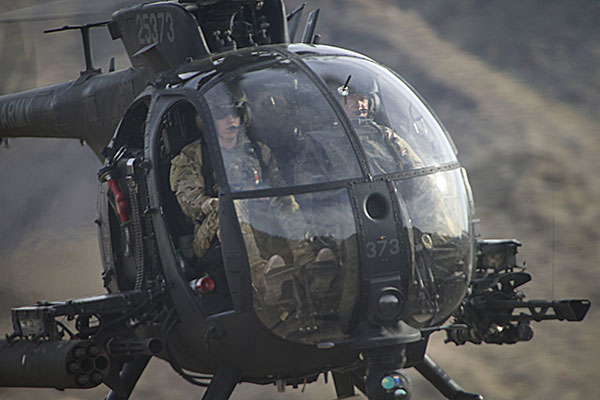
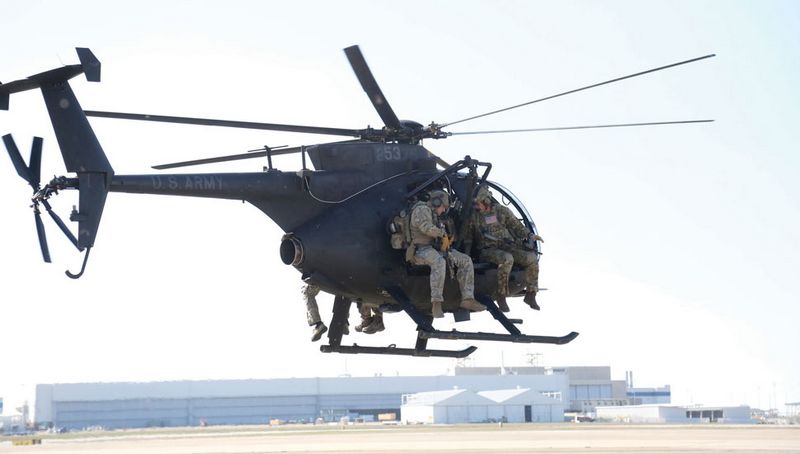
Little Bird's look is very functional. The design features a large bubble-frame glass cockpit with excellent visibility from the two-person cockpit. The cockpit is located directly forward of the small crew compartment area (MH-6) and can accommodate up to 6 combat readiness task forces on "bench" style seats along the outside of the hull of the engine room. Behind it is the engine housing. The powerplant consists of an Allison brand T63-A-5A or T63-A-700 series turboshaft engine rated at 650 hp with a five- or six-blade main rotor (depending on model) and a two-blade or four-blade tail rotor.
The main rotor is mounted on a short mast on the fuselage, while the tail rotor is mounted on the port side of the plane, away from the slender short tail section. The rear is characterized by a complex T-shaped layout consisting of a vertical rear wing with a horizontal plane on top, which itself is attached with two small vertical planes. The engine exhaust, although usually located above the tail of most other helicopters, is actually located below the bird's tail mount. The weight of the entire aircraft is transferred to the ground via two basic slides supported in two places.
Skateboards provide a convenient stepping area for hitchhikers and serve little birds well. Birds are usually painted black to reflect their stealth.
Performance
The single engine power rating allows the bird to reach a top speed of 175 mph and a cruising speed of 155 mph. It has a specified range of 267 miles, a service ceiling of 18,700 feet and a climb rate of 2,061 feet per minute. Internal fuel is listed as 62 US gallons.
Operating weight is 1,509 lbs, with a maximum takeoff limit of 3,100 lbs. When fully "clean," the bird weighed 1,591 pounds. Its size and weight make it a relatively easy system to transport when moved using existing U.S. aircraft transporters.
Armed
Probably the most important multifunctional aspect of the light attack version of the bird is the use of two light universal mounts on the sides of the fuselage, allowing the flexible system to take advantage of a wide range of powerful weapon options, including cannon pods, missile pods and missile. Birdie can mount an M230 series chain gun or 7. 62mm M134 minigun and 12.7mm Gatling-type GAU-19 heavy machine gun paired. The Mk 19 40mm automatic grenade launcher is also an option, no doubt based on combat experience with combat helicopters deployed over Vietnam. For rocket launches, Bird uses a pair of standard 7-round 2.75-inch Hydra-70 rocket pods.
For anti-tank/anti-tank defense, the Little Bird has been approved for use with Hellfire or TOW anti-tank missile systems. In addition, the helicopter can use the Stinger short-range air-to-air missile to defend itself against low-flying enemy air targets.
Force call
This little bird was first used in a combat setting during the 1983 invasion of Grenada. Pilots fly their birds from their base in Barbados to the island nation of Grenada. Their mission revolves around the evacuation of the injured in Operation Emergency Fury.
The birds were flown from the United States on a Lockheed C-130 Hercules transport aircraft that used to operate from land and sea bases in the region. Birds were also deployed in covert operations to support the opposition in 1983, with the planes flying from their base in Honduras to Nicaragua. During Operation Just Cause in late 1989, several 160th century birds were used in pre-invasion operations.
Both the MH-6 and AH-6 were successfully used in the eventual capture of General Manuel Noriega.
Black Hawk Down
The bird's most famous use is probably the 1993 battle in Mogadishu, Somalia. The MH-6 model was used to bring Delta Force personnel into action during operations. AH-6 gunship counterparts assist Delta Force and Army Rangers in attempting to reach one of the Black Hawk crash sites. In the ensuing operation, the crew of MH-6 managed to rescue two injured American service members by landing near one of the crash sites - one crew left the plane on foot, while the other used his of automatic weapons fire from the cockpit. Wait for the helicopter.
While the Battle of Mogadishu marked a rather dark moment in U.S. military history, there's no denying the sheer level of self-sacrifice that motivated all those involved in the operation to do their thing for each other. The Little Birds work tirelessly all night to stop Mohammad Farrah Aidid's cronies.
On a related note, several AH-6 bird models were returned to Somalia in September 2009 and successfully killed terrorist Saleh Ali Saleh Nabhan.
Other current promotions
MH-6s and AH-6s have been in service throughout Iraq since the invasion began in 2003. From fire support to rescue operations, the powerful small helicopter and its well-trained crew are responsible for ensuring the safety of its many employees, including foreign contractors and friendly services. U.S.
Army Soldier Jessica Lynch's well-known rescue was accomplished by arming the AH-6 Birdie.
Bird variant
From its OH-6 Cayuse roots, the little bird has evolved into several useful and equally powerful battlefield variants. The AH-6C is a special forces attack aircraft, essentially an OH-6A modified to carry weapons used by the 160th Special Operations Aviation Regiment known as the Nightcrawler. The electronic warfare/air command post variant exists as the EH-6E, while the MH-6E is used to designate an improved attack/transport model. The AH-6F, AH-6G and MH-6H are all special forces attack and transport capable platforms. Model J (AH-6J/MH-6J) represents a new form factor with improved GPS, FLIR and motor systems and is based on the MD 530MG model.
Likewise, the AH-6M and MH-6M are based on the commercial MD 530 series, which are modifications of the AH-6J and MH-6J models, respectively. These are heavily modified for special forces use and are sometimes referred to as "Mission Enhancement Birds" (or MELB).
Little Birds have also been modified into smaller, unmanned drone models in the form of AH-5X and MH-6X (aka "Unmanned Birds" or ULB). The program currently (as of 2009) evaluates the Bird Airframe as a remotely operated casualty evacuation platform with two identifiable "victim boxes" each with a weight limit of 300 pounds.
These compartments are located on each side of the hull. The tests were promising and involved using 200-pound dummies in these boxes to simulate human weight. The ready crew awaits the approaching ULB and intervenes to help the wounded after the helicopter has landed safely.
The only operators of Birds remain the U.S. Army and the FBI Hostage Rescue Team.
By the way, the LOH program was later reopened in 1967. The next round of evaluation produced the Bell OH-58 Kiowa light helicopter for the U.S. Army.
Specification
Basic
Production
Roles
- Ground Attack
- Close Air Support (CAS)
- Electronic Warfare (EW)
- Traffic
- Reconnaissance (RECCE)
- Special Forces
- driverless
Dimensions
32.15 ft (9.8 m)
27.23 ft (8.3 m)
9. 84 feet (3 m)
Weight
722 kg
1,406 kg
Performance
Performance
175 mph (282 km/h; 152 knots)
18,701 ft (5,700 m; 3.54 mi)
267 miles (430 km; 232 nmi)
628 m/min
Armor
Mission-specific ordnance may include any combination of the two assembly stations (AH-6):
1 x 30mm M230 Chain Gun/Auto Cannon.
2 x 7.62mm M134 miniature machine guns.
2 x 12.7mm GAU-19 Gatling guns.
2 x M261 7-shot rocket pods (2.75" Hydra 70 rockets).
2 x AGM-114 Hellfire Anti-Tank Missiles (ATGM).
2 x TOW ATGM.
2 x Stinger short-range air-to-air missiles.
Changes
AH-6C - Special Forces Assault; based on the OH-6A Cayuse.
EH-6E - Air Command Post; Electronic Warfare
MH-6E - Improved transport model.
AH-6F - Special Forces attack model.
AH-6G - Special Forces attack model.
MH-6H - Special forces transport model.
AH-6I ("International") - Saudi Arabian export model based on the AH-6S.
AH-6J - Improved; updated engine, GPS and FLIR systems; based on MD 530MG; attack model.
MH-6J - Modified; updated engine, GPS and FLIR systems; based on MD 530MG; transport model.
AH-6M - Mission Enhanced Little Bird (MELB); highly modified form; attack mod.
MH-6M - Mission Enhanced Little Bird (MELB); highly modified form; transport model.
 Argentina
 Armenia
 Australia
 Austria
 Austria-Hungary
 Belgium
 Brazil
 United Kingdom
 Brunei
 Bulgaria
 Canada
 Chile
Chile China
China Colonial America
 Colombia
 Confederate States
 Croatia
 Czech
Czech Denmark
 Egypt
Egypt Finland
 France
 Georgia
 Germany
 German Imperial
 Greece
 Holland
 Hungary
 India
India Indonesia
 Iran
Iran Iraq
Iraq Ireland
 Israel
 Italy
Italy Japan
Japan Japan (1940)
 Jordan
 Kingdom of Italy
 Malaysia
 Mexico
 Myanmar
 Nazi Germany
 Netherlands
 New Zealand
 North Korea
 Norway
 Pakistan
 Peru
Peru Philippines
 Poland
 Portugal
 Prussia
 Romania
 Russia
 Saudi Arabia
 Serbia
 Singapore
 Slovakia
 Slovenia
 South Africa
 South Korea
 Soviet Union
 Spain
Spain Sweden
 Switzerland
 Syria
Syria Taiwan
 Thailand
 Turkey
 UAE
UAE Ukraine
 Vietnam
 Yugoslavia