

History
During World War II (1939-1945), the French aerospace company Caudron was no stranger to aircraft construction. It began official operations as early as 1909 and continued to produce a large number of aircraft types that served in World War I (1914-1918).
Fast forward to 1933, the company was taken over by Renault and began operating under the name "Caudron-Renault", which included the serial design that led to the German occupation of France in 1940 - war/wartime became "CR.710" - with modern A sleek, racer-like single-seat, single-engine monoplane.
On the eve of the war with neighboring Germany, the French Air Force attempted to modernize its combat capabilities, which led to designs such as the CR. In 1936, the 710 came to the fore. Like the other great powers of the time, ideas turned to developing an "economically oriented" fighter that would rely on wood for much of its construction, as it proved to be more readily available and cheaper to manufacture. cr.
The 710 competed with the ANF-Mureaux 190, and the French Air Ministry saw an offer from Caudron-Renault and awarded a contract for three prototypes. Its design is attributed to a certain Marcel Riffard.
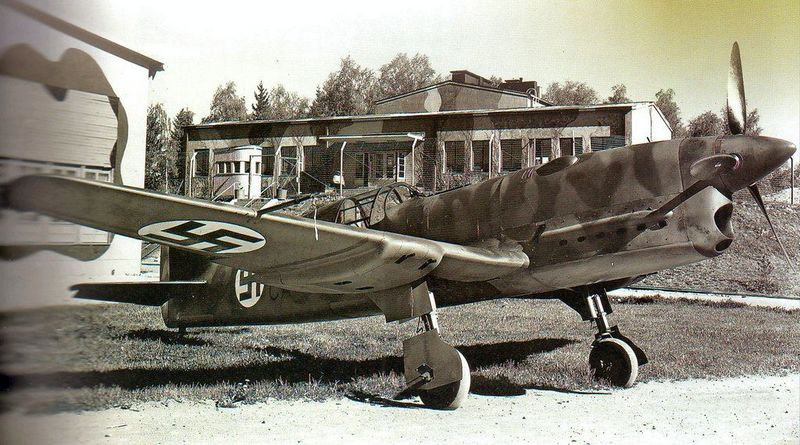
cr. First flown on July 18, 1936, the 710 (also known as the "Cyclone") was powered by a Renault 12R-01 (mated to a Renault 6Q) with a supercharged inverter V12 air-cooled engine producing 500 hp. It is mounted on the nose and drives a three-bladed propeller in a "puller" arrangement. The cockpit is located behind the long tube nose, and the unique frame arrangement tries to give the pilot a good view outside the cockpit. The fuselage tapers in the traditional manner towards the stern and is covered by circular vertical fins and a mid-mounted horizontal plane.
The landing gear is a typical "tail" configuration, although fixed in flight. The main legs have been spit out for better aerodynamic efficiency.
Overall, the look of the plane is reminiscent of fast racing cars of the 1930s - sleek, slim and compact. This is because of CR. Derived from the Caudron "Coupe Deutsch" racing monoplane, the 710 is where performance is key (though not military combat flight). As a combat platform, the CR.
710 is equipped with 2 x 20mm Hispano-Suiza HS. Nine automatic cannons are housed in the underwing pods, one for each wing.
In the 1937 test, CR. The 710 prototype was approaching 295 mph, and incremental updates to engine customization led to the "CR.711" and "CR.712" designations. Next was the "CR. 713", this form was equipped with a retractable undercarriage and a modified inclined rudder.
She flew for the first time on December 15, 1937, forging the production "CR.713". 714" (both CR. 710 and CR. 713 prototypes were lost in February 1938 accident).
cr. The 714 made its maiden flight on July 6, 1938 (officially known as "CR. 714. 01"), which included 4 x 7.5 mm MAC 1934 series medium machine guns in the wings as standard armament (from under the original twin wings) wing) gun). The weapon system was added to the airworthy design in November 1938, and as early as November 5, French authorities had ordered 20 of the brand and held future options for another 180.
The first example appeared on June 10, 1939, including the landing flaps (now reduced chord), wing elements (now reduced camber), and the Renault 12R-03 engine (allowing greater maneuvers) were changed.
The French Air Force was ultimately unimpressed by the CR. 714, so the aircraft (and its production units) were passed on to Finland, which was in dire need of modern monoplanes (the Soviet Union invaded on November 30, 1939 to start the "Winter War"). Eighty men were planned to cross over Finland, but in the end only six made it successfully, and no one saw official combat action against the Soviet Union.
Two Polish Air Force fighter squadrons in exile also received this model, and the service managed to fly these specimens in combat conditions during the war.
Beyond CR. 714, the only version of the CR. 710 batches to make it available for any meaningful production, they justify other related branches/variants of the series. The "CR. 720" is proposed as a dedicated trainer shape to carry a lower rated engine of only 100-220hp, while the "CR.
760" will be developed with the 750hp Italian Isotta-Fraschini "Delta" engine. This version first flew in May 1940, but was destroyed by its leaders before the German attack.
The "CR.770" became another proposed branch of the series, this model was equipped with a 16-cylinder engine of the Renault 626 type, which produced 800 hp. The entry made its first flight in November 1939, but the example was again destroyed by the French before the Germans advanced.
The final form of the Cyclone series fighter is to become "CR.780". It will be powered by a 500 hp 12-cylinder Renault 468 series engine driving a pair of three-bladed propeller units in counter-rotation. Suggested weapons focus on 2 x Hispano-Suiza HS.
404 automatic cannons and 2 x 7.5mm MAC 1934 machine guns. cr. The 780 has never surpassed Caudron-Renault's drawing board.
Overall CR score between 60 and 90. In fact, the family built 710 fighter jets. The last example was airlifted from Finland to 1941.
Specification
Basic
Production
Roles
- Fighter
Dimensions
8.65m
29.43 ft (8.97 m)
2.87m
Weight
1,400 kg
1,880 kg
Performance
Performance
286 mph (460 km/h; 248 knots)
13,123 ft (4,000 m; 2.49 mi)
559 miles (900 km; 486 nautical miles)
415 m/min
Armor
Originals (CR. 710 - CR. 713):
2 x 20mm Hispano-Suiza HS. There are 9 automatic cannons in the underwing pods (one pod per wing).
Later (CR. 714):
4 x 7.5mm MAC 1934 machine guns in wing mounts (two per wing panel).
Proposal (CR. 780):
2 x 20mm Hispano-Suiza HS. 404 cannon.
2 x 7.5mm MAC 1934 machine guns.
Changes
cr. 710 "Cyclone" - name of the basic series; Renault 12R-01 air-cooled engine, 450 hp; prototype lost in February 1938.
cr. 711 - Increased engine power.
CR-712 - Increased engine power.
cr. 713 - December 1937 model; retractable landing gear; modified tail rudder; Renault 12R-01 engine; prototype lost February 1938.
cr. 714 - April 1938 model; modified wings, flaps, reinforced fuselage and Renault 12R-03 engine.
cr. 720 - Proposed dedicated trainer with engine power ranging from 100 to 200 hp.
cr. 770 - Proposed fighter version with 800 hp Renault 626 16-cylinder engine
cr.
 Argentina
 Armenia
 Australia
 Austria
 Austria-Hungary
 Belgium
 Brazil
 United Kingdom
 United States
 Brunei
 Bulgaria
 Canada
 Chile
Chile China
China Colonial America
 Colombia
 Confederate States
 Croatia
 Czech
Czech Denmark
 Egypt
Egypt Finland
 Georgia
 Germany
 German Imperial
 Greece
 Holland
 Hungary
 India
India Indonesia
 Iran
Iran Iraq
Iraq Ireland
 Israel
 Italy
Italy Japan
Japan Japan (1940)
 Jordan
 Kingdom of Italy
 Malaysia
 Mexico
 Myanmar
 Nazi Germany
 Netherlands
 New Zealand
 North Korea
 Norway
 Pakistan
 Peru
Peru Philippines
 Poland
 Portugal
 Prussia
 Romania
 Russia
 Saudi Arabia
 Serbia
 Singapore
 Slovakia
 Slovenia
 South Africa
 South Korea
 Soviet Union
 Spain
Spain Sweden
 Switzerland
 Syria
Syria Taiwan
 Thailand
 Turkey
 UAE
UAE Ukraine
 Vietnam
 Yugoslavia