


History
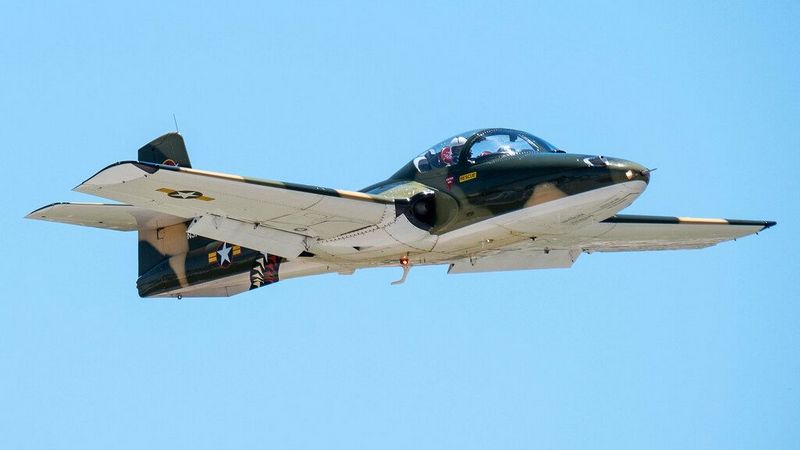
The Cessna T-37 grew out of a 1952 United States Air Force (USAF) need for a light, two-seat, jet-powered training platform under the project name "Trainer Experimental (TX)". Cessna threw its hat into the ring and developed its "Type 318," which placed the twin-turbojet propulsion scheme at the root of the wing, in a traditional single-tail layout, and placed two crew members side by side . The wings are low-mounted monoplanes constructed as straight appendages with truncated tips.
A three-wheeled chassis completes the modern equipment. In 1954, the U.S. Air Force advanced the Cessna 318 design as the "XT-37", ordering three airworthy prototypes.
XT-37A represents a complete prototype with two Continental YJ69-T-9 series turbojets. These engines are nothing more than locally licensed replicas of the French "Marbore" series Turbomeca engines - the same engines used to power the French-built "Magister" Fouga trainer aircraft (described in detail elsewhere on this website) . These units each provide 920 pounds of thrust and, combined with an aerodynamically improved airframe, give this nimble little aircraft good performance. Speeds reached 390 mph in testing and closer to 425 mph on later production aircraft.
The plan suffered a setback when the first prototype crashed in rotational motion, leading to fuselage and empennage modificationsthough rotational recovery remained a sticking point in the design throughout its career.
The T-37A "Tweet" was the first production model, with 534 built (with J69 T-9 engines). The U.S. Air Force began training with the T-37A in June 1956, and the aircraft was indeed tested but generally considered a good and powerful platform for pilots to fly. The cockpit was not pressurized because the aircraft was operating below the 25,000-foot altitude specified by the U.S. Air Force.
U.S. Air Force approval eventually led to the line being used as a trainer and light attack aircraft by other U.S. allied aviation services around the world.
The T-37B continued to be produced, but with J69-T-25 engines (1,025 lb thrust each) and received upgraded communications and navigation tweaks. These arrived in 1959. The T-37C had an inherent light attack capability via underwing pylons (one per wing), with 269 of the brand produced.
External transactions may be as high as ?500.
The XAT-37D is a counterinsurgency model with light attack capabilities. Two prototypes have been completed, but mass production has not yet taken place.
The YT-48A was a proposed T-37 development program intended to be equipped with a pair of Garrett F109-GA-100 engines, but this model was not adopted.
The USAF did not find a true successor to the T-37 until the arrival of the Beechcraft T-6 "Texan II" (detailed elsewhere on this page). The Texan II went against the turbojet and returned to piston-powered form. The last USAF T-37 was retired in July 2009 after 1,269 were built at Cessna. One of its most famous offshoots, the 577, was the 1963 A-37 Dragonfly (also known as the "Super Tweeter"), built to light ground attack aircraft specifications for use in several aircraft, including the U.S.
Air Force. Air Service Agency. These saw combat action in the Vietnam War (1955-1975).
Current operators of the T-37 route include Colombia, Ecuador and Pakistan. Former operators range from Bangladesh and Brazil to Turkey and Vietnam. Captured Vietnamese form from South Vietnam after the Vietnam War.
Specification
Basic
Production
Roles
- Ground Attack
- Close Air Support (CAS)
- Education
Dimensions
8.92m
10.3m
2.8m
Weight
1,755 kg
2,993 kg
Performance
Performance
425 mph (684 km/h; 369 knots)
39,199 ft (11,948 m; 7.42 mi)
932 miles (1,500 km; 810 nautical miles)
3,370 ft/min (1,027 m/min)
Armor
No real trainer version. Some are equipped with 2 x 250lb conventionally thrown bombs (mostly "C" export models).
Changes
Type 318 - Competition designation for the Cessna program.
XT-37 - Prototype designation based on the Model 318.
T-37A - first production model with 2 x Continental J69-T-9 turbojets, of which 534 were produced.
T-37B - Equipped with more powerful J69-T-5 engines with wingtip fuel tanks and upgraded avionics.
T-37C - Built for export; added underwing hardpoints.
A-37 "Dragonfly"/"Super Twitter" - Lightly armed ground attack aircraft based on the T-37 design.
 Argentina
 Armenia
 Australia
 Austria
 Austria-Hungary
 Belgium
 Brazil
 United Kingdom
 Brunei
 Bulgaria
 Canada
 Chile
Chile China
China Colonial America
 Colombia
 Confederate States
 Croatia
 Czech
Czech Denmark
 Egypt
Egypt Finland
 France
 Georgia
 Germany
 German Imperial
 Greece
 Holland
 Hungary
 India
India Indonesia
 Iran
Iran Iraq
Iraq Ireland
 Israel
 Italy
Italy Japan
Japan Japan (1940)
 Jordan
 Kingdom of Italy
 Malaysia
 Mexico
 Myanmar
 Nazi Germany
 Netherlands
 New Zealand
 North Korea
 Norway
 Pakistan
 Peru
Peru Philippines
 Poland
 Portugal
 Prussia
 Romania
 Russia
 Saudi Arabia
 Serbia
 Singapore
 Slovakia
 Slovenia
 South Africa
 South Korea
 Soviet Union
 Spain
Spain Sweden
 Switzerland
 Syria
Syria Taiwan
 Thailand
 Turkey
 UAE
UAE Ukraine
 Vietnam
 Yugoslavia