
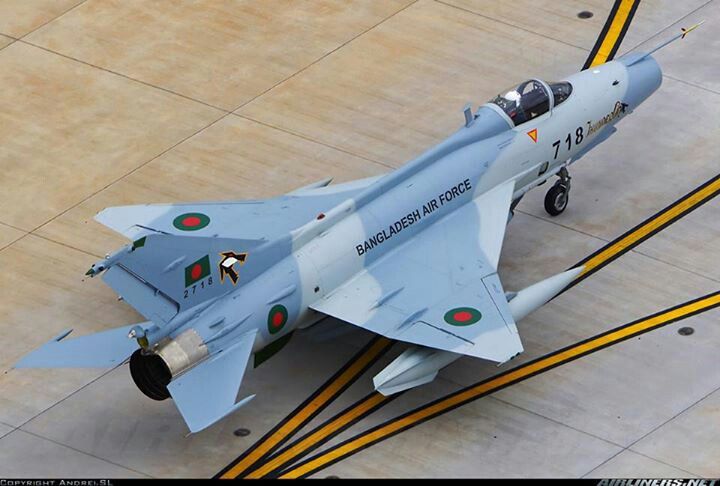


History
After World War II (1939-1945), China and the Soviet Union were cooperating political powers. Naturally, this led to China being the recipient of modern technologies developed by Soviet engineers.
Eventually, the introduction of Soviet aircraft, tanks and small arms enabled the Chinese to use the Mikoyan-Gurevich MiG-15 "Fagot" jet fighter in the Korean War. In 1955, the Soviet government granted China a license to produce the MiG-17 jet fighter, and hundreds of them were produced locally. Hands-on experience building advanced jets eventually enabled the booming Chinese aviation industry, centered on ordnance, airframes and engines. For decades, reverse-engineering military weapons has showcased a certain amount of Chinese talenta feature that continues to this day.
After all, the two-seater trainers, which are designed, developed and produced entirely in-house, are all done in-house. Licensed production of the MiG-19 then entered the 1960s, although this period was quickly hampered by the Sino-Soviet split of 1960-1989, and political and military partnerships deteriorated.
Despite the differences, relations apparently eased during this period, enough to open the door for the Soviet Union to introduce their new MiG-21 "Fishbed" interceptor to the Chinese. Licensed for production in 1962, the local Shenyang company was commissioned to replicate the MiG-21F-13 "Fishbed-C" and its RD-11F-300 series engines. The Soviets helped with staff, aviation agencies, and kits, which were shipped to local Chinese rallies. At China's initiative, the MiG-21F was designated "J-7", while its export counterpart became "F-7".
The corresponding engine copy is the localized "WP-7" product. The first engine tests took place in October 1965, and the prototype was completed in November of the same year. The first flight of the Chinese F-7 was on January 17, 1966.
This model proved to be a viable replica, and serial production was ordered, albeit slowly, from June 1967. The arrival of the "Cultural Revolution" (1966-1976) accelerated production, which was then distributed to the Chengdu factory.
The revolution undoubtedly hurt the J-7 at first, as the outage delayed the system's full operational status until the early 1980s. Since then, many problems have become apparent, as the Chinese product proved to be underperforming compared to the Soviet version.
The problem was not resolved until 1985.
The core of the F-7 can be considered a perfect replica of the excellent and widely used MiG-21 of the 1960s. The fuselage is mostly tubular, with a low-set delta main wing and a swept-back tail. The aircraft relies on a vertical tail. The cockpit is set up nicely with a light framed canopy.
There is no traditional nose cone, as the nose is open to allow the single-engine armature to breathe. The landing gear is fully retractable and consists of two single-wheel main legs and a single-wheel front leg.
Chinese production has enabled Chengdu to sell versions of their aircraft to budget buyers around the world, and many parties have accepted Chinese offers. This type has proven very popular in Africa, the Middle East and South Asia, where it finally provides a powerful interceptor with additional strike capability at cost.
Advances in the J-7 line contributed to the type's effectiveness, although it was almost always a decade or so behind its Western competitors.
The first production model, simply called the J-7 (export model F-7), was committed in 1966 by 12 people from the Shenyang company. These versions have only a single 30mm NR-30 cannon and two underwing hardpoints for mounting air-to-air munitions as usual. The J-7I is an improved J-7 now handled by Chendgu and introduced in the 1970s. A variable air intake was installed on the original fixed version, and the 2 x 30mm guns completed the standard armament installation.
This resulted in an upgraded J-7I ("modified") with an improved hydraulic system (a clear problem area for earlier installations). From there, the J-7 appeared in a plethora of viable hunters, interceptors, and attack mounts, which proved to be increasingly popular around the world.
Albania and Tanzania were among the first F-7 operators to receive export-oriented F-7A variants. Pakistan became a strong supporter and key Chinese customer for the F-7 product line, as well as elsewhere. Egypt uses the F-7, as do North Korea and Bangladesh. Iraq became a former operator after the 2003 U.S.-led invasion, with 80 of them permanently decommissioned. Work on an improved J-7II began in 1975 with a more efficient and powerful engine.
These aircraft have been used in Egypt and Iraq (as F-7Bs) since the 1980s.
The F-7M "Airguard" variant is an upgraded J-7II variant intended for export sales and equipped with western-facing avionics to appeal to a wider mass market. Added extra hardpoints, as well as UK and US interior systems.
More powerful engines work in tandem with a new swept delta wing design for improved performance and handling. The J-III followed, largely based on believing the MiG-21MF in Egypt and reverse-engineered by Chinese engineers for replication and eventual resale. These new mounts provide a new radome assembly for the all-weather attack radar, a capability many previous models lacked.
A local company in Guizhou manages the production of the JJ-7 and FT-7 and two-seat trainers of similar models.
There are other J-7/F-8 variants (see variant list below for full list). Many only made minor changes to design (HUD support, in-cockpit MFDs, HOTAS, etc.) and functionality, while others were overhauled or completely rewritten but never implemented. In any case, the F-7 is more or less past its prime, and by modern standards it's a declassified fighter anyway.
However, it proved to be relatively inexpensive to acquire and enabled many countries to provide it with reasonable range air service, especially when 1960s fighter jets were sufficient to subdue weaker neighbors.
Specification
Basic
Production
Roles
- Fighter
- Intercept
- Ground Attack
Dimensions
48.82 ft (14.88 m)
8.32m
13.48 ft (4.11 m)
Weight
5,300 kg
9,100 kg
Performance
Performance
1,367 mph (2,200 km/h; 1,188 knots)
57,415 ft (17,500 m; 10.87 mi)
1,367 miles (2,200 km; 1,188 nautical miles)
11,704 m/min (38,400 ft/min)
Armor
Default:
1 or 2 x 30-1 30mm internal guns (depending on production model).
External air-to-air and air-to-ground weapons via two or four underwing hardpoints. Ammunition includes air-to-air missiles, air-to-surface missile pods and conventionally dropped bombs.
Changes
J-7 - name of the basic series; original production version; 12 examples of Shengyang finish; 1 x 30mm cannon.
J-7I - Improved J-7; produced in Chengdu; 2 x 30mm guns; 2 x Underwing mount points.
J-7I (improved) - improved hydraulic system
J-7II - Improved J-7I model; 2 x 30mm guns; WP-7B engine.
J-7IIA - Improved J-7II; equipped with west-facing avionics suite; head-up display.
J-7IIM - Upgraded to F-7M standard
J-7IIH - Improved J-7II; improved punching capability; multifunction display; support for PL-8 anti-aircraft missiles.
J-7IIK - Upgrade to J-7MP standard
J-7III - MiG-21MF copy; JL-7 fire control radar; modern avionics; WP-13 engine.
J-7B - Modified canopy
J-7BS - 4x Underwing Hardpoints
J-7E - Late 1980s modified J-7II; double delta wing assembly; WF-13F engine; radar system Super Skyranger; HOTAS.
J-7EB - acrobatic public performance mount
J-7EH - Maritime patrol variant that supports anti-ship guns.
J-7FS - Technology Demonstrator
J-7G - Improved J-7E; new KLJ-6E PD radar system; improved engine performance; helmet mounted visor; 1 x 30mm cannon.
J-7G2 - Improved J-7G with advanced radar equipment.
J-7GB - acrobatic stand for public display
J-7M - Technology Demonstrator
J-7MF - Proposed modernization J-7FS; air intake under hull; position wing canard.
J-7MG - Export model proposed for western oriented customers; equipped with Super Sky Ranger Adar; Martin Baker ejection seat.
J-7MP - Improved J-7MG model; AIM-9 Siewinder capable.
J-7PG - equipped with Italian radar system
JJ-7 - Guizhou two-seat trainer bracket
JJ-7I - MiG-21US two-seater trainer
JJ-7II - JJ-7I with Rockwell Collins Avionics Suite.
JL-9 (FTC-2000) - A modern two-seater trainer aircraft based on GAIC's JJ-7.
JZ-7 - J-7 Scout Mount
J-7 (UAV) - Unmanned drone based on J-7I
F-7II - AExport J-7IIA
F-7IIN - Zimbabwean F-7M model
Export F-7III - J-7III
J-7IIIA - Improved F-7III export
F-7A - export model to Albania and Tanzania
F-7B - J-7II export model
F-7BG - export model from Bangladesh
F-7BG1 - Improved Bangladesh export model
F-7BS - J-7BS export model
F-7D - J-7IIIA export model
F-7M "Airguard" - Improved J-7II export; Western equipment and avionics.
F-7MB - Bangladesh export model
F-7MF - Proposed export variant of J-7MF with Italian radar.
F-7MG - J-7MG export model
F-7MP - J-7MP export model
F-7N - Iranian F-7MP export model
F-7P - a modern export model of the Pakistan Air Force
F-7PG - Pakistan Air Force export model
F-7W - J-7 export model with HUD
FT-7 - JJ-7 export model
FT-7A - MiG-21U export conversion kit
FT-7B - JJ-7II export trainer model
FT-7M - F-7M trainer for export
FT-7P - F-7MP/F-7P trainer for export
FT-7PG - FT-7 export trainer
F-7S "Sabre II" - Grumman proposed modification of F-7M for Pakistan Air Force; cancelled.
F-7 "Super-7" - derived from the British upgrade program.
 Argentina
 Armenia
 Australia
 Austria
 Austria-Hungary
 Belgium
 Brazil
 United Kingdom
 United States
 Brunei
 Bulgaria
 Canada
 Chile
Chile Colonial America
 Colombia
 Confederate States
 Croatia
 Czech
Czech Denmark
 Egypt
Egypt Finland
 France
 Georgia
 Germany
 German Imperial
 Greece
 Holland
 Hungary
 India
India Indonesia
 Iran
Iran Iraq
Iraq Ireland
 Israel
 Italy
Italy Japan
Japan Japan (1940)
 Jordan
 Kingdom of Italy
 Malaysia
 Mexico
 Myanmar
 Nazi Germany
 Netherlands
 New Zealand
 North Korea
 Norway
 Pakistan
 Peru
Peru Philippines
 Poland
 Portugal
 Prussia
 Romania
 Russia
 Saudi Arabia
 Serbia
 Singapore
 Slovakia
 Slovenia
 South Africa
 South Korea
 Soviet Union
 Spain
Spain Sweden
 Switzerland
 Syria
Syria Taiwan
 Thailand
 Turkey
 UAE
UAE Ukraine
 Vietnam
 Yugoslavia