



History
The concept of a jet "seaplane fighter" has been in the minds of military aircraft engineers since the end of World War II (1939-1945) and there have been numerous attempts to implement the program. The process involves a jet or rocket-powered fighter jet that can take off and land on water while retaining fighter-like characteristics in the air. In theory, this could give combat troops a clear tactical advantage - aircraft could be deployed anywhere in the world (over 70% of the planet is covered by water) and stationed there until needed - which is better than loitering aircraft carriers Much cheaper and safer.
His ability to quickly enter the sky allows him to intercept looting enemy forces for short periods of time.
The United States Navy (USN) has always been interested in the supersonic aircraft type and followed the example of the United States Air Force (USAF) after World War II. However, the supersonic type launched and recovered from the deck of an aircraft carrier presents a series of technical challenges - mainly due to the speeds involved.
As a result, it will be a while before the US Navy has a viable supersonic fighter jet, and until then, subsonic fighter jets are still commonplace.
Aircraft manufacturer CONVAIR (1943-1996) presented to the US Navy the idea of ??a supersonic fighter based on the idea of ??a seaplane interceptor. The proposal was so interesting that by the end of 1951, the US Navy had ordered two prototypes and another 12 production-quality aircraft had been contracted.
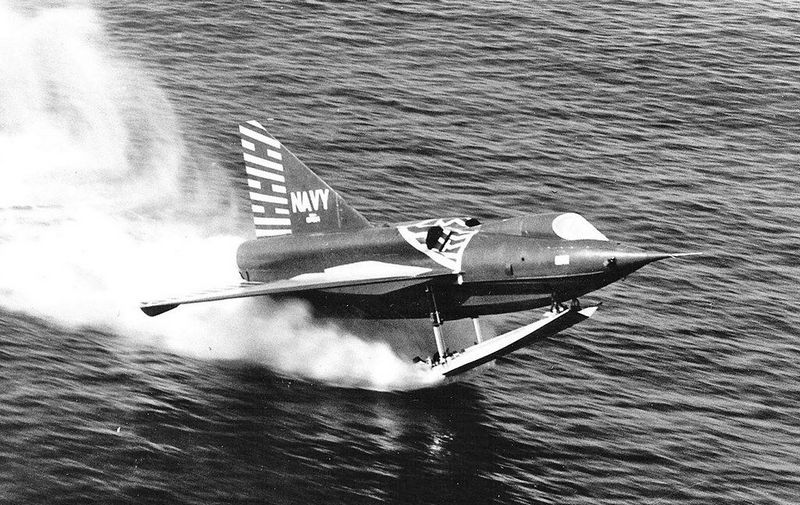
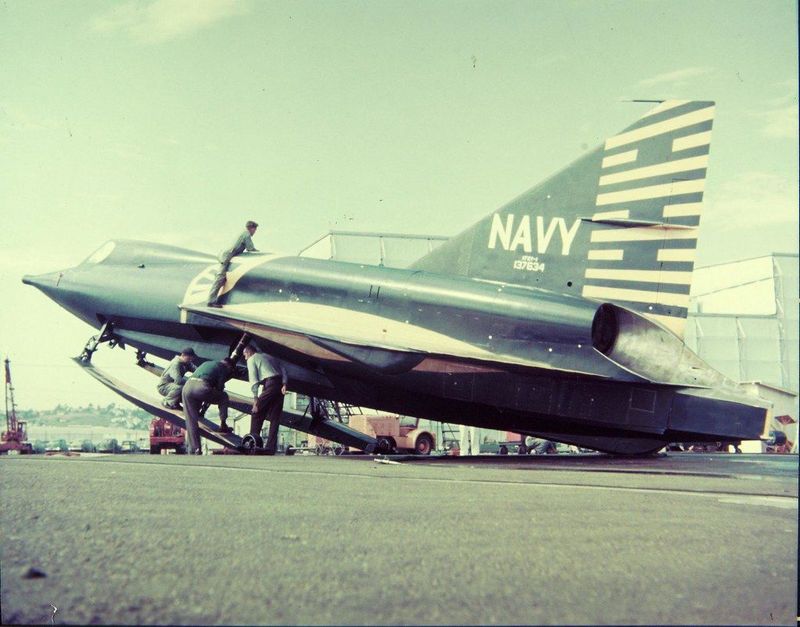
The resulting design is known as the F2Y "Sea Dart". It exploits some design qualities that make CONVAIR's upcoming 1956 Mach 1 interceptor "Delta Dagger" memorable with its sharp lines, triangular cockpit canopy and triangular tail. For water work, the bottom of the hull has a boat-like appearance and retractable skis are used for walking on the water. Power will be provided by two Westinghouse XJ46-WE-02 turbojets (6,100 pounds of thrust each) buried in the fuselage, with twin exhaust rings at the rear of the aircraft just above the waterline.
Since salt water can damage sensitive parts of the turbojet, the air intakes for each unit are placed on the back of the cockpit. The use of a delta-wing main aircraft arrangement eliminates the need for a dedicated tail.
Delays in the original Westinghouse XJ46 engines resulted in prototypes being replaced by alternate (and underperforming) Westinghouse J34-WE-32 turbojets (4,900 lb thrust each). Testing began in San Diego Bay, and it was rather coincidental that the first flight took place on January 14, 1953, when the aircraft climbed to high speed.
Since then, the program has revealed a growing number of flaws in design and performance that would lead to the demise of Sea Dart. The engine never helped the plane run as intended, and the ski arrangement was not as successful as expected (several ski arrangement variants were used). Supersonic speed proved elusive and could only be achieved in a single dive maneuver - making the Sea Dart the only seaplane in aviation history to accomplish this feat.
Resistance is an ongoing downside of this product.
All this led to the cancellation of the second contract prototype, which brought the service test airframe to the fore. This model - BuNo 135762 was lost in mid-air when it disintegrated during a flight on November 4, 1954, taking the life of the test pilot. By then, U.S.
Navy authorities had moved away from the novel seaplane fighter concept and focused more on delivering the service's first supersonic carrier fighter (which would become the Douglas F4D "Skyray").
Completed a total of five Sea Darts, but not all of them were flown. The program ended in April 1957, and the four surviving members became museum exhibits.
The completed Sea Dart is 52.6 feet long, with a wingspan of 33.7 feet and a height of 16.1 feet. The top speed is 825 mph and the range is up to 513 miles. The service cap is listed at 54,800 feet, with a reported climb rate of 17,100 feet per minute.
The fighter's proposed armament would include 4 x 20mm Colt Mk 12 series cannons and support for FFAR (Folding Tail Aviation Rocket) and early air-to-air missiles (AAM).
Specification
Basic
Production
Roles
- Fighter
- Naval/Navigation
- X-Plane / Development
Dimensions
52. 49 feet (16 m)
10.3m
16.08 ft (4.9 m)
Weight
12,632 lb (5,730 kg)
7,480 kg
Performance
Performance
823 mph (1,325 km/h; 715 knots)
54,790 ft (16,700 m; 10.38 mi)
513 miles (825 km; 445 nmi)
17,100 ft/min (5,212 m/min)
Armor
Suggested standard:
4 x 20mm Colt Mk 12 internal guns.
Suggested options:
2 x Air-to-Air Missiles (AAM).
30 x 5" air missile (unguided).
Changes
F2Y "Sea Dart" - Series name
XF2Y-1 - Serial designation of base prototype; five completed
YF-7A - Redesignated 1962 (in line with USAF reorganization).
 Argentina
 Armenia
 Australia
 Austria
 Austria-Hungary
 Belgium
 Brazil
 United Kingdom
 Brunei
 Bulgaria
 Canada
 Chile
Chile China
China Colonial America
 Colombia
 Confederate States
 Croatia
 Czech
Czech Denmark
 Egypt
Egypt Finland
 France
 Georgia
 Germany
 German Imperial
 Greece
 Holland
 Hungary
 India
India Indonesia
 Iran
Iran Iraq
Iraq Ireland
 Israel
 Italy
Italy Japan
Japan Japan (1940)
 Jordan
 Kingdom of Italy
 Malaysia
 Mexico
 Myanmar
 Nazi Germany
 Netherlands
 New Zealand
 North Korea
 Norway
 Pakistan
 Peru
Peru Philippines
 Poland
 Portugal
 Prussia
 Romania
 Russia
 Saudi Arabia
 Serbia
 Singapore
 Slovakia
 Slovenia
 South Africa
 South Korea
 Soviet Union
 Spain
Spain Sweden
 Switzerland
 Syria
Syria Taiwan
 Thailand
 Turkey
 UAE
UAE Ukraine
 Vietnam
 Yugoslavia