

History
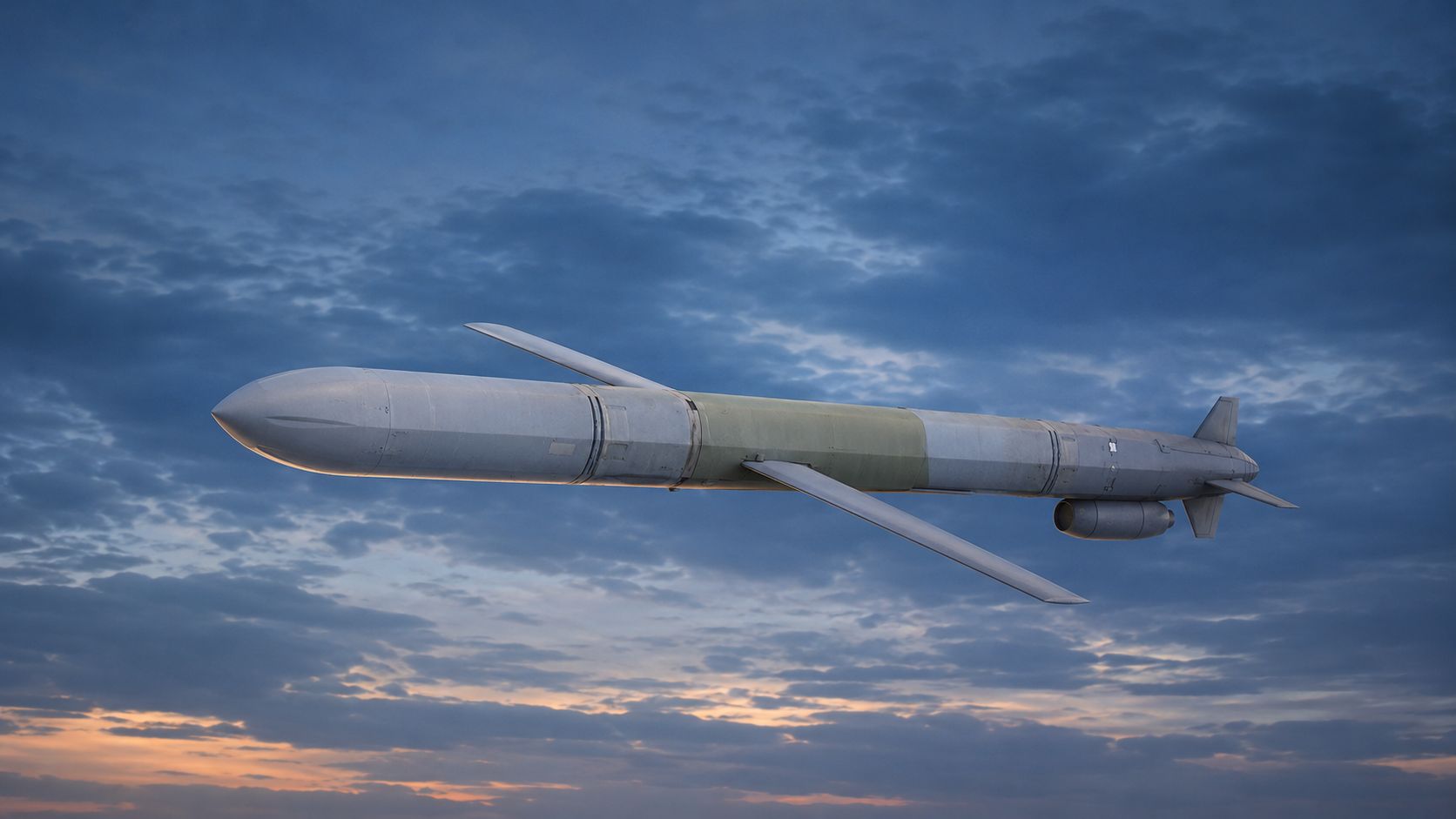
The MKB Raduga Kh-101 is a Russian long-range, air-launched cruise missile with a conventional warhead. It is designed for precision attacks against ground targets from outside the immediate reach of many air-defense systems.
The missile combines a turbofan engine, low-altitude flight, reduced radar visibility, and several navigation methods. Its principal launch aircraft are the Tupolev Tu-95MS and Tu-160 strategic bombers.
The Kh-101 entered Russian service during the 2010s. It has subsequently been used in Syria and extensively during the Russian invasion of Ukraine.
Development
Development began during the late 1980s as the Soviet Union sought a successor to the Kh-55 and Kh-555 air-launched cruise missiles. The program produced two related weapons: the conventionally armed Kh-101 and the nuclear-capable Kh-102.
Available accounts differ on the early test chronology. Some sources report initial tests in 1995, while another places the first flight in 1998 and the beginning of evaluation trials in 2000. MKB Raduga developed and manufactured the missile.
The Kh-101 reportedly achieved an initial operational capability in 2003, although sources generally identify 2012 as the year of formal entry into service. Public images of the weapon began appearing during the intervening period.
Production
Production has continued during the Russian invasion of Ukraine. After a Kh-101 fell in Poland on 30 July 2026, the District Prosecutor's Office in Lublin reported that examination of the wreckage identified it as a missile manufactured during the second quarter of 2026 at an enterprise in the Moscow region. A Ukrainian expert participated in the identification.
Design
Airframe
The Kh-101 has an aerodynamically shaped fuselage intended to generate lift and reduce radar visibility. Its wings deploy after launch. The missile is approximately 7.45 m long, with a reported launch mass between 2,200 and 2,400 kg.
Radar-absorbing materials and a low flight profile are intended to make detection and interception more difficult. Reported low-level flight altitudes range from approximately 30 to 70 m above the terrain.
Propulsion and performance
A TRDD-50A turbofan engine provides approximately 450 kgf of thrust. Reported cruise speed is about Mach 0.58, while maximum speed is approximately Mach 0.78.
Published range figures vary substantially. The Center for Strategic and International Studies gives a range of 2,500–2,800 km. Other sources report approximately 3,500 km, while higher estimates extend to 4,500–5,500 km. These differences may reflect varying assumptions or configurations, and an authoritative public figure is not available.
Guidance
The missile uses inertial navigation together with GLONASS satellite-navigation updates. It can also compare observed terrain with stored mapping data to correct its route. Sources describe an electro-optical or imaging terminal system for final guidance.
Reported accuracy varies from approximately 6 m to 20 m circular error probable. These figures are estimates rather than independently verified performance data.
Warhead
The Kh-101 carries a conventional warhead. Reported payload figures range from 400 to 450 kg. Available warhead descriptions include high-explosive, fragmentation, penetrating, and submunition configurations.
Launch platforms
The principal confirmed carriers are the Tu-95MS and Tu-160 strategic bombers. A Tu-95MS can carry Kh-101 missiles on external under-wing pylons. A Tu-160 can employ two internal rotary launchers, each holding six missiles.
Operational history
The Kh-101 made its documented combat debut in Syria in November 2015. Tu-95 and Tu-160 bombers launched the missiles against targets associated with the Islamic State. Further launches were reported during Russian operations in Syria in 2016 and 2017.
Russia has used the Kh-101 extensively during its invasion of Ukraine, including attacks against infrastructure and other fixed targets. Its long range allows carrier aircraft to release the missile far from the intended target, while its low-altitude route complicates radar detection.
During a large Russian missile and drone attack on Ukraine on 30 July 2026, a missile entered Polish airspace and fell near Tarnawa-Kolonia in eastern Poland. Polish authorities initially described the Kh-101 identification as the leading hypothesis. Subsequent examination reported by the District Prosecutor's Office in Lublin identified the wreckage as a Kh-101 produced in the second quarter of 2026. The incident prompted a Polish investigation and diplomatic action.
Variants
- Kh-101: Conventionally armed air-launched cruise missile intended for long-range precision attacks against ground targets.
- Kh-102: Related strategic variant designed to carry a nuclear warhead. It is distinct from the conventionally armed Kh-101.
Operators
- Russia: Operated by the Russian Aerospace Forces and carried principally by Tu-95MS and Tu-160 strategic bombers. The number in service is not publicly confirmed.
Specifications (Kh-101)
General characteristics
- Type: Air-launched cruise missile
- Length: 7.45 m
- Launch mass: 2,200–2,400 kg
- Propulsion: TRDD-50A turbofan
- Engine thrust: Approximately 450 kgf
- Launch platforms: Tu-95MS and Tu-160 strategic bombers
Performance
- Cruise speed: Approximately Mach 0.58
- Maximum speed: Approximately Mach 0.78
- Reported range: 2,500–2,800 km, with other published estimates ranging from approximately 3,500 to 5,500 km
- Low-level flight altitude: Approximately 30–70 m
- Reported accuracy: Approximately 6–20 m circular error probable
Guidance and armament
- Guidance: Inertial navigation, GLONASS satellite-navigation correction, terrain comparison, and reported electro-optical terminal guidance
- Warhead: Conventional high-explosive, fragmentation, penetrating, or submunition warhead
- Warhead mass: Reported as 400–450 kg
Related equipment
- Kh-55: Soviet air-launched cruise missile that preceded the Kh-101 family.
- Kh-555: Conventionally armed development of the Kh-55 and another predecessor to the Kh-101.
- Kh-102: Nuclear-capable member of the Kh-101/Kh-102 missile family.
 Argentina
 Armenia
 Australia
 Austria
 Austria-Hungary
 Belgium
 Brazil
 United Kingdom
 United States
 Brunei
 Bulgaria
 Canada
 Chile
Chile China
China Colonial America
 Colombia
 Confederate States
 Croatia
 Czech
Czech Denmark
 Egypt
Egypt Finland
 France
 Georgia
 Germany
 German Imperial
 Greece
 Holland
 Hungary
 India
India Indonesia
 Iran
Iran Iraq
Iraq Ireland
 Israel
 Italy
Italy Japan
Japan Japan (1940)
 Jordan
 Kingdom of Italy
 Malaysia
 Mexico
 Myanmar
 Nazi Germany
 Netherlands
 New Zealand
 North Korea
 Norway
 Pakistan
 Peru
Peru Philippines
 Poland
 Portugal
 Prussia
 Romania
 Saudi Arabia
 Serbia
 Singapore
 Slovakia
 Slovenia
 South Africa
 South Korea
 Soviet Union
 Spain
Spain Sweden
 Switzerland
 Syria
Syria Taiwan
 Thailand
 Turkey
 UAE
UAE Ukraine
 Vietnam
 Yugoslavia