
History
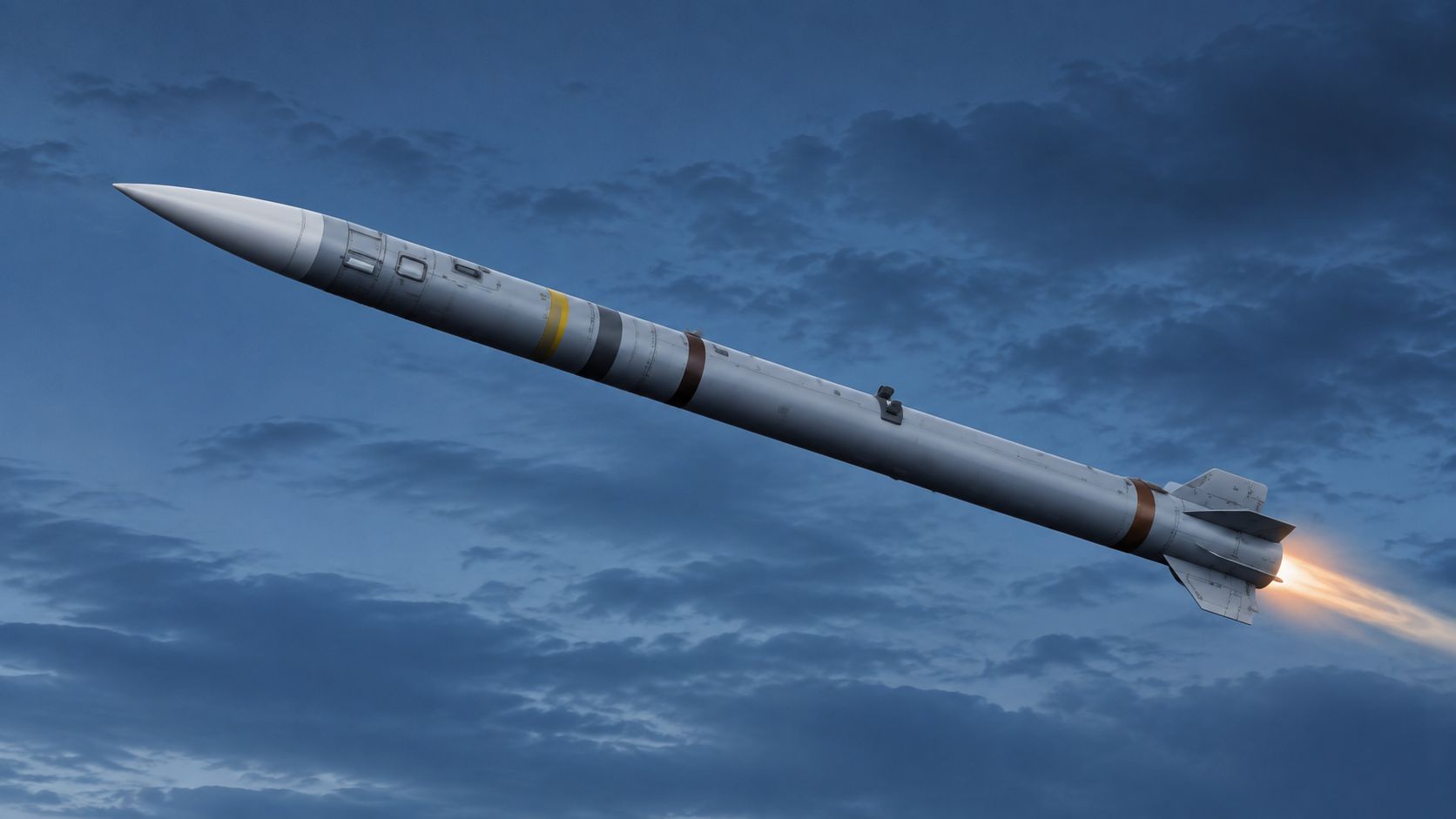
The Lockheed Martin AIM-260 Joint Advanced Tactical Missile, or JATM, is a classified American beyond-visual-range air-to-air missile. It is being developed for the United States Air Force and United States Navy to complement and eventually replace the AIM-120 AMRAAM.
The program is intended to provide greater engagement range against advanced aerial threats while retaining compatibility with modern fighter aircraft. The F-22 Raptor and F/A-18E/F Super Hornet are initial integration platforms, while integration with the F-35 Lightning II and other aircraft is planned.
Australia confirmed that it will acquire the AIM-260 through the United States Foreign Military Sales process. The Royal Australian Air Force is expected to become the first foreign user of the missile.
Development and testing
Public accounts place the beginning of the JATM program in 2017 or 2018. Lockheed Martin developed the missile in response to increasingly capable long-range air-to-air weapons, particularly China's PL-15. The designation AIM-260A was assigned in 2018.
Aerial target testing began by April 2020, and the missile reportedly made its first test flights around that time. Flight testing was described as well underway by 2022. The program has remained highly classified, and confirmed technical information is limited.
United States Air Force officials initially expected production and operational introduction during the early 2020s. Later reports indicated that integration difficulties involving fifth-generation fighters delayed initial operational capability. The missile was still described as undergoing final development and testing in 2025.
Public photographs taken on 13 May 2026 showed an F/A-18F operated by the United States Navy's VX-31 test and evaluation squadron carrying an AIM-260A during testing from Eglin Air Force Base. The images provided the first widely reported view of an apparent live missile associated with the program.
Australian procurement
In August 2026, Australian defence minister Richard Marles announced the acquisition of the AIM-260 during Exercise Pitch Black in Darwin. Australia will obtain the missile through the United States government's Foreign Military Sales process.
The Royal Australian Air Force plans to integrate the weapon first with its F/A-18F Super Hornets. The F-35A Lightning II and EA-18G Growler are expected to follow. No delivery schedule was announced with the procurement confirmation.
Design
The AIM-260 is designed for long-range engagements beyond visual range. Its external dimensions are reported to be similar to those of the AIM-120D, allowing it to use existing carriage arrangements and fit inside the internal weapon bays of stealth aircraft such as the F-22 and F-35.
Most design details remain classified. Published accounts describe an inertial mid-course guidance system, a two-way datalink and a multimode terminal seeker, but these features have not been fully disclosed by the program authorities. The propulsion system is reported to use a long-burning solid-propellant rocket motor optimized for greater range.
Secondary sources commonly estimate a range of at least 200 km (125 mi). This figure has not been officially confirmed. Publicly reported estimates of speed, seeker configuration and warhead characteristics also vary, so they should not be treated as definitive specifications. Additional background is available from Air & Space Forces Magazine and the Directory of U.S. Military Rockets and Missiles.
Program status
The AIM-260A remains associated with development, testing and initial procurement rather than confirmed operational service. The F-22 is expected to be the first United States Air Force operational platform. The United States Navy has tested the missile with the F/A-18F Super Hornet.
Planned integration includes the F-35 Lightning II and potentially unmanned Collaborative Combat Aircraft. Australia plans to field the missile on the F/A-18F, followed by the F-35A and EA-18G, but its delivery and service-entry dates have not been disclosed.
Variants
- AIM-260A: Developmental and planned operational version of the Joint Advanced Tactical Missile.
- DATM-260A: Designation assigned to a captive-carry or training configuration associated with the AIM-260A program.
- NATM-260A: Special test-missile designation associated with the program.
- JAIM-260A: Special test or instrumentation designation associated with the program.
Planned users
- United States Air Force: Developing and procuring the missile, with initial integration focused on the F-22 and later integration planned for the F-35 and potentially Collaborative Combat Aircraft.
- United States Navy: Testing and procuring the missile for use with the F/A-18E/F Super Hornet.
- Royal Australian Air Force: Confirmed foreign customer. Initial integration is planned for the F/A-18F, followed by the F-35A and EA-18G.
Specifications (AIM-260A)
General characteristics
- Type: Beyond-visual-range air-to-air guided missile
- Developer: Lockheed Martin
- Country of origin: United States
- Status: Development, testing and initial procurement
- Dimensions: Classified; reportedly similar in external form to the AIM-120D
Guidance and propulsion
- Guidance: Reported inertial mid-course guidance, two-way datalink and multimode terminal seeker
- Propulsion: Reported solid-propellant rocket motor
- Reported range: At least 200 km (125 mi); not officially confirmed
- Warhead: Reported high-explosive blast-fragmentation type; official details remain classified
Integration
- Initial United States platforms: F-22 Raptor and F/A-18E/F Super Hornet
- Planned United States platforms: F-35 Lightning II and potentially Collaborative Combat Aircraft
- Planned Australian platforms: F/A-18F Super Hornet, F-35A Lightning II and EA-18G Growler
Related equipment
- AIM-120 AMRAAM: Existing medium-range air-to-air missile that the AIM-260 is intended to complement and eventually replace.
- AIM-174B: A separate, larger United States Navy long-range air-to-air weapon derived from the SM-6 missile family.
- PL-15: Chinese long-range air-to-air missile frequently cited as an important reason for initiating the JATM program.
 Argentina
 Armenia
 Australia
 Austria
 Austria-Hungary
 Belgium
 Brazil
 United Kingdom
 Brunei
 Bulgaria
 Canada
 Chile
Chile China
China Colonial America
 Colombia
 Confederate States
 Croatia
 Czech
Czech Denmark
 Egypt
Egypt Finland
 France
 Georgia
 Germany
 German Imperial
 Greece
 Holland
 Hungary
 India
India Indonesia
 Iran
Iran Iraq
Iraq Ireland
 Israel
 Italy
Italy Japan
Japan Japan (1940)
 Jordan
 Kingdom of Italy
 Malaysia
 Mexico
 Myanmar
 Nazi Germany
 Netherlands
 New Zealand
 North Korea
 Norway
 Pakistan
 Peru
Peru Philippines
 Poland
 Portugal
 Prussia
 Romania
 Russia
 Saudi Arabia
 Serbia
 Singapore
 Slovakia
 Slovenia
 South Africa
 South Korea
 Soviet Union
 Spain
Spain Sweden
 Switzerland
 Syria
Syria Taiwan
 Thailand
 Turkey
 UAE
UAE Ukraine
 Vietnam
 Yugoslavia