
History
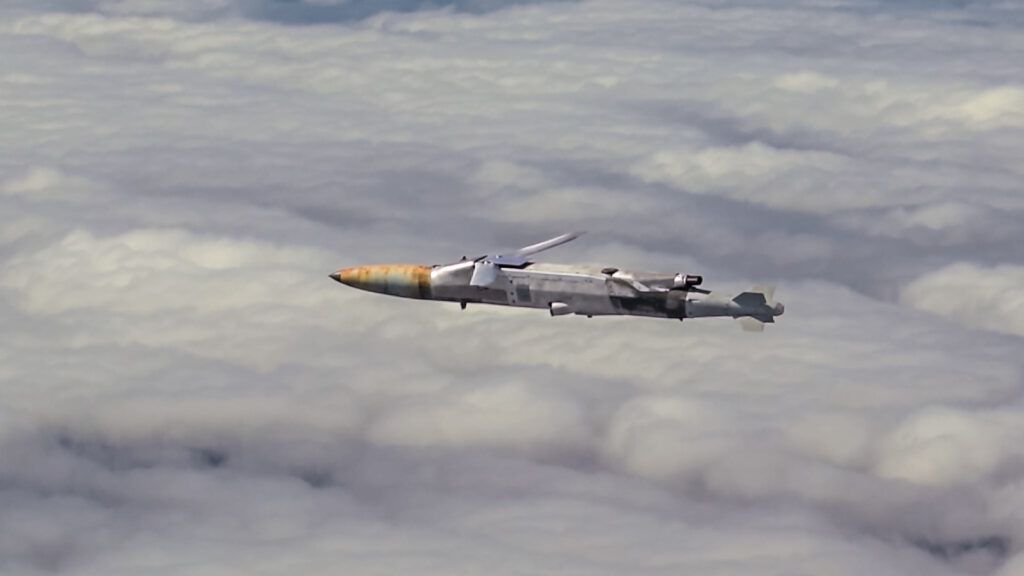
The Boeing GBU-75 Joint Direct Attack Munition Long Range, or JDAM LR, is a powered precision-guided weapon developed for long-range strikes against land and naval targets. It combines established JDAM guidance and aircraft interfaces with deployable wings and a compact turbojet engine.
The weapon is intended to engage targets from beyond the effective range of many enemy air-defence systems. Boeing also designed the system to use existing JDAM infrastructure and aircraft integration, supporting rapid fielding and production.
With a 226 kg (500 lb) payload, the GBU-75 has a stated range of more than 300 nautical miles (556 km). Its supported missions include conventional land attack, naval strike, and maritime aerial mining.
The original JDAM entered service in 1999 as a guidance and control kit that converted compatible unguided bombs into precision-guided weapons. The later JDAM Extended Range added a wing kit and increased the maximum stated range from approximately 15 nautical miles (28 km) to about 40 nautical miles (74 km). JDAM LR developed this concept further by adding powered flight.
Development and testing
Boeing invested nearly $100 million of its own funds in the JDAM LR program. The company retained the established JDAM guidance tail kit and aircraft interface while integrating a deployable wing kit supplied by Ferra Engineering and a Kratos TDI-J85 turbojet engine. A Janes program report described the weapon as an evolutionary development of JDAM ER.
The U.S. Navy conducted flight demonstrations at the Point Mugu Sea Range off California in April 2026. An F/A-18 Super Hornet released the weapon during the trials. The April 1 flight covered approximately 200 nautical miles (370 km) in 34 minutes and ended within metres of the intended target, according to Boeing. A second flight on April 3 followed a profile that included altitude changes and manoeuvres. The tests examined safe separation, controlled powered flight, navigation, guidance, and compatibility with existing aircraft systems. Further details were reported by Defense News.
Initial production contract
On 5 August 2026, the U.S. Air Force awarded Boeing a $75 million undefinitized contract action for the BSU-111/B Payload Delivery Unit, the formal procurement designation associated with JDAM LR. The award cleared initial production of payload delivery units for the U.S. Navy. Boeing described it as the first production contract for the GBU-75. The Boeing announcement also confirmed that the initial test program had demonstrated sustained powered flight and military-code GPS navigation along a predefined profile.
Design
JDAM LR retains the JDAM guidance tail kit and aircraft interface. A deployable wing kit provides aerodynamic lift, while the compact air-breathing propulsion system sustains flight after release. This arrangement gives the weapon a much longer reach than the unpowered standard and extended-range JDAM configurations.
The propulsion system uses a Kratos TDI-J85 turbojet. Boeing describes the architecture as modular and provisioned for additional equipment through open-system interfaces. An optional onboard 1.5 kW generator can support seekers, a data link, or other mission avionics, although the available sources do not identify these options as part of the initial production configuration.
The GBU-75 is designed to use the existing interface and launch-acceptability calculations of aircraft already integrated with conventional JDAM weapons. Boeing states that the weapon is compatible with existing JDAM-integrated aircraft, while the publicly documented 2026 flight tests used an F/A-18 Super Hornet.
The standard payload is in the 226 kg (500 lb) class, and the design accepts Mk 82-form-factor payloads. Boeing also lists a low-cost decoy fuel-tank configuration with substantially greater range. The manufacturer's technical summary is available in the JDAM LR product card.
Program status
As of August 2026, JDAM LR had completed its first powered flight demonstrations and received its first production contract. The U.S. Navy was continuing testing and aircraft-integration work toward operational deployment. The available sources do not confirm that the weapon had entered operational service.
The program is intended to provide a higher-volume alternative to more expensive long-range cruise missiles. Boeing stated that the use of established JDAM components, infrastructure, and aircraft interfaces would support production scaling, but no planned production quantity or unit price was disclosed.
Variants
- Baseline JDAM LR: Powered long-range precision-strike configuration carrying a payload of up to 226 kg (500 lb).
- Quickstrike Long Range: Maritime aerial-mining configuration identified in Boeing material.
- Maritime Strike: Naval-strike configuration identified in Boeing material.
- Decoy fuel-tank configuration: Low-cost decoy version with additional fuel and a stated range exceeding 700 nautical miles (1,296 km).
Specifications (GBU-75 JDAM LR)
General characteristics
- Manufacturer: Boeing
- Procurement designation: BSU-111/B Payload Delivery Unit
- Type: Powered, air-launched precision-guided munition
- Payload: Up to 226 kg (500 lb)
- Compatible payload form: Mk 82 form factor
- Propulsion: Kratos TDI-J85 compact turbojet engine
- Lift system: Deployable wing kit
- Guidance: JDAM guidance tail kit with military-code GPS navigation
- Optional electrical generation: 1.5 kW for optional seekers, data link, or other mission avionics
Performance
- Range with 226 kg payload: More than 300 nautical miles (556 km)
- Range in decoy fuel-tank configuration: More than 700 nautical miles (1,296 km)
- Demonstrated flight: Approximately 200 nautical miles (370 km) in 34 minutes during the 1 April 2026 test
Mission capabilities
- Primary roles: Long-range conventional land attack and naval strike
- Additional role: Maritime aerial mining
- Documented test aircraft: Boeing F/A-18 Super Hornet
Related equipment
- Joint Direct Attack Munition: The established unpowered guidance-kit family from which JDAM LR derives its guidance, control, and aircraft-interface architecture.
- JDAM Extended Range: Wing-equipped unpowered development that preceded the powered JDAM LR configuration.
 Argentina
 Armenia
 Australia
 Austria
 Austria-Hungary
 Belgium
 Brazil
 United Kingdom
 Brunei
 Bulgaria
 Canada
 Chile
Chile China
China Colonial America
 Colombia
 Confederate States
 Croatia
 Czech
Czech Denmark
 Egypt
Egypt Finland
 France
 Georgia
 Germany
 German Imperial
 Greece
 Holland
 Hungary
 India
India Indonesia
 Iran
Iran Iraq
Iraq Ireland
 Israel
 Italy
Italy Japan
Japan Japan (1940)
 Jordan
 Kingdom of Italy
 Malaysia
 Mexico
 Myanmar
 Nazi Germany
 Netherlands
 New Zealand
 North Korea
 Norway
 Pakistan
 Peru
Peru Philippines
 Poland
 Portugal
 Prussia
 Romania
 Russia
 Saudi Arabia
 Serbia
 Singapore
 Slovakia
 Slovenia
 South Africa
 South Korea
 Soviet Union
 Spain
Spain Sweden
 Switzerland
 Syria
Syria Taiwan
 Thailand
 Turkey
 UAE
UAE Ukraine
 Vietnam
 Yugoslavia