
History
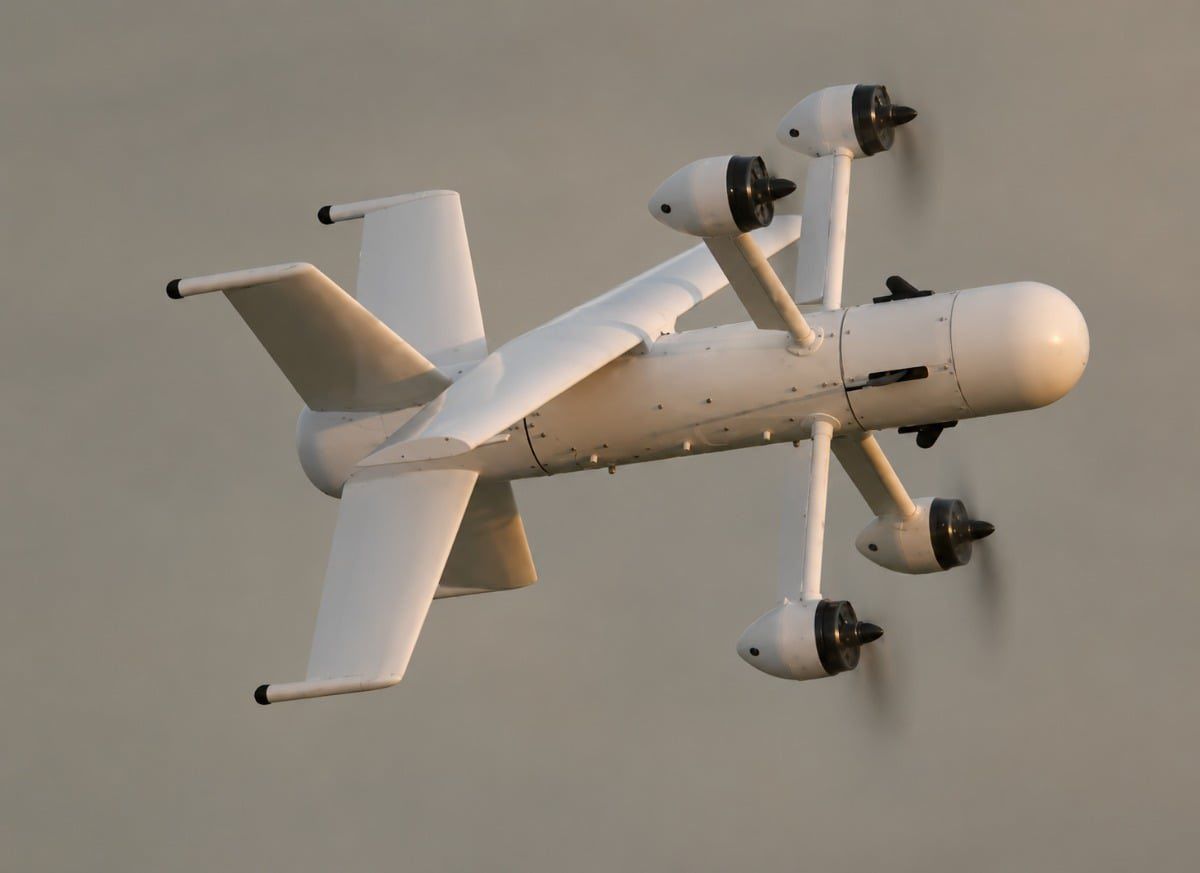
The Lockheed Martin MORFIUS X-Rotor is a ground-launched, recoverable unmanned aircraft designed to counter groups of hostile drones. It carries a high-power microwave payload intended to disrupt or disable electronic systems aboard multiple targets during one flight.
Lockheed Martin describes the system as a one-to-many counter-unmanned aircraft system. The company claims that one X-Rotor can neutralize more than 50 drones per flight, although this figure has not been published as an independently verified test result.
The X-Rotor was publicly unveiled at the Farnborough International Airshow in July 2026. At that time, prototype production and flight testing were continuing, and the system had not been identified as operational.
Earlier MORFIUS development
MORFIUS stands for Mobile Radio Frequency-Integrated UAS Suppressor. Earlier versions reportedly used a tube-launched, fixed-wing aircraft based on the ALTIUS-600 platform. These versions were developed to carry a high-power microwave effector close to an approaching drone before activating it.
Lockheed Martin states that earlier MORFIUS variants had been flying since 2017. The X-Rotor uses the same general family of microwave effectors developed for those preceding systems. According to the company, this earlier work demonstrated effects against difficult targets while limiting collateral damage.
The program addressed a central limitation of directed-energy systems: microwave energy becomes less effective as distance increases. Placing the effector aboard an unmanned aircraft allows it to approach a drone formation instead of requiring a fixed emitter to act entirely from the defended position.
Testing and unveiling
Before its public introduction, MORFIUS underwent flight, interception and lethality-related testing in Arizona, California and Oklahoma. Lockheed Martin did not publish detailed test configurations, engagement ranges or the number and types of targets used in these trials.
On 20 July 2026, Lockheed Martin formally introduced the MORFIUS X-Rotor at Farnborough. The company's official announcement presented it as a reusable alternative to expendable counter-drone interceptors. Contemporary reports from Aviation Week and Defense News confirmed that prototype testing and development remained underway.
Lockheed Martin announced that it was accelerating production of both the X-Rotor prototypes and their microwave payloads. Additional flight tests were planned after the 2026 unveiling. The company associated the project with United States efforts to obtain rapidly deployable and affordable counter-UAS systems.
Design
Air vehicle
The X-Rotor is an unmanned rotary-wing air vehicle with an X-shaped rotor arrangement. It launches from the ground and is designed to be recovered in the field after an engagement. Recovery and reuse are intended to reduce the cost of repeated defense against inexpensive hostile drones.
The disclosed design differs from the tube-launched, fixed-wing configuration associated with earlier MORFIUS variants. Public sources do not provide the X-Rotor's dimensions, mass, propulsion system, speed, endurance, operating altitude or engagement range.
High-power microwave payload
The aircraft carries a lightweight high-power microwave effector. Rather than launching a projectile at each target, this payload directs radio-frequency energy toward a volume containing hostile drones. The energy is intended to interfere with vulnerable electronic components such as flight-control hardware, receivers and motor controllers.
This approach is designed for one-to-many engagements. A conventional interceptor normally attacks one target, while an airborne microwave effector may affect several drones located within its effective area. Lockheed Martin claims a capacity of more than 50 neutralized drones in one flight. The company has not disclosed the conditions under which this figure was established.
The effect does not require the target to be destroyed by an explosive warhead. Disabling essential electronics may instead cause the aircraft to lose control or cease functioning. Actual results depend on factors including distance, exposure, orientation and the electromagnetic protection of each target, but Lockheed Martin has not published performance values for these factors.
Sensors and command integration
MORFIUS X-Rotor is described as sensor-agnostic and command-and-control-agnostic. It can therefore be integrated with different external sensor and command networks rather than requiring a dedicated detection system.
Lockheed Martin also states that the X-Rotor does not depend on a dedicated fire-control radar or a unique sensor for command guidance during an engagement. The aircraft must still receive sufficient target and mission information from the wider defense system, but the architecture is intended to let users employ sensors and command systems already available at a defended site.
Program status
As of its July 2026 unveiling, MORFIUS X-Rotor was a prototype system under active development. Lockheed Martin was increasing prototype production and preparing further flight tests. No production contract, unit price, operational deployment, service-entry date or confirmed operator had been announced in the supplied sources.
The system is intended to reduce reliance on expensive, expendable interceptors when defending against large numbers of comparatively inexpensive drones. Reusability and the ability to engage multiple targets are central to this objective. The claimed cost advantage has not been quantified publicly.
Variants
- Earlier MORFIUS variants: Predecessor airborne high-power microwave demonstrators that Lockheed Martin says have flown since 2017. Secondary reporting associates the original configuration with a tube-launched, fixed-wing ALTIUS-600 air vehicle.
- MORFIUS X-Rotor: Ground-launched rotary-wing prototype designed for field recovery and reuse. It carries a high-power microwave payload and is claimed to neutralize more than 50 drones during one flight.
Specifications (MORFIUS X-Rotor)
General characteristics
- Type: Recoverable airborne high-power microwave counter-UAS system
- Manufacturer: Lockheed Martin
- Configuration: Unmanned X-rotor aircraft
- Launch method: Ground-launched
- Recovery: Designed for field recovery and reuse
- Development status: Prototype testing and accelerated prototype production announced in 2026
Mission equipment
- Effector: Lightweight high-power microwave payload
- Primary role: Countering groups of hostile unmanned aircraft
- Claimed engagement capacity: More than 50 drones per flight under unspecified conditions
- Sensor integration: Designed to operate with different external sensor systems
- Command integration: Compatible with different command-and-control systems
- Fire-control radar: No dedicated fire-control radar required according to Lockheed Martin
 Argentina
 Armenia
 Australia
 Austria
 Austria-Hungary
 Belgium
 Brazil
 United Kingdom
 Brunei
 Bulgaria
 Canada
 Chile
Chile China
China Colonial America
 Colombia
 Confederate States
 Croatia
 Czech
Czech Denmark
 Egypt
Egypt Finland
 France
 Georgia
 Germany
 German Imperial
 Greece
 Holland
 Hungary
 India
India Indonesia
 Iran
Iran Iraq
Iraq Ireland
 Israel
 Italy
Italy Japan
Japan Japan (1940)
 Jordan
 Kingdom of Italy
 Malaysia
 Mexico
 Myanmar
 Nazi Germany
 Netherlands
 New Zealand
 North Korea
 Norway
 Pakistan
 Peru
Peru Philippines
 Poland
 Portugal
 Prussia
 Romania
 Russia
 Saudi Arabia
 Serbia
 Singapore
 Slovakia
 Slovenia
 South Africa
 South Korea
 Soviet Union
 Spain
Spain Sweden
 Switzerland
 Syria
Syria Taiwan
 Thailand
 Turkey
 UAE
UAE Ukraine
 Vietnam
 Yugoslavia