
History
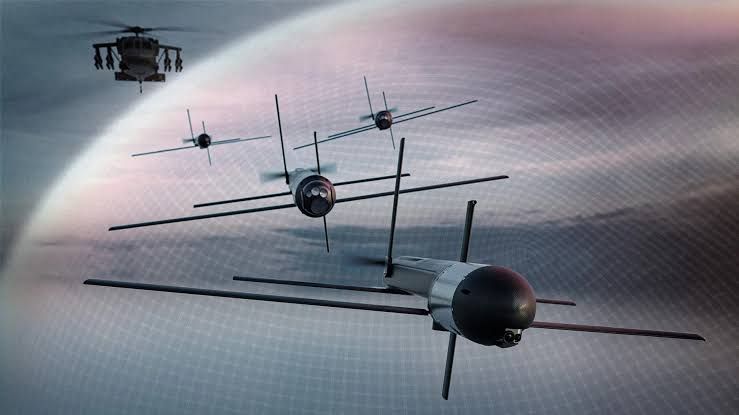
The AeroVironment Mayhem 10 is a modular launched-effects unmanned aerial vehicle designed for intelligence, surveillance and reconnaissance, electronic warfare, communications relay, deception, and precision-strike missions. Its interchangeable payload section allows the mission equipment to change without replacing the air vehicle.
Mayhem 10 is intended for launch from air, ground, and maritime platforms. AeroVironment designed it to operate individually or as part of a collaborating group under operator supervision, including in environments affected by navigation and communications interference.
The aircraft is the first member of a new AeroVironment product line derived from experience with the Switchblade family. It is being offered for the United States Army's Launched Effects program.
Development
AeroVironment unveiled Mayhem 10 in April 2026. The company described the system as an answer to requirements for adaptable and comparatively expendable aircraft that can perform several tasks during contested operations.
The design uses a Modular Open Systems Approach. A published interface is intended to permit third-party payload and software integration without redesigning the complete aircraft. AeroVironment stated that this architecture would also allow capabilities to be updated after deployment.
In May 2026, AeroVironment said it was targeting low-rate initial production by autumn 2026. The company also planned to establish capacity for hundreds of aircraft per month during the first half of 2027. These were production objectives rather than confirmed deliveries. The manufacturer's development rationale and schedule were described in its Mayhem 10 program overview.
Collaborative-autonomy integration
On 29 July 2026, AeroVironment and Applied Intuition announced a strategic teaming agreement. Applied Intuition's Acuity ISR/Strike software was selected for integration with Mayhem 10 to support collaborative hunter-killer and swarm behavior.
The software is intended to let several aircraft share targeting information, assign or change roles, and adapt their actions as threats change. A single operator supervises the group instead of directly controlling every aircraft throughout the mission.
The companies reported that several Mayhem 10 systems had completed a demonstration after months of integration work at multiple locations. During the event, the aircraft synchronized their actions, operated collaboratively, and adapted to different simulated threats. The location and date of the demonstration were not disclosed. Details of the agreement and demonstration appear in the official collaboration announcement.
Design
Air vehicle and modular payload
Mayhem 10 is a Group 2 unmanned aircraft built around a removable forward payload section. The same air vehicle can accept electro-optical and infrared sensors, electronic-warfare equipment, communications relays, decoys, or lethal payloads. This arrangement permits different aircraft within one group to perform sensing, deception, relay, and strike tasks.
The air vehicle reportedly weighs approximately 13.2 kg (29 lb), while the complete round weighs approximately 19.1 kg (42 lb). Its mission-payload capacity is 4.5 kg (10 lb). Crews can prepare and launch the system in less than five minutes, according to AeroVironment.
Navigation, communications, and control
The system uses onboard processing and AI-enabled autonomy for functions that include target recognition and coordinated multi-aircraft operation. AeroVironment states that alternative navigation methods supplement satellite navigation when GPS is degraded or denied.
A secure mobile ad hoc mesh network allows participating aircraft to exchange information. The design is intended to resist jamming and spoofing and to continue operating with degraded communications, although published operational testing has not independently verified every performance claim.
Mayhem 10 is compatible with AeroVironment's Tomahawk Grip controller and AV_Halo COMMAND software. Reported interfaces include STANAG 4586, RAS-A, and Cursor-on-Target integration with TAK and ATAK systems.
Launch methods
AeroVironment promotes Mayhem 10 for air, ground, and maritime employment. Proposed air-launch platforms include Black Hawk and Apache helicopters and future FLRAA aircraft. The system can also use fixed or vehicle-mounted ground launchers. Maritime concepts include launch from surface vessels and submarines.
Mission equipment
The modular payload bay can carry non-lethal or lethal mission equipment. Supported roles include electro-optical and infrared surveillance, electronic attack or support, communications relay, decoy and deception missions, and precision strike. The open interface is intended to accept payloads and autonomy software supplied by other companies.
Program status
As of July 2026, Mayhem 10 was a newly unveiled system undergoing integration and demonstration work. AeroVironment and Applied Intuition had demonstrated collaborative behavior with multiple aircraft, but the available sources did not identify a military operator, production contract, operational deployment, or combat use.
The collaboration supports the United States Army's Launched Effects requirements and is intended to scale across short-, medium-, and long-range categories. This positioning does not by itself constitute an Army procurement decision.
Specifications (Mayhem 10)
General characteristics
- Classification: Group 2 launched-effects unmanned aerial vehicle
- Air-vehicle weight: approximately 13.2 kg (29 lb)
- Complete-round weight: approximately 19.1 kg (42 lb)
- Payload capacity: 4.5 kg (10 lb)
- Assembly and launch preparation: less than five minutes
Performance
- Range: more than 100 km (62 mi)
- Endurance: more than 50 minutes
- Cruise speed: approximately 129 km/h (80 mph)
- Maximum dash speed: more than 193 km/h (120 mph)
- Nominal operating altitude: approximately 198 m (650 ft) above ground level
- Service ceiling: approximately 4,572 m (15,000 ft)
Payload options
- Surveillance: electro-optical and infrared sensor packages
- Electronic warfare: modular electronic-warfare payloads
- Communications: communications-relay equipment
- Deception: decoy and deception payloads
- Strike: modular lethal payloads for precision engagement
 Argentina
 Armenia
 Australia
 Austria
 Austria-Hungary
 Belgium
 Brazil
 United Kingdom
 Brunei
 Bulgaria
 Canada
 Chile
Chile China
China Colonial America
 Colombia
 Confederate States
 Croatia
 Czech
Czech Denmark
 Egypt
Egypt Finland
 France
 Georgia
 Germany
 German Imperial
 Greece
 Holland
 Hungary
 India
India Indonesia
 Iran
Iran Iraq
Iraq Ireland
 Israel
 Italy
Italy Japan
Japan Japan (1940)
 Jordan
 Kingdom of Italy
 Malaysia
 Mexico
 Myanmar
 Nazi Germany
 Netherlands
 New Zealand
 North Korea
 Norway
 Pakistan
 Peru
Peru Philippines
 Poland
 Portugal
 Prussia
 Romania
 Russia
 Saudi Arabia
 Serbia
 Singapore
 Slovakia
 Slovenia
 South Africa
 South Korea
 Soviet Union
 Spain
Spain Sweden
 Switzerland
 Syria
Syria Taiwan
 Thailand
 Turkey
 UAE
UAE Ukraine
 Vietnam
 Yugoslavia