
History
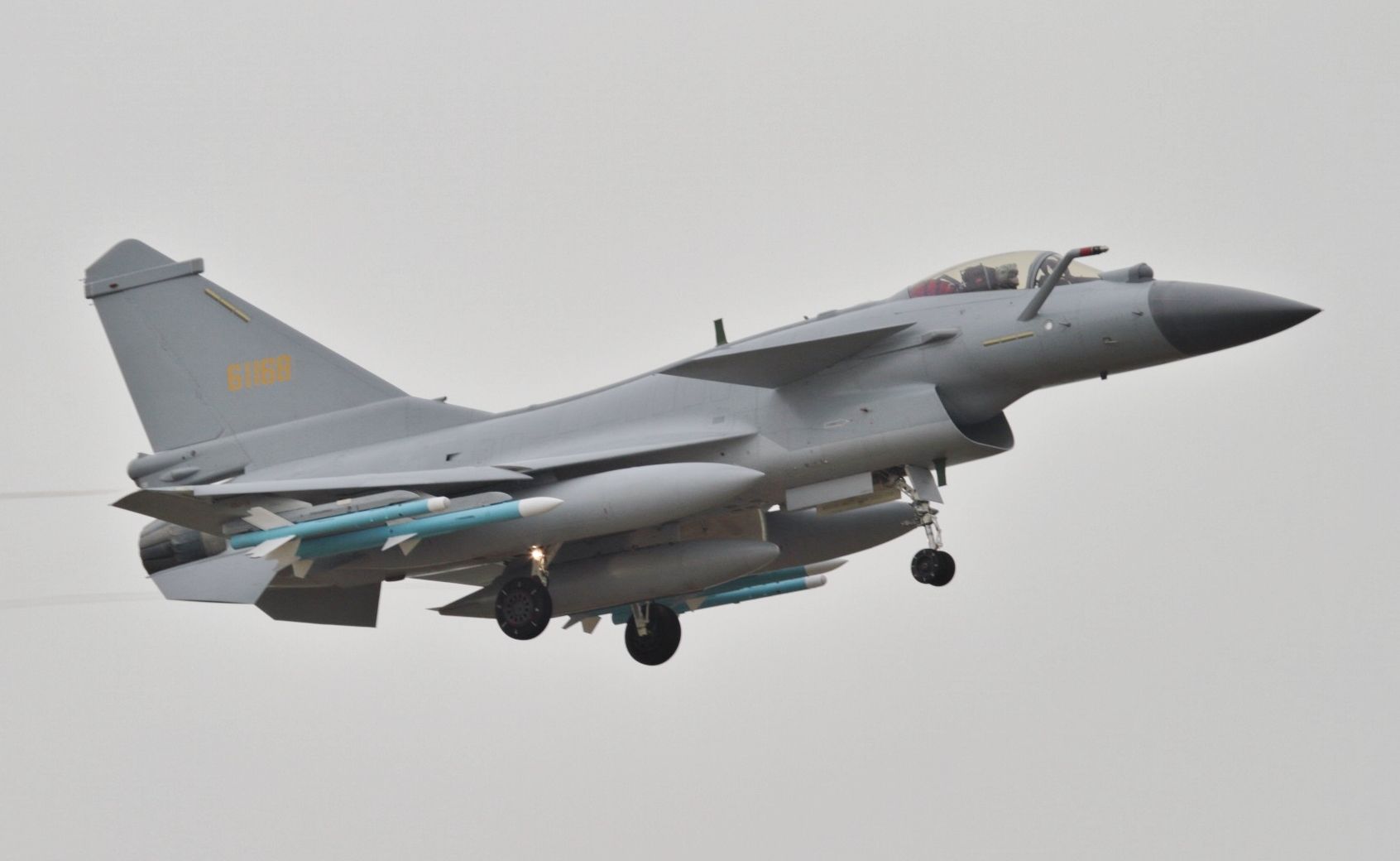
The Chengdu J-10C is a Chinese single-engine multirole fighter developed from the J-10 family. It combines a canard-delta airframe with digital fly-by-wire controls, a reported active electronically scanned array radar, and modern air-to-air weapons.
The J-10C entered Chinese service as the principal advanced production variant of the J-10. Its export derivative, the J-10CE, was subsequently supplied to Pakistan. Deliveries to Uzbekistan were reported in August 2026, but the contract and delivery status had not been independently confirmed.
Development of the original J-10 began under Project 10 during the 1980s. The program was led by the Chengdu Aircraft Design Institute, also known as Institute 611, with Song Wencong serving as chief designer. The first J-10 prototype flew on 23 March 1998, and the initial J-10A entered service with the People's Liberation Army Air Force during the mid-2000s.
The improved J-10B introduced a diverterless supersonic inlet, revised sensors, and an infrared search-and-track system. The J-10C developed this configuration further with increased use of composite materials, radar-absorbing treatments, an improved electronic architecture, and a reported AESA radar.
Open-source chronology for the exact variant is incomplete. A published J-10C comparison dates its first flight to 2013. More detailed J-10 histories generally identify 2018 as the year in which the J-10C became combat-ready. Later production aircraft appeared with the Chinese WS-10B engine around 2021, reducing reliance on Russian AL-31FN-series engines.
Pakistan received its first J-10CE fighters in March 2022 and became the first confirmed foreign operator. During fighting between Pakistan and India in May 2025, Pakistan claimed that J-10CE aircraft armed with PL-15-series missiles shot down several Indian aircraft. The specific number of losses and the precise role of the J-10CE remain disputed and have not been conclusively verified by a neutral authority.
In August 2026, Military Watch Magazine reported that Uzbekistan had received its first J-10C fighters after training pilots and maintenance personnel in China. Reports referred to a possible order for 24 aircraft, but the publication described the contract and delivery details as difficult to verify.
Design
Airframe and flight controls
The J-10C has a tailless delta wing, movable canard foreplanes, a single vertical stabilizer, and one engine. Its relaxed-stability aerodynamic configuration improves control response but requires a digital fly-by-wire system to keep the aircraft stable. The flight-control computers continuously adjust the control surfaces while translating the pilot's commands into aircraft movement.
The airframe uses aluminum-lithium alloys, titanium, and carbon-fiber composite materials. Published accounts state that the J-10C also incorporates radar-absorbing treatments intended to reduce its radar signature. These measures do not make it a stealth aircraft.
Published dimensions and weights vary between sources. The more detailed figures reported by Militarnyi give a length of 16.43 m, a wingspan of 9.75 m, a height of 5.43 m, and a maximum takeoff weight of 19,277 kg. Other references provide rounded or slightly different values, so these figures should be treated as open-source estimates rather than manufacturer-verified data.
Powerplant
J-10 production initially depended on the Russian Saturn AL-31FN afterburning turbofan. Later J-10C aircraft appeared with the domestically produced Shenyang WS-10B Taihang. Published afterburning-thrust estimates for the WS-10B generally fall near 142 to 145 kN, although engine installations and reported figures vary by production period.
Avionics
The J-10C reportedly carries a multifunction AESA radar. An AESA radar uses numerous independently controlled transmitter and receiver modules to steer its beam electronically. This supports air-target tracking, ground mapping, and electronic-warfare functions without mechanically turning the antenna.
The aircraft is also associated with an infrared search-and-track sensor, helmet-mounted cueing, secure data links, and an integrated electronic-warfare suite. Exact radar ranges, module counts, and electronic-warfare performance remain uncertain in public sources.
Armament
The J-10C has an internal 23 mm cannon and 11 external hardpoints. Its air-to-air armament includes the short-range infrared-guided PL-10 and the active-radar-guided PL-15 for beyond-visual-range engagements. Other reported weapons include PL-12 air-to-air missiles, KD-series air-to-surface missiles, YJ-91 anti-radiation missiles, anti-ship missiles, and guided or unguided bombs.
Published maximum external payload figures range from approximately 6,000 to 7,000 kg. Operational loads depend on the mission, fuel requirements, pylons, external tanks, and required flight performance.
Operational history
The People's Liberation Army Air Force operates the domestic J-10C. Pakistan operates the closely related J-10CE export version, which entered its inventory in 2022.
The May 2025 India-Pakistan fighting produced the first widely reported combat claims involving the J-10CE. Pakistan attributed several Indian aircraft losses to J-10CE fighters and PL-15-series missiles. Available reporting does not conclusively establish the number and types of aircraft lost or which Pakistani platform launched each weapon. The claims must therefore be treated as disputed rather than as a confirmed combat tally.
Uzbekistan was reported as a new recipient in 2026. Because neither the precise contract nor individual deliveries had been independently verified in the supplied reporting, Uzbekistan is best described as a reported recipient rather than a confirmed operator.
Variants
- J-10A: Initial single-seat production fighter with a mechanically scanned pulse-Doppler radar.
- J-10S: Two-seat training and combat-capable member of the J-10 family.
- J-10B: Improved version with a diverterless supersonic inlet, revised radar installation, and infrared search-and-track sensor.
- J-10C: Advanced domestic production variant with a reported AESA radar, revised avionics, composite materials, radar-signature reduction measures, and integration of PL-10 and PL-15 missiles.
- J-10CE: Export derivative of the J-10C supplied to Pakistan.
Operators
- China: The People's Liberation Army Air Force operates the domestic J-10C.
- Pakistan: The Pakistan Air Force has operated the J-10CE export variant since 2022.
- Uzbekistan: Receipt of the first aircraft was reported in August 2026, but the order quantity and delivery status remained unconfirmed.
Specifications (J-10C)
Publicly available J-10C specifications are estimates. Sources disagree on several dimensions, weights, and performance values. The ranges below reflect the supplied references, including a separate J-10CE specification profile and a broader J-10 family history.
General characteristics
- Crew: 1
- Length: approximately 16.4-16.9 m
- Wingspan: approximately 9.75-9.8 m
- Height: approximately 5.43-5.7 m
- Empty weight: approximately 8,840-9,750 kg
- Maximum takeoff weight: approximately 19,000-19,277 kg
- External hardpoints: 11
- Maximum reported payload: approximately 6,000-7,000 kg
- Powerplant: 1 afterburning turbofan; later production aircraft use the WS-10B
Performance
- Maximum speed: published estimates range from Mach 1.8 to Mach 2.2 at altitude
- Service ceiling: approximately 18,000 m
- Combat radius: mission-dependent; published estimates vary substantially
- Ferry range: approximately 2,900 km with external fuel tanks in one published estimate
- Load limits: reported as +9 g to -3 g
Armament and sensors
- Gun: 1 internal 23 mm twin-barrel cannon
- Short-range air-to-air missiles: PL-8 and PL-10
- Beyond-visual-range air-to-air missiles: PL-12 and PL-15
- Air-to-surface weapons: reported compatibility with KD-series missiles, YJ-91 anti-radiation missiles, anti-ship missiles, and guided or unguided bombs
- Radar: reported multifunction AESA radar
- Other sensors: infrared search-and-track system and targeting pods
 Argentina
 Armenia
 Australia
 Austria
 Austria-Hungary
 Belgium
 Brazil
 United Kingdom
 United States
 Brunei
 Bulgaria
 Canada
 Chile
Chile Colonial America
 Colombia
 Confederate States
 Croatia
 Czech
Czech Denmark
 Egypt
Egypt Finland
 France
 Georgia
 Germany
 German Imperial
 Greece
 Holland
 Hungary
 India
India Indonesia
 Iran
Iran Iraq
Iraq Ireland
 Israel
 Italy
Italy Japan
Japan Japan (1940)
 Jordan
 Kingdom of Italy
 Malaysia
 Mexico
 Myanmar
 Nazi Germany
 Netherlands
 New Zealand
 North Korea
 Norway
 Pakistan
 Peru
Peru Philippines
 Poland
 Portugal
 Prussia
 Romania
 Russia
 Saudi Arabia
 Serbia
 Singapore
 Slovakia
 Slovenia
 South Africa
 South Korea
 Soviet Union
 Spain
Spain Sweden
 Switzerland
 Syria
Syria Taiwan
 Thailand
 Turkey
 UAE
UAE Ukraine
 Vietnam
 Yugoslavia