
History
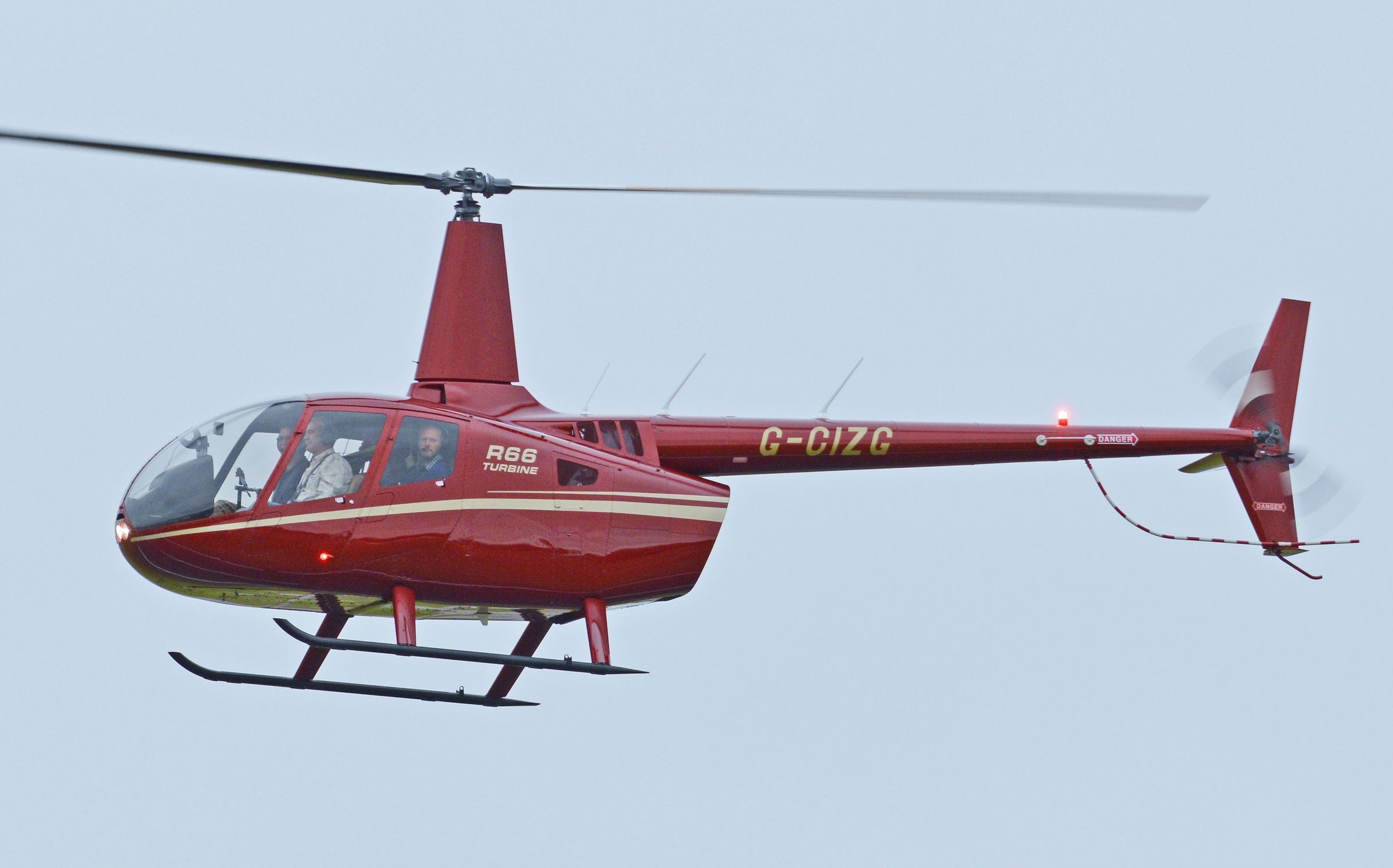
The Robinson R66 Turbine is a five-seat light helicopter developed and manufactured in the United States by Robinson Helicopter Company. It was created as a turbine-powered extension of the company's R44 family for passenger transport, training, utility work, law enforcement, and other civil and government missions.
Development
Robinson announced the R66 in 2007 as its first turbine-powered helicopter. The design retained the general rotor system, control arrangement, and economical operating philosophy of the piston-powered R44 while adding a larger cabin, a separate baggage compartment, and a Rolls-Royce RR300 turboshaft engine.
The prototype made its first flight on 7 November 2007. Development included flight testing, engine integration, structural verification, and certification work. The US Federal Aviation Administration issued type and production certificates on 25 October 2010.
Production
Preliminary production began in 2010, followed by full-rate manufacture in 2011. The R66 became widely used by private operators, flight schools, charter companies, police agencies, and utility organizations. Robinson reported delivery of the 1,500th aircraft in 2024.
US Army training selection
In August 2026, the US Army selected a contractor team led by M1 Support Services for its Flight School Next program. The team's proposal uses the R66 as the principal aircraft for entry-level rotary-wing training at Fort Rucker, Alabama.
The planned model is contractor-owned and contractor-operated. M1 is responsible for aircraft, maintenance, simulators, academic teaching, flight instruction, and related support. The program is intended to train between 800 and 1,500 Army helicopter pilots per year. Selection for the program does not convert the commercial R66 into an armed combat helicopter.
Design
The R66 is a conventional light helicopter with a two-blade main rotor, a two-blade tail rotor, skid landing gear, and a single turboshaft engine. Its five-seat cabin places the pilot and one passenger in front and three passengers across the rear bench.
Airframe
The structure uses metal construction with composite materials in selected components. A separate baggage compartment provides more cargo space than the smaller R44. The helicopter's compact size and mechanically straightforward design support operation from small landing sites and simplify training and maintenance.
Rotor and controls
A two-blade teetering main rotor follows the configuration used on other Robinson helicopters. Conventional cyclic, collective, and anti-torque controls are installed. The similar handling philosophy helps pilots and organizations transition between the R44 and R66 while accounting for the performance and procedures of the turbine engine.
Powerplant
The helicopter uses one Rolls-Royce RR300 turboshaft. The engine was developed for the light-helicopter market and provides the R66 with turbine reliability and performance in a comparatively small airframe. Power is transmitted to the main and tail rotors through the helicopter's drive system.
Avionics
Production aircraft can be equipped with modern Garmin digital avionics, navigation equipment, and displays. Exact cockpit configuration varies by production year, customer, and mission. Police and special-mission installations can add electro-optical sensors, searchlights, communications equipment, and external loudspeakers.
Operational history
R66 helicopters operate internationally in private transport, tourism, training, patrol, aerial observation, and utility roles. The type's commercial availability and operating economics made it attractive for high-volume training.
Under Flight School Next, the US Army plans to use contractor-provided R66 helicopters for foundational pilot instruction. Students will later transition to Army operational aircraft. The long potential contract duration reflects the training service framework and does not establish the number of aircraft or guarantee operation for the entire maximum period.
Variants
- R66 Turbine — standard five-seat light utility and passenger helicopter.
- R66 Police — law-enforcement configuration with mission equipment such as an electro-optical sensor, searchlight, and public-address system.
- R66 Flight School Next trainer — planned contractor-operated training configuration for US Army initial rotary-wing instruction.
Operators
- United States — numerous civil and government operators; selected for contractor-operated US Army Flight School Next training.
- International operators — used by private, commercial, training, and public-service organizations in multiple countries.
Specifications (R66 Turbine)
General characteristics
- Crew: one pilot
- Capacity: four passengers
- Length: approximately 11.66 m including rotors
- Main rotor diameter: approximately 10.06 m
- Height: approximately 3.48 m
- Empty weight: approximately 581 kg
- Maximum takeoff weight: approximately 1,225 kg
- Powerplant: one Rolls-Royce RR300 turboshaft
Performance
- Maximum speed: approximately 259 km/h
- Cruise speed: approximately 204 km/h
- Range: approximately 650 km under published standard conditions
- Service ceiling: approximately 4,270 m
Related equipment
- Robinson R44 — piston-powered helicopter from which the R66's general configuration was developed.
- Bell 505 Jet Ranger X — light turbine helicopter offered by a competing team for the US Army training program.
 Argentina
 Armenia
 Australia
 Austria
 Austria-Hungary
 Belgium
 Brazil
 United Kingdom
 Brunei
 Bulgaria
 Canada
 Chile
Chile China
China Colonial America
 Colombia
 Confederate States
 Croatia
 Czech
Czech Denmark
 Egypt
Egypt Finland
 France
 Georgia
 Germany
 German Imperial
 Greece
 Holland
 Hungary
 India
India Indonesia
 Iran
Iran Iraq
Iraq Ireland
 Israel
 Italy
Italy Japan
Japan Japan (1940)
 Jordan
 Kingdom of Italy
 Malaysia
 Mexico
 Myanmar
 Nazi Germany
 Netherlands
 New Zealand
 North Korea
 Norway
 Pakistan
 Peru
Peru Philippines
 Poland
 Portugal
 Prussia
 Romania
 Russia
 Saudi Arabia
 Serbia
 Singapore
 Slovakia
 Slovenia
 South Africa
 South Korea
 Soviet Union
 Spain
Spain Sweden
 Switzerland
 Syria
Syria Taiwan
 Thailand
 Turkey
 UAE
UAE Ukraine
 Vietnam
 Yugoslavia