
History
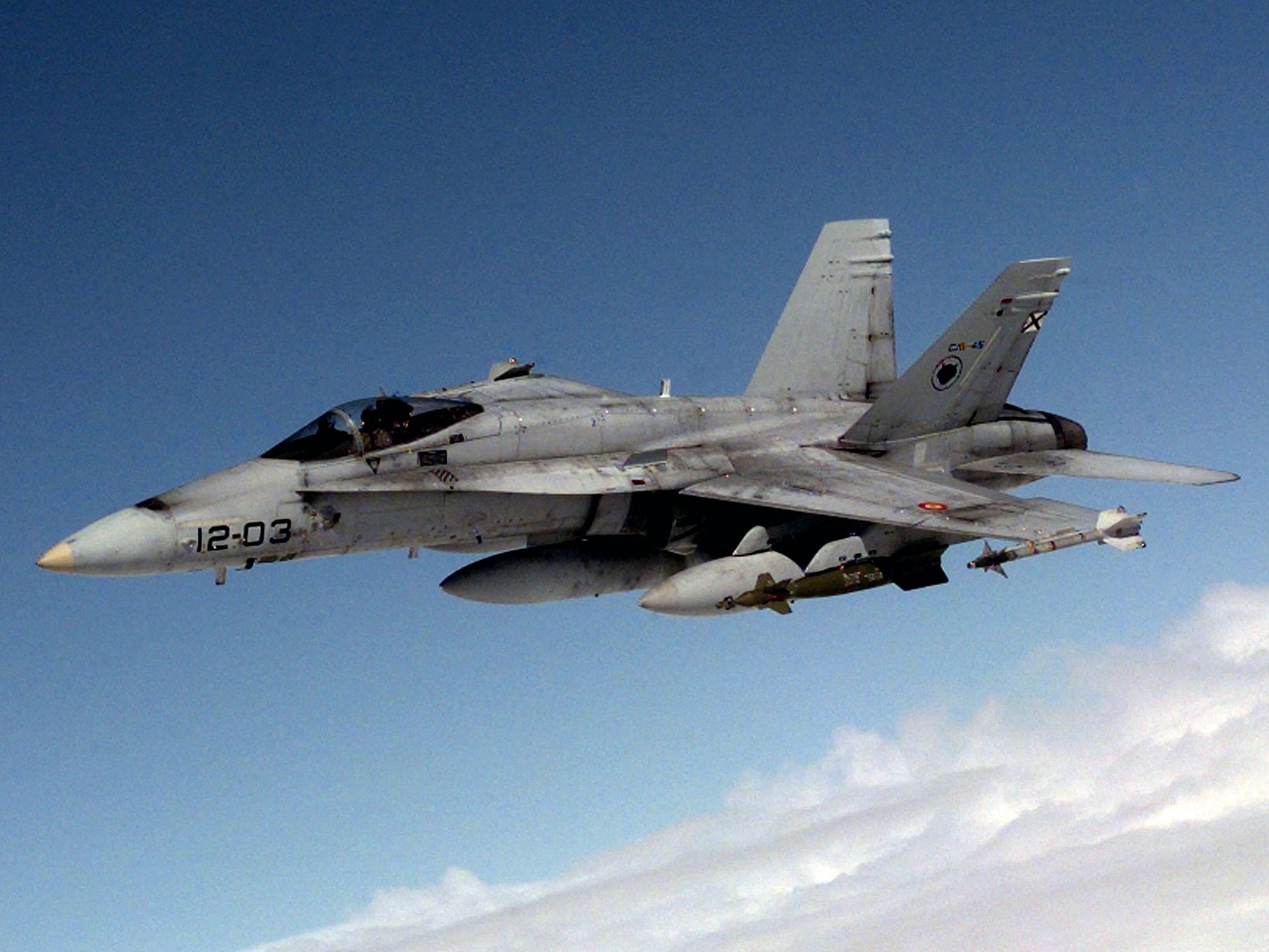
The EF-18 Hornet is the Spanish Air and Space Force version of the McDonnell Douglas F/A-18A and F/A-18B multirole fighter. Spain designates the single-seat aircraft C.15 and the two-seat trainer CE.15. The informal EF-18 name uses the letter E for España and does not indicate an electronic-warfare variant.
Selection
Spain sought a modern fighter to replace F-4C Phantom II, F-5 Freedom Fighter, and Mirage aircraft. The Hornet entered the competition in 1980 and offered a twin-engine design with both air-to-air and air-to-surface capability. Spain selected it in December 1982.
An initial plan for 72 single-seat and 12 two-seat aircraft was reduced for budgetary reasons. The final order covered 60 F/A-18A and 12 F/A-18B aircraft. Spanish industry, led by CASA, received maintenance and overhaul responsibilities as part of the acquisition.
Delivery and modernization
The first Spanish aircraft arrived in 1985, with operational deliveries continuing through the second half of the decade. Spain later acquired 24 former US Navy F/A-18A aircraft to expand the fleet. These aircraft were designated C.15 as well, although their equipment and upgrade path initially differed from the original order.
The EF-18M modernization brought improved mission computers, displays, communications, navigation, electronic warfare, and compatibility with newer weapons. Upgrades allowed the aircraft to remain effective in NATO air-defense and strike missions long after the original F/A-18A configuration became obsolete elsewhere.
Design
EF-18 retains the legacy Hornet's twin-engine, mid-wing configuration with leading-edge root extensions, twin vertical stabilizers, and tricycle landing gear. It is smaller and structurally distinct from the later F/A-18E/F Super Hornet.
Airframe
The airframe was designed for high maneuverability and reliable operation. Leading-edge root extensions generate controlled vortices at high angle of attack, while digital flight controls manage an aerodynamically relaxed aircraft. The robust landing gear and folding outer wings originate from the type's carrier-aircraft design, although Spain operates it from land bases.
Cockpit and avionics
The EF-18M cockpit incorporates multifunction displays and updated navigation and communications equipment. Modernization improved compatibility with NATO procedures and weapons. Radar, electronic-warfare, and software configurations can vary between aircraft and upgrade standards.
Powerplant
Two General Electric F404 afterburning turbofans power the aircraft. The twin-engine arrangement was one factor in Spain's original selection. Each engine is fed through a separate side intake and can be serviced independently.
Armament
The fighter has an internal 20 mm M61A1 cannon and nine external stations. Spanish aircraft can carry air-to-air missiles, guided and unguided air-to-surface weapons, targeting equipment, reconnaissance pods, and external fuel tanks. The exact load depends on aircraft standard, certification, and mission.
Operational history
Spanish EF-18s have performed national air defense, NATO air policing, exercises, and overseas deployments. The aircraft has also supported combat and enforcement operations conducted by Spain with allied forces.
In 2026, Spain deployed seven EF-18M fighters to Romania for NATO air policing. During the night of 16 August, one Spanish aircraft established radar contact with an unidentified drone that had entered Romanian airspace from the direction of Moldova. After receiving authorization, the fighter destroyed the target over an uninhabited area. Romanian authorities did not initially confirm the drone's origin.
Variants
- EF-18A / C.15 — Spanish single-seat F/A-18A fighter.
- EF-18B / CE.15 — Spanish two-seat F/A-18B conversion trainer with combat capability.
- EF-18M — modernized Spanish aircraft with updated avionics, communications, electronic warfare, and weapon integration.
- Former US Navy F/A-18A — additional aircraft acquired by Spain and integrated into the C.15 fleet.
Operators
- Spain — Spanish Air and Space Force operates the EF-18 for air defense, strike, training, and NATO missions.
Specifications (EF-18A / F/A-18A)
General characteristics
- Crew: one
- Length: approximately 17.07 m
- Wingspan: approximately 11.43 m
- Height: approximately 4.66 m
- Wing area: approximately 37.2 square metres
- Maximum takeoff weight: approximately 23,500 kg
- Powerplant: two General Electric F404 afterburning turbofans
Performance
- Maximum speed: approximately Mach 1.8 at altitude
- Service ceiling: approximately 15,000 m
Armament
- Gun: one 20 mm M61A1 Vulcan cannon
- Hardpoints: nine
- Air-to-air weapons: compatible missiles include Sidewinder, Sparrow, and AMRAAM according to aircraft standard
- Air-to-surface weapons: guided bombs, missiles, conventional bombs, and mission pods according to certification
Related equipment
- McDonnell Douglas F/A-18 Hornet — original US aircraft from which the Spanish EF-18 was derived.
- Boeing F/A-18E/F Super Hornet — larger later aircraft that is not an EF-18 variant.
 Argentina
 Armenia
 Australia
 Austria
 Austria-Hungary
 Belgium
 Brazil
 United Kingdom
 Brunei
 Bulgaria
 Canada
 Chile
Chile China
China Colonial America
 Colombia
 Confederate States
 Croatia
 Czech
Czech Denmark
 Egypt
Egypt Finland
 France
 Georgia
 Germany
 German Imperial
 Greece
 Holland
 Hungary
 India
India Indonesia
 Iran
Iran Iraq
Iraq Ireland
 Israel
 Italy
Italy Japan
Japan Japan (1940)
 Jordan
 Kingdom of Italy
 Malaysia
 Mexico
 Myanmar
 Nazi Germany
 Netherlands
 New Zealand
 North Korea
 Norway
 Pakistan
 Peru
Peru Philippines
 Poland
 Portugal
 Prussia
 Romania
 Russia
 Saudi Arabia
 Serbia
 Singapore
 Slovakia
 Slovenia
 South Africa
 South Korea
 Soviet Union
 Spain
Spain Sweden
 Switzerland
 Syria
Syria Taiwan
 Thailand
 Turkey
 UAE
UAE Ukraine
 Vietnam
 Yugoslavia