
History
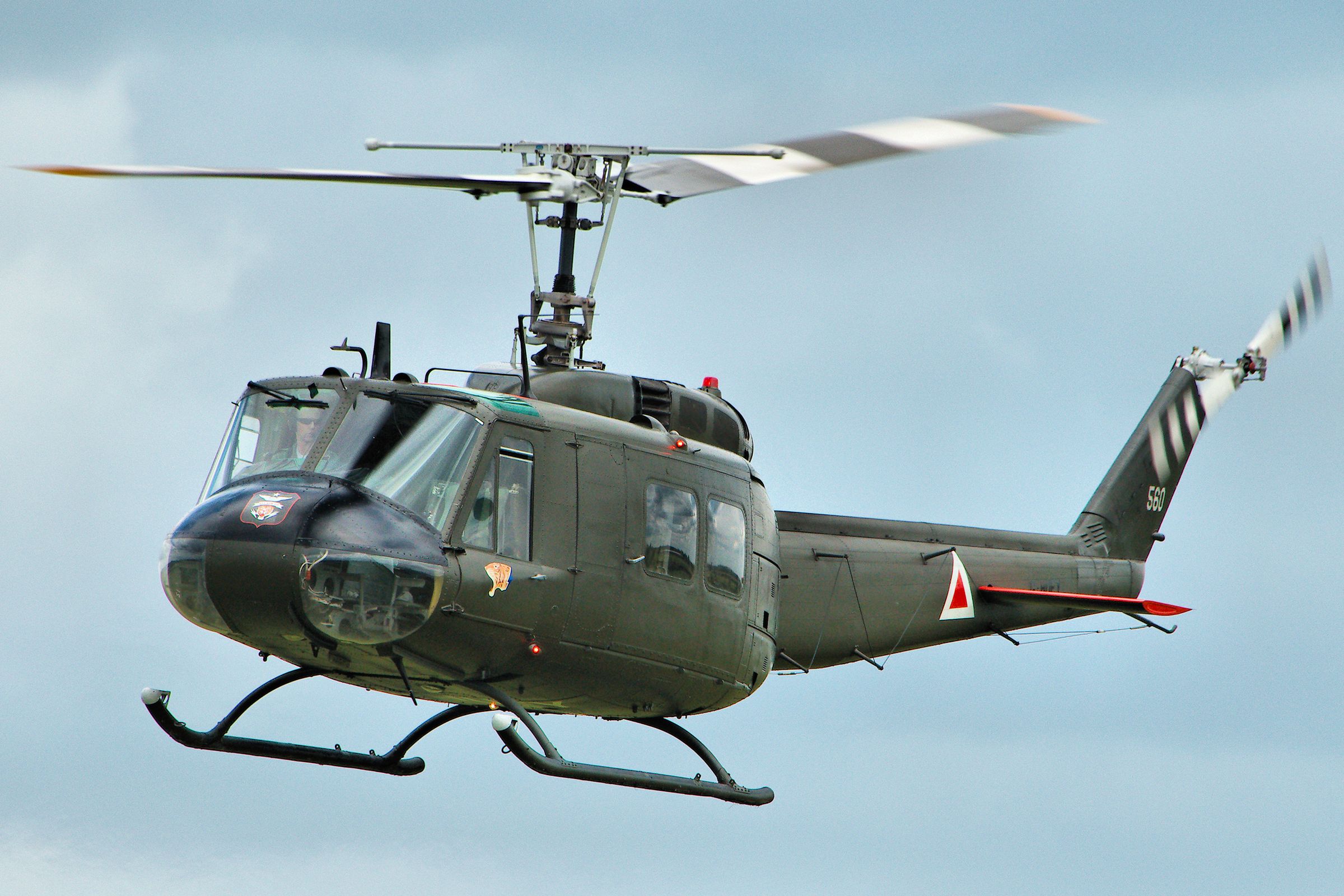
The Bell H-1 helicopter family is the modernized United States Marine Corps pairing of the UH-1Y Venom utility helicopter and the AH-1Z Viper attack helicopter. Both types were developed through the H-1 upgrade program and use extensive commonality in their rotor systems, engines, drivetrain, avionics, software, controls, and other major components.
The H-1 program began in 1996 as an effort to replace or substantially modernize the Marine Corps' UH-1N utility and AH-1W attack helicopter fleets. The UH-1Y first flew on 20 December 2001, while developmental testing of the UH-1Y and AH-1Z was completed in early 2006.
Although created for the United States Marine Corps, the family later gained an export operator when the Czech Republic selected H-1 helicopters to replace its Mi-24 Hind fleet. By 2026 the Czech Air Force was the only European operator of the Bell H-1 family and had begun employing both Venom and Viper helicopters in NATO counter-unmanned-aircraft missions.
Development and testing
The United States Marine Corps launched the H-1 upgrade program in 1996. Bell was contracted to modernize UH-1N utility helicopters into the UH-1Y configuration and AH-1W attack helicopters into the AH-1Z configuration. The program was structured around extensive commonality between the two aircraft. Published descriptions place their shared component content at approximately 84–85%, reducing the number of different parts, systems, training requirements, and maintenance processes required for a mixed utility and attack helicopter force.
The UH-1Y was initially intended to be produced by rebuilding existing UH-1N airframes. In April 2005, however, approval was given to build new UH-1Y airframes instead. The UH-1Y and AH-1Z completed developmental testing in early 2006. Operational evaluation followed, including testing at Naval Air Station Patuxent River. The two types entered the final portion of their test program in February 2008.
Production and service introduction
The Marine Corps certified the UH-1Y as operationally capable in August 2008. Its first operational deployment followed in January 2009 with the aviation combat element of the 13th Marine Expeditionary Unit. Full-rate UH-1Y production began in September 2009. The Marine Corps ultimately acquired 160 UH-1Ys, and the final aircraft from that production run was delivered in January 2019.
Production activity later resumed for the Czech program. In December 2019 the Czech Republic signed an H-1 procurement valued at CZK14.6 billion, initially covering 12 helicopters. Eight UH-1Y Venoms were included in the order, while the broader procurement also introduced the AH-1Z Viper to Czech service. Additional donated H-1 aircraft were announced in 2022. The first Czech UH-1Y was delivered in 2023. The Czech acquisition replaced the country's retired Mi-24 Hind fleet and made the Czech Air Force the H-1 family's first European operator. The 2026 status of the program was described by Janes.
Design
The modern H-1 family combines a utility helicopter and an attack helicopter around a common technical architecture. The UH-1Y and AH-1Z share their tail boom, engines, four-blade rotor system, drivetrain, avionics architecture, software, flight controls, and cockpit displays. This approach allows an operator to maintain two different mission aircraft while using many of the same components and support procedures.
UH-1Y Venom
The UH-1Y is a twin-engine, four-blade utility helicopter developed from the UH-1N Twin Huey. Its modernization introduced a digital glass cockpit with multifunction displays, upgraded transmissions, increased engine power, improved safety features, and a modern forward-looking infrared system. A 530 mm (21 in) fuselage extension ahead of the main door increased internal capacity.
The four-blade main rotor uses composite blades. Compared with the UH-1N, the UH-1Y has increased payload capability, higher cruising speed, reduced vibration, and substantially greater range. The aircraft can carry troops, litters, or cargo and can also be armed for escort, fire support, and other combat missions.
AH-1Z Viper
The AH-1Z is the dedicated attack member of the H-1 family. It shares the family powerplant, rotor system, drivetrain, avionics architecture, and other major systems with the UH-1Y while providing specialized attack, reconnaissance, target-acquisition, and escort capabilities. In Czech service, the Viper has also been adapted to the counter-UAS mission.
Avionics and electronic warfare
The UH-1Y uses a digital cockpit and electro-optical and infrared equipment for navigation, observation, and target identification. The aircraft can also carry the AN/ALQ-231(V)3 Intrepid Tiger II electronic-warfare pod. The system provides electronic attack and support functions and uses an open architecture intended to permit reprogramming as threats change.
Armament
The UH-1Y can use two external weapon stations for 70 mm rockets, including Hydra 70 and laser-guided APKWS II rockets. Door or pintle weapons can include the 7.62 mm M240D, 12.7 mm GAU-21, or 7.62 mm GAU-17/A Gatling gun.
The AH-1Z provides heavier dedicated attack capability. Reporting on Czech counter-drone operations identifies APKWS laser-guided 70 mm rockets, the Viper's 20 mm cannon, and AIM-9 Sidewinder missiles among its available weapons. APKWS has been emphasized for counter-UAS work because it provides a precision option against relatively small aerial targets without relying exclusively on larger air-to-air missiles. Czech AH-1Z counter-drone deployments were described by AdriaDefense and Defense.info.
Operational history
UH-1Ys reached Afghanistan in 2009. During the Taliban attack on Camp Bastion, Marine Corps UH-1Ys and AH-1W SuperCobras provided air support while the base was under attack. The UH-1Y became the Marine Corps' standard utility helicopter after the UH-1N was retired from Marine service in 2014. UH-1Ys and AH-1Ws were also used by the 22nd Marine Expeditionary Unit during operations against Islamic State forces in Libya in August 2016.
The Czech H-1 fleet acquired a new mission as NATO adapted its air defenses to low-flying unmanned aircraft. Czech crews incorporated counter-UAS tactics into their training and were evaluated through the VORTEX exercise and NATO Tactical Evaluation procedures.
On 3 March 2026, Czech UH-1Y Venoms began an operational deployment to Poland under a NATO eastern-flank mission. Two Venoms and their support personnel were sent to reinforce defenses against low-flying drones and other aerial threats. The mission required the helicopters to work with ground-based air-defense and surveillance elements, using their mobility and onboard sensors to investigate and, if required, engage targets. Details of the deployment were reported by Army Recognition.
In June 2026 the Czech contingent transitioned from the UH-1Y to the AH-1Z Viper. Two Vipers were deployed to Poland for a mission focused on detecting and engaging low-altitude unmanned aircraft. Their dedicated attack sensors and weapons expanded the available engagement options, including APKWS guided rockets and the 20 mm cannon. The deployment represented an operational milestone for the Czech H-1 fleet and demonstrated the use of attack helicopters as a mobile layer within a wider counter-UAS air-defense network.
On 23 July 2026 a Czech UH-1Y crashed at an air force base with five people aboard. One person was killed and four were injured.
Variants
- UH-1Y Venom: Twin-engine utility and multirole member of the H-1 family, developed from the UH-1N. It supports troop transport, cargo, casualty evacuation, escort, reconnaissance, command-and-control, armed support, and counter-UAS missions.
- AH-1Z Viper: Dedicated attack member of the H-1 family, developed through the same modernization program and designed around extensive component commonality with the UH-1Y. Czech aircraft have been deployed for NATO counter-UAS operations.
Operators
- United States Marine Corps: Primary operator of the H-1 family. The service acquired 160 UH-1Y Venoms and operates the UH-1Y together with the AH-1Z in Marine light attack helicopter units.
- Czech Air Force: Selected the H-1 family in 2019 to replace the Mi-24 Hind fleet. The initial contract covered 12 H-1 helicopters and included eight UH-1Y Venoms. Further donated aircraft were announced in 2022. The Czech Air Force is the only European operator of the family and has deployed both UH-1Y and AH-1Z helicopters to Poland for NATO counter-UAS missions.
Specifications (UH-1Y Venom)
General characteristics
- Crew: 2, pilot and co-pilot
- Capacity: Up to 3,021 kg (6,660 lb) payload, up to ten crashworthy passenger seats, six litters, or equivalent cargo
- Length: 17.78 m (58 ft 4 in)
- Height: 4.45 m (14 ft 7 in)
- Empty weight: 5,371 kg (11,840 lb)
- Maximum takeoff weight: 8,391 kg (18,500 lb)
- Powerplant: 2 × General Electric T700-GE-401C turboshaft engines, 1,363 kW (1,828 shp) each for 2 minutes 30 seconds; 1,153 kW (1,546 hp) each continuous
- Main rotor diameter: 14.88 m (48 ft 10 in)
- Main rotor area: 168.0 m² (1,808 sq ft)
Performance
- Maximum speed: 304 km/h (164 kn)
- Cruise speed: 293 km/h (158 kn)
- Never-exceed speed: 367 km/h (198 kn)
- Combat range: 240 km (130 nmi) with a 990 kg (2,182 lb) payload
- Endurance: 3 hours 18 minutes
- Service ceiling: 6,100 m (20,000 ft) or higher
- Rate of climb: 12.8 m/s (2,520 ft/min)
Armament
- External stations: 2 stations for 70 mm (2.75 in) Hydra 70 or APKWS II rockets
- Door weapons: 2 pintle mounts for 7.62 mm M240D machine guns, 12.7 mm GAU-21 machine guns, or 7.62 mm GAU-17/A Gatling guns
Published UH-1Y development, configuration, service, and specification information is also compiled in the UH-1Y Venom reference.
Related equipment
- Bell UH-1N Twin Huey: Earlier utility helicopter from which the UH-1Y was developed.
- Bell AH-1W SuperCobra: Earlier Marine Corps attack helicopter modernized through the H-1 program into the AH-1Z configuration.
 Argentina
 Armenia
 Australia
 Austria
 Austria-Hungary
 Belgium
 Brazil
 United Kingdom
 Brunei
 Bulgaria
 Canada
 Chile
Chile China
China Colonial America
 Colombia
 Confederate States
 Croatia
 Czech
Czech Denmark
 Egypt
Egypt Finland
 France
 Georgia
 Germany
 German Imperial
 Greece
 Holland
 Hungary
 India
India Indonesia
 Iran
Iran Iraq
Iraq Ireland
 Israel
 Italy
Italy Japan
Japan Japan (1940)
 Jordan
 Kingdom of Italy
 Malaysia
 Mexico
 Myanmar
 Nazi Germany
 Netherlands
 New Zealand
 North Korea
 Norway
 Pakistan
 Peru
Peru Philippines
 Poland
 Portugal
 Prussia
 Romania
 Russia
 Saudi Arabia
 Serbia
 Singapore
 Slovakia
 Slovenia
 South Africa
 South Korea
 Soviet Union
 Spain
Spain Sweden
 Switzerland
 Syria
Syria Taiwan
 Thailand
 Turkey
 UAE
UAE Ukraine
 Vietnam
 Yugoslavia