
History
The Shaanxi Y-15 is a Chinese four-engine turboprop military transport aircraft under flight testing. It is being developed by Shaanxi Aircraft Corporation as a medium tactical airlifter positioned below the larger jet-powered Y-20.
The aircraft is intended to provide a new-generation replacement for older Y-8-family transports and, eventually, the Y-9. Its design emphasizes a larger cargo compartment, rear-ramp loading and operation from relatively austere airfields.
The program was widely known for years as the Y-30, but imagery of the flight-test aircraft and its apparent serial number 15001 have increasingly supported the Y-15 designation. Public information remains limited, and many performance figures are still estimates rather than officially confirmed specifications.
A program history traces the conceptual origins to efforts in the early 2000s to replace or supplement the Y-8 family. It identifies a 2010 reference by China Aviation Industry Corporation to a transport aircraft project called model 15-2000, although the relationship between that early designation and the final aircraft was not publicly explained.
Y-30 concept
The program received wider public attention at the 2014 Zhuhai Airshow, where Aviation Industry Corporation of China displayed a model identified as the Y-30 or New Medium Transport. The model already showed the main configuration later associated with the Y-15: four turboprop engines, a high-mounted wing, T-tail and rear cargo ramp.
Figures associated with the 2014 concept included an approximately 80-tonne maximum takeoff weight, a 30-tonne payload and a range of roughly 6,000 to 7,000 km. These early concept figures should not be treated as specifications for the later prototype because subsequent reporting gives materially different weight and range estimates.
Public information about the project became sparse after the 2014 display. Reports cited by the available sources indicate renewed or accelerated work during the early 2020s. Some reporting places the revival around 2022, while other accounts state that unofficial reports in 2023 indicated work had resumed at Shaanxi Aircraft Corporation.
Prototype and flight testing
The prototype made its reported maiden flight on 16 December 2025. Early flight-test imagery appeared during December 2025, approximately eleven years after the Y-30 model had been publicly displayed at Zhuhai.
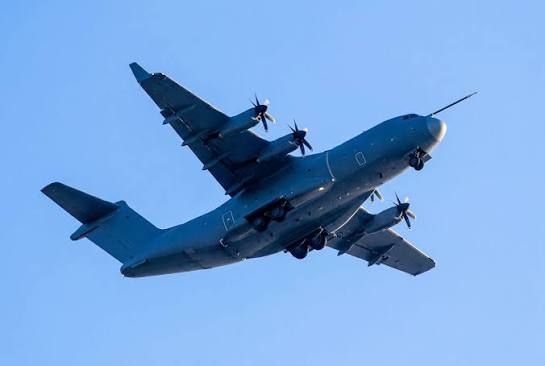
Clearer imagery released in 2026 showed the aircraft in flight and provided a better view of its landing gear, wing, fuselage and tail. A contemporary overview of the aircraft noted that the prototype's apparent 15001 serial and growing open-source reporting supported the Y-15 designation, while also stressing that little had been officially confirmed.
The flight-test aircraft carries a long air-data boom from the nose. This is test instrumentation used to measure parameters such as pressure, temperature and airflow. Available imagery does not show an aerial-refueling probe on the prototype, despite earlier interpretations of the nose boom as such a device.
Design
The Y-15 is a high-wing transport with a broad fuselage, rear loading ramp, T-tail and heavy-duty landing gear. Its four turboprop engines drive six-blade propellers. The aircraft also has prominent winglets at the tips of a comparatively straight high-lift wing.
The general arrangement places the aircraft in the medium tactical transport class. Although its broad fuselage, high wing and T-tail create some visual similarity to the Airbus A400M, the available sources describe the Y-15 as a smaller aircraft with substantially less engine power. Its intended operational role is therefore closer to aircraft such as the C-130J and China's Y-9.
Wing and field performance
The relatively straight wing and winglets are intended to support low-speed handling and short-field operation while retaining useful cruise efficiency. One detailed technical report gives a takeoff run of approximately 1,280 m and a landing distance of no more than 1,100 m. These figures remain reported values rather than manufacturer-confirmed performance data.
Powerplant
The aircraft is reported to use four AER-500 turboprop engines, designated WJ-10 for military use. One source gives maximum takeoff power as approximately 5,000 kW per engine and cruise power as approximately 3,120 kW. Other reporting describes the engines as producing around 6,800 hp each, which is broadly consistent with a power output of about 5,000 kW.
The engines drive six-blade propellers. Reporting also describes development of more advanced eight-blade propellers and work on a more powerful WJ-16 engine, but these are future developments and are not confirmed features of the current Y-15 prototype.
Cargo compartment
The Y-15 is reported to have a wider and taller internal cargo compartment than the Y-9, addressing one of the principal limitations of the older transport family. A reported cargo-compartment size is approximately 14 m long, 3.7 m high and 3.7 m wide.
Payload estimates vary. Several reports cite approximately 30 tonnes, while another source gives an upper estimate of 35 tonnes and describes about 20 tonnes as an optimal transport load. Because the aircraft remains in testing and no authoritative specification has been published in the supplied material, these figures should be regarded as provisional.
Program status
The Y-15 remained in flight testing in August 2026. The program is intended to provide the People's Liberation Army Air Force with a modern medium tactical transport capable of operating closer to forward areas than the larger Y-20 and of carrying bulkier loads than older Y-8 and Y-9 aircraft.
Potential missions discussed in the available reporting include movement of troops, vehicles, supplies and equipment, as well as airborne assault and airdrop operations. Such roles describe the aircraft's anticipated employment rather than confirmed operational use.
Reports also discuss future specialized derivatives and possible export sales, but no production variants or export operators are confirmed in the supplied evidence. The transition from the prototype to a production fleet will depend on completion of the flight-test program.
Specifications (Y-15 prototype, reported)
General characteristics
- Type: Four-engine turboprop medium tactical transport aircraft
- Length: 43.8 m
- Wingspan: 42 m
- Height: 14.6 m
- Maximum takeoff weight: Estimated 100-110 tonnes
- Maximum payload: Estimated 30-35 tonnes
- Reported optimal cargo load: Approximately 20 tonnes
- Cargo compartment: Approximately 14 m long, 3.7 m wide and 3.7 m high
- Powerplant: 4 × AER-500/WJ-10 turboprop engines
- Maximum takeoff power: Approximately 5,000 kW per engine
- Propellers: Six-blade propellers
Performance
- Maximum speed: Reported 735 km/h
- Cruise speed: Reported 600 km/h
- Maximum unrefueled range: Reported 3,300 km
- Service ceiling: Reported 9,000 m
- Takeoff run: Reported 1,280 m
- Landing distance: Reported no more than 1,100 m
Related equipment
- Shaanxi Y-8: Older Chinese four-engine turboprop transport family derived from the Soviet Antonov An-12 design and one of the aircraft families the Y-15 is intended to replace.
- Shaanxi Y-9: Modernized Y-8 derivative and current Chinese turboprop transport that the Y-15 is reported eventually to replace or supplement.
- Xi'an Y-20: Larger four-engine jet-powered strategic transport intended to cover heavier and longer-range airlift missions.
- Lockheed Martin C-130J: Western turboprop tactical transport described in the available reporting as being in the same broad operational class as the Y-15.
 Argentina
 Armenia
 Australia
 Austria
 Austria-Hungary
 Belgium
 Brazil
 United Kingdom
 United States
 Brunei
 Bulgaria
 Canada
 Chile
Chile Colonial America
 Colombia
 Confederate States
 Croatia
 Czech
Czech Denmark
 Egypt
Egypt Finland
 France
 Georgia
 Germany
 German Imperial
 Greece
 Holland
 Hungary
 India
India Indonesia
 Iran
Iran Iraq
Iraq Ireland
 Israel
 Italy
Italy Japan
Japan Japan (1940)
 Jordan
 Kingdom of Italy
 Malaysia
 Mexico
 Myanmar
 Nazi Germany
 Netherlands
 New Zealand
 North Korea
 Norway
 Pakistan
 Peru
Peru Philippines
 Poland
 Portugal
 Prussia
 Romania
 Russia
 Saudi Arabia
 Serbia
 Singapore
 Slovakia
 Slovenia
 South Africa
 South Korea
 Soviet Union
 Spain
Spain Sweden
 Switzerland
 Syria
Syria Taiwan
 Thailand
 Turkey
 UAE
UAE Ukraine
 Vietnam
 Yugoslavia