
History
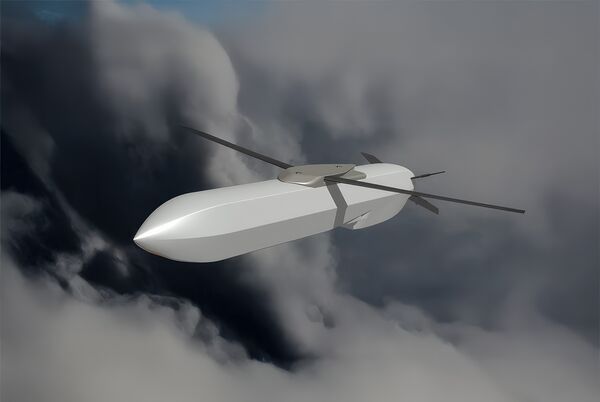
The GKN Aerospace Swedish uncrewed air vehicle technology demonstrator is a low-cost UAV development program created for Sweden's Defence Materiel Administration, FMV. The aircraft is intended primarily as a technology and process demonstrator rather than an operational product, with emphasis on rapid development, affordability and security of supply.
The program combines a new air vehicle, onboard systems and a dedicated clean-sheet turbojet engine. GKN Aerospace unveiled a full-scale mock-up in August 2026, while development continued toward a planned first flight in 2027.
The project also examines how Swedish defence organizations and industry can shorten development cycles by working in parallel on requirements, engineering, manufacturing and testing. Future production has not been approved and would depend on the results of the demonstrator program and a defined Swedish Armed Forces requirement.
Development
FMV awarded GKN Aerospace the development contract in November 2025. Contemporary reports valued the award at approximately SKr150 million, also reported as GBP12 million, and gave the company 18 months to design, develop and demonstrate the new UAV. GKN refers to the effort as Project Otto. An early description of the program stated that the clean-sheet turbojet-powered demonstrator was to fly by May 2027. The contract and planned schedule were reported by Janes.
The program was established to explore potential low-cost capabilities for the Swedish Armed Forces and Air Force while also testing a more agile development process. GKN described the UAV as a flexible platform that could be adapted to different mission profiles, with final capability priorities to be determined by the customer rather than fixed at the beginning of development.
GKN Aerospace drew on several parts of its European organization. Program leadership and engine development were centered in Sweden. Composite fuselage production was handled by the company's Dutch operation, while its UK organization performed software and integration work. Other small and medium-sized companies also participated.
In August 2026 GKN displayed a full-scale mock-up of the UAV and its dedicated turbojet engine during the Swedish Air Force centenary events at Malmen Air Base. The milestone came less than one year after the contract award and marked the transition toward continued system development and preparation for flight testing. The unveiling and program status were also described by Defence Industry Europe.
Planned flight testing
As of August 2026, the demonstrator had not yet flown. FMV said with a high degree of assurance that the aircraft would fly no later than early 2027, while the original 18-month development schedule called for a flying demonstration by May 2027. Ground demonstrations of the engine, fuselage and onboard systems form part of the program before the overall system is validated in flight.
Design
The demonstrator is a high-subsonic uncrewed aircraft designed around a low-cost and rapidly producible architecture. Its external form has been compared with a long-range strike missile or one-way effector, but the project has not been assigned a confirmed operational role and is not being presented as a production weapon.
GKN has stated that the vehicle can be launched from either the air or the ground. The design is intended to support different future mission profiles, allowing the program to evaluate how a common platform could be adapted as Swedish military requirements evolve.
Airframe and systems
The airframe uses a composite fuselage produced through GKN Aerospace's operation in the Netherlands. Software and integration activities were carried out by the company's UK organization. The program includes the aircraft's onboard systems as well as propulsion, with development work proceeding in parallel to support the accelerated schedule.
The broader development approach emphasizes simplicity, cost, scalable manufacturing and security of supply. FMV and GKN are using the demonstrator to examine how much of a future system could be developed and manufactured using Swedish and European industrial capabilities. A detailed discussion of the program's development philosophy and European supply-chain approach was published by Militär Aktuell.
Powerplant
The UAV is powered by a dedicated small turbojet developed as a clean-sheet design by GKN Aerospace's engine organization in Trollhättan, Sweden. GKN described it as the first clean-sheet aero-engine built in Sweden for approximately 70 years. The engine's thrust has not been disclosed.
Bench running began in July 2026, and several engines were being built for the test campaign. GKN said a significant portion of the engine components were produced using additive manufacturing, including parts of the compressor and engine cases. This approach was selected to reduce development and manufacturing lead times that would otherwise have been extended by conventional forging or casting processes.
Program status
As of August 2026, the GKN Aerospace UAV remained a development demonstrator. A full-scale mock-up had been unveiled and the dedicated turbojet engine was undergoing ground testing, but flight testing had not yet begun.
Sweden had no defined requirement to procure the aircraft as an operational system. FMV stated that successful testing could create a path toward production if the Swedish Air Force identifies a requirement, but no series-production decision or operational service entry had been announced.
The program therefore serves two purposes: validating technologies for a low-cost uncrewed aircraft and evaluating a faster method of cooperation between FMV, the Swedish Armed Forces and industry. Affordability, development speed and security of supply are central criteria.
Specifications (GKN Aerospace Swedish UAV technology demonstrator)
General characteristics
- Type: Uncrewed air vehicle technology demonstrator
- Payload: 100-300 kg (220-660 lb)
- Launch method: Air-launched or ground-launched
- Powerplant: One GKN Aerospace clean-sheet small turbojet; thrust not disclosed
Performance
- Range: 600-1,000 km (323-539 nmi)
- Speed: High subsonic
 Argentina
 Armenia
 Australia
 Austria
 Austria-Hungary
 Belgium
 Brazil
 United Kingdom
 United States
 Brunei
 Bulgaria
 Canada
 Chile
Chile China
China Colonial America
 Colombia
 Confederate States
 Croatia
 Czech
Czech Denmark
 Egypt
Egypt Finland
 France
 Georgia
 Germany
 German Imperial
 Greece
 Holland
 Hungary
 India
India Indonesia
 Iran
Iran Iraq
Iraq Ireland
 Israel
 Italy
Italy Japan
Japan Japan (1940)
 Jordan
 Kingdom of Italy
 Malaysia
 Mexico
 Myanmar
 Nazi Germany
 Netherlands
 New Zealand
 North Korea
 Norway
 Pakistan
 Peru
Peru Philippines
 Poland
 Portugal
 Prussia
 Romania
 Russia
 Saudi Arabia
 Serbia
 Singapore
 Slovakia
 Slovenia
 South Africa
 South Korea
 Soviet Union
 Spain
Spain Switzerland
 Syria
Syria Taiwan
 Thailand
 Turkey
 UAE
UAE Ukraine
 Vietnam
 Yugoslavia