
History
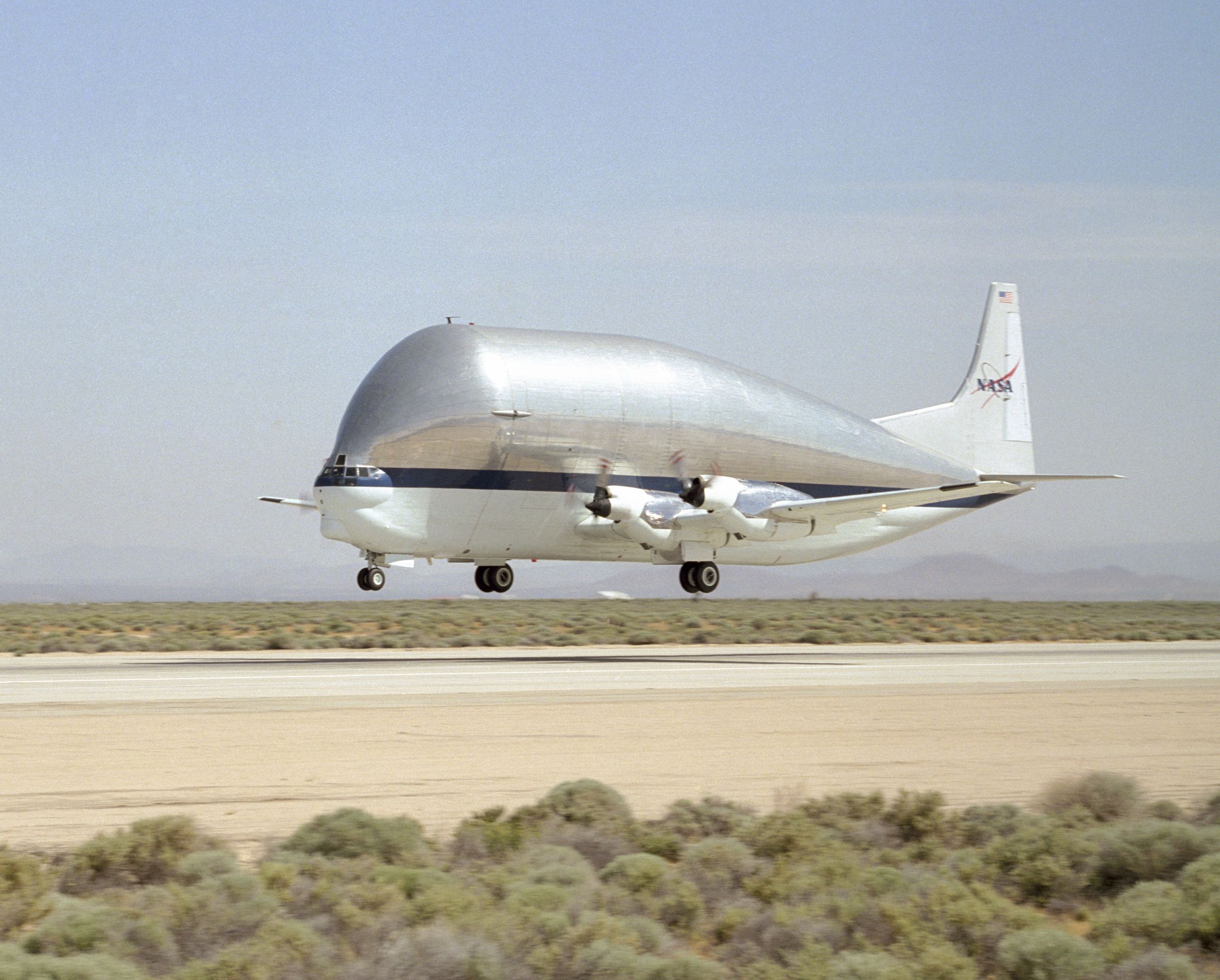
The Aero Spacelines Super Guppy is an American oversized cargo aircraft developed to transport exceptionally large aerospace components that could not fit inside conventional cargo aircraft. It evolved from the Boeing 377 Stratocruiser and C-97 family and became closely associated with NASA transportation requirements during the Apollo program.
The first Super Guppy SG made its first test flight on August 31, 1965. Its enlarged fuselage provided the internal volume needed to move large rocket and spacecraft hardware between production and launch-related facilities.
The Super Guppy family later included the Super Guppy Turbine, or SGT, which introduced a purpose-built main fuselage section, more powerful Allison turboprop engines, a wider cargo floor, and a pressurized crew cabin. Five Super Guppies were built in two variants, and one later aircraft remained in NASA service.
Development
The first Super Guppy was built by Aero Spacelines from a retired Boeing YC-97J Stratofreighter. An aviation history account identifies the donor aircraft as YC-97J serial 52-2693 and records the first flight on August 31, 1965. The aircraft retained major elements of the Boeing design but received a greatly enlarged upper fuselage for outsized cargo.
The original SG was lengthened to about 43 m, while its cargo compartment had a maximum internal diameter of about 7.6 m and a length of approximately 28.8 m. The cargo-floor width remained about 2.7 m because the design retained the lower fuselage structure of the Stratocruiser family. The aircraft used four Pratt & Whitney T34 turboprop engines. Technical data for the type are also listed by Flugzeuginfo.
On September 25, 1965, during certification testing involving high-speed dives, the upper fuselage structure of the Super Guppy collapsed. The crew succeeded in landing the aircraft on Rogers Dry Lake. The upper fuselage structure was subsequently redesigned and rebuilt before the program continued.
The Super Guppy was used to move large hardware for the United States space program. It was capable of carrying a complete S-IVB stage, the third stage of the Saturn V launch vehicle, and transported such stages several times during the Apollo program. The aircraft avoided some of the difficulties associated with moving very large but relatively lightweight aerospace structures by road, rail, or sea. An overview of the aircraft's development and role is available from the Super Guppy reference article.
Super Guppy Turbine
Aero Spacelines subsequently developed the Super Guppy Turbine. Although the first SG was itself powered by turboprops, the later SGT incorporated four Allison 501-D22C engines and a substantially redesigned cargo fuselage. Unlike the first aircraft, the main cargo-fuselage section of the SGT was built from scratch.
The redesigned structure increased the cargo-floor width to about 4 m and the cargo-compartment length to approximately 34 m. The improved fuselage and engines supported a maximum payload of about 23,800 kg. The SGT also incorporated a pressurized crew cabin, allowing higher-altitude cruising than the earlier configuration.
The SGT retained the cockpit, wings, tail, and main landing gear derived from the Boeing 377 family. Its nose landing gear came from the Boeing 707 and was installed in a reversed orientation. This lowered the front of the aircraft, made the cargo floor more nearly level, and simplified loading.
During the early 1970s, two Super Guppy Turbines were used by Airbus to carry aircraft components from production facilities to the final assembly plant in Toulouse. In 1982 and 1983, two additional SGT aircraft were built in France by Union de Transports Aériens Industries after Airbus obtained production rights. The four aircraft used in this transport role were eventually replaced by the Airbus Beluga.
Design
The defining feature of the Super Guppy is its extremely large-volume fuselage. The aircraft was intended for cargo whose dimensions, rather than mass alone, prevented transport in conventional freighters. A later Super Guppy cargo compartment is described as approximately 7.6 m high, 7.6 m wide, and 33.8 to 34 m long. A separate oversized-freight overview gives comparable dimensions and a payload exceeding 23.6 tonnes in its Super Guppy description.
Loading is accomplished through a hinged forward fuselage and nose assembly that opens to expose the cargo compartment. This arrangement allows very large structures to be moved directly into the aircraft without requiring them to pass through a conventional side cargo door. An aircraft history summary also describes the hinged nose as the type's principal loading feature.
Powerplant
The original Super Guppy SG used four Pratt & Whitney T34 turboprop engines. Published data for the SG list approximately 5,145 kW, or 6,900 shp, per engine. The later Super Guppy Turbine used four Allison 501-D22C turboprop engines.
Cargo system
The original SG had a cargo compartment approximately 28.8 m long with a maximum internal diameter of about 7.6 m, but its usable floor was narrower because of the retained Boeing lower fuselage. The later SGT increased cargo-compartment length to approximately 34 m and widened the floor to about 4 m. Its maximum payload was approximately 23,800 kg.
Operational history
NASA used the Super Guppy family to transport large spacecraft and launch-vehicle components. During the Apollo period, the aircraft moved Saturn rocket hardware, including complete S-IVB stages. In later service, NASA used a Super Guppy to transport retired T-38 aircraft, the X-38 prototype spacecraft, Orion spacecraft and heat shields, and Space Launch System hardware.
The original Super Guppy retired in 1991 and was placed on display at the Pima Air and Space Museum in Tucson, Arizona. A later Super Guppy remained in NASA service and was based at El Paso International Airport in Texas.
In July 2026, NASA's active Super Guppy was reported damaged during a severe storm and was undergoing repairs. The damage prevented its planned appearance at EAA AirVenture Oshkosh 2026, and its availability for later public appearances remained uncertain at the end of August 2026.
Variants
- Super Guppy SG: Original Aero Spacelines version built from a retired Boeing YC-97J Stratofreighter. It first flew on August 31, 1965 and used four Pratt & Whitney T34 turboprop engines.
- Super Guppy Turbine SGT: Later version with a newly constructed main cargo fuselage, four Allison 501-D22C engines, a wider cargo floor, a longer cargo compartment, and a pressurized crew cabin.
Operators
- United States — NASA: Used Super Guppy aircraft to transport large aerospace and spacecraft hardware. One later Super Guppy remained in NASA service after the original aircraft was retired.
- Airbus: Used Super Guppy Turbines to transport aircraft components to final assembly in Toulouse. Four aircraft ultimately served in this role before being replaced by the Airbus Beluga.
Specifications (Super Guppy Turbine)
General characteristics
- Type: Oversized cargo transport aircraft
- Powerplant: Four Allison 501-D22C turboprop engines
- Cargo-compartment length: Approximately 34 m
- Maximum internal cargo width and height: Approximately 7.6 m by 7.6 m
- Cargo-floor width: Approximately 4 m
- Maximum payload: Approximately 23,800 kg
Related equipment
- Aero Spacelines Pregnant Guppy: Earlier oversized cargo aircraft from which the Super Guppy concept evolved.
- Airbus Beluga: Later oversized transport aircraft that replaced the Super Guppy fleet in Airbus component-transport service.
 Argentina
 Armenia
 Australia
 Austria
 Austria-Hungary
 Belgium
 Brazil
 United Kingdom
 Brunei
 Bulgaria
 Canada
 Chile
Chile China
China Colonial America
 Colombia
 Confederate States
 Croatia
 Czech
Czech Denmark
 Egypt
Egypt Finland
 France
 Georgia
 Germany
 German Imperial
 Greece
 Holland
 Hungary
 India
India Indonesia
 Iran
Iran Iraq
Iraq Ireland
 Israel
 Italy
Italy Japan
Japan Japan (1940)
 Jordan
 Kingdom of Italy
 Malaysia
 Mexico
 Myanmar
 Nazi Germany
 Netherlands
 New Zealand
 North Korea
 Norway
 Pakistan
 Peru
Peru Philippines
 Poland
 Portugal
 Prussia
 Romania
 Russia
 Saudi Arabia
 Serbia
 Singapore
 Slovakia
 Slovenia
 South Africa
 South Korea
 Soviet Union
 Spain
Spain Sweden
 Switzerland
 Syria
Syria Taiwan
 Thailand
 Turkey
 UAE
UAE Ukraine
 Vietnam
 Yugoslavia