

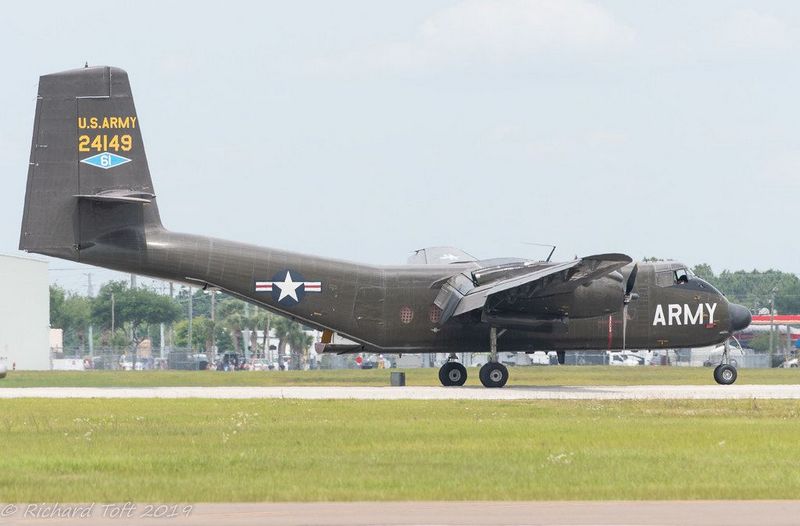

De Havilland Canada DHC-4 Reindeer History
The
Caribou series proved to be so effective as a battlefield transport aircraft that many were put into service after the capture of the C-7 in North Vietnamese hands. The model continued to enter service in limited numbers, serving with the Australian Army in East Timor until 2000.
By 1973, more than 300 examples of the reindeer series had been produced.
The Caribou is a twin-engine design undertaken by de Havilland Canada as a private project hoping to appeal to the armed forces of Canada and the United States of America. The original design, known as the DHC-4, was developed with short take-off and landing (STOL) capability in mind, while also being a naturally robust design most attractive to the U.S.
Army, which later ordered five ratings Model, such as YAC -1. The reindeer thus evolved into the production model of the AC-1 series, which later became the CV-2. When the USAF took control of the Caribou aircraft in early 1967, the name changed again to the more recognizable C-7 series.
The heart of the Caribou is powered by two 1,450 hp (DHC-4) Pratt & Whitney engines. The engine is mounted on a high-wing/straight-wing monoplane assembly that allows for optimal ground clearance around the fuselage, especially for a three-blade propeller system. A large cargo door is mounted aft of the fuselage, and a single rudder stern assembly extends above the cargo door.
The cargo hold is very large and can transport 32 soldiers, 22 medical evacuees, 2 cars or up to 4 tons of cargo for equipment, supplies or artillery systems.
Eventually, the United States became the largest operator of the Caribou system, which is jointly operated by the U.S. Army and the U.S. Air Force. Australia operates (and continues to do so in some cases) of the genre with countries such as Canada, Spain, Colombia and India.
The system proved very capable on the harsh Vietnam front and was a highly regarded vehicle due to its ability to land on short runways to provide supplies/manpower and recover the wounded.
Specification
Basic
Production
Roles
- Traffic
Dimensions
72.60 ft (22.13 m)
29.15m
9.68m
Weight
8,293 kg
14,195 kg
Performance
Performance
216 mph (347 km/h; 187 knots)
24,800 ft (7,559 m; 4.7 mi)
1,308 miles (2,105 km; 1,137 nautical miles)
413 m/min
Armor
No.
Changes
YAC-1 - US Army Evaluation Model Designation, 5 of which have been ordered.
AC-1A - The original production model designation was later changed to CV-2B, then C-7A.
CV-2B - US Army Serial Number
C-7A - US Air Force Serial Number
DHC-4A - Australian base model series designation.
 Argentina
 Armenia
 Australia
 Austria
 Austria-Hungary
 Belgium
 Brazil
 United Kingdom
 United States
 Brunei
 Bulgaria
 Chile
Chile China
China Colonial America
 Colombia
 Confederate States
 Croatia
 Czech
Czech Denmark
 Egypt
Egypt Finland
 France
 Georgia
 Germany
 German Imperial
 Greece
 Holland
 Hungary
 India
India Indonesia
 Iran
Iran Iraq
Iraq Ireland
 Israel
 Italy
Italy Japan
Japan Japan (1940)
 Jordan
 Kingdom of Italy
 Malaysia
 Mexico
 Myanmar
 Nazi Germany
 Netherlands
 New Zealand
 North Korea
 Norway
 Pakistan
 Peru
Peru Philippines
 Poland
 Portugal
 Prussia
 Romania
 Russia
 Saudi Arabia
 Serbia
 Singapore
 Slovakia
 Slovenia
 South Africa
 South Korea
 Soviet Union
 Spain
Spain Sweden
 Switzerland
 Syria
Syria Taiwan
 Thailand
 Turkey
 UAE
UAE Ukraine
 Vietnam
 Yugoslavia