
History
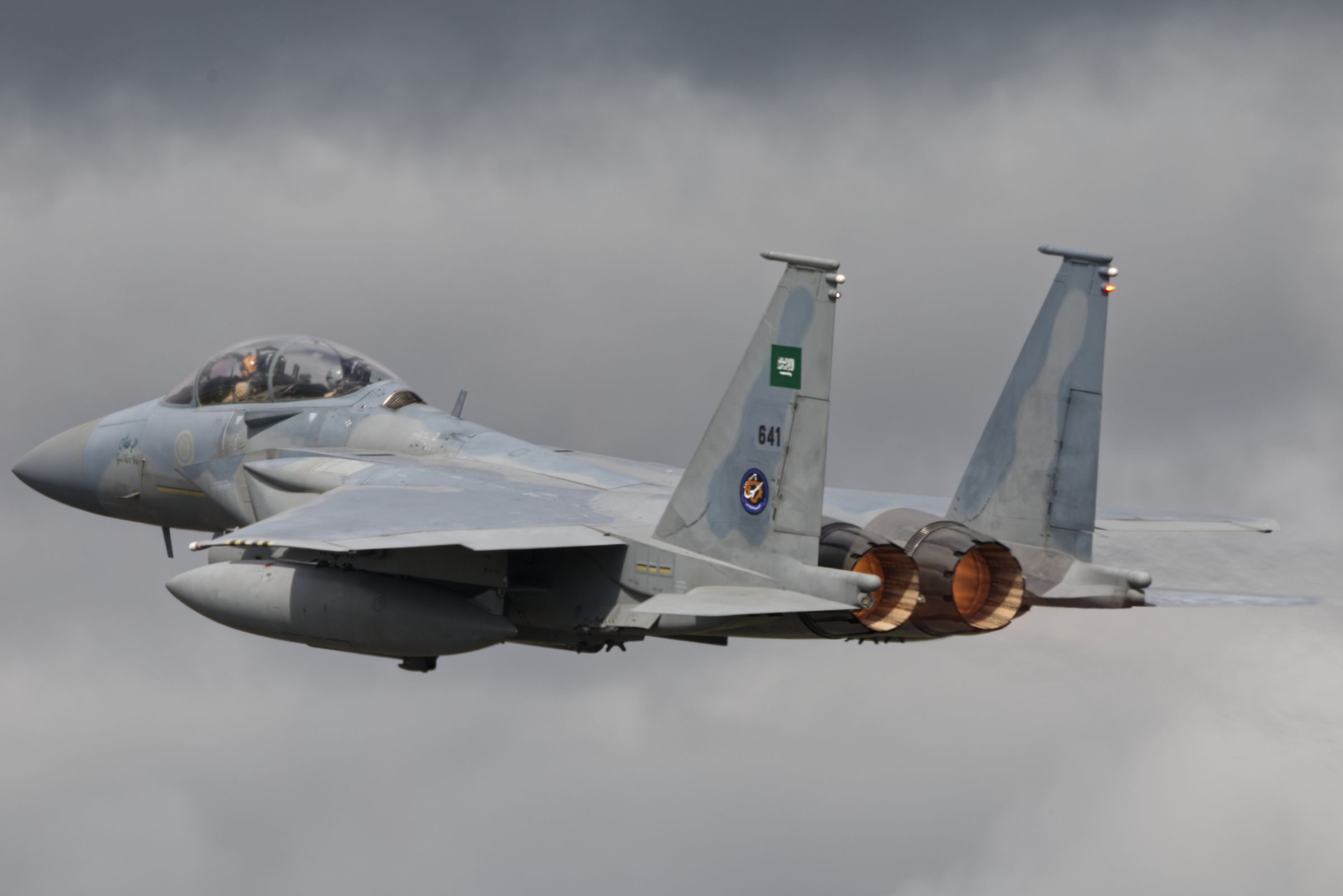
The Boeing F-15SA is a two-seat multirole fighter developed for the Royal Saudi Air Force as an advanced Saudi version of the F-15 Strike Eagle family. It combines air-to-air and air-to-surface capability with an active electronically scanned array radar, digital flight controls, modern electronic warfare equipment, and expanded weapon-station use.
Saudi Arabia ordered 84 newly built F-15SA aircraft and the modernization of 70 existing F-15S fighters to a comparable standard. The acquisition formed part of a Foreign Military Sales agreement valued at $29.4 billion.
The first F-15SA was rolled out at Boeing's St. Louis facility in April 2013. Deliveries of F-15SA aircraft took place from 2016 through 2020, with the final advanced fighters delivered in December 2020.
Development and acquisition
Saudi Arabia announced the Foreign Military Sales Letter of Offer and Acceptance in December 2011. The agreement covered 84 new F-15SA fighters and upgrades for 70 F-15S aircraft already operated by the Royal Saudi Air Force. Saudi personnel also received technical training at United States Air Force installations as part of the program.
The F-15SA incorporated systems and structural changes beyond the earlier Saudi F-15S. These included a redesigned wing, a new nose barrel, digital fly-by-wire flight controls, updated cockpit displays, an AESA radar, and a modern digital electronic warfare suite. The fly-by-wire system permitted the reactivation of underwing stations 1 and 9, increasing flexibility for external stores.
The Royal Saudi Air Force subsequently converted earlier F-15S aircraft to the upgraded SR configuration. By September 2026, the Saudi F-15 inventory included approximately 150 aircraft of the SA and SR standards within a total F-15 fleet of 232 aircraft.
Design
Airframe and flight controls
The F-15SA retains the basic twin-engine, twin-tail configuration of the Strike Eagle family and has two crew positions. Its airframe incorporates structural changes including a redesigned wing and new nose barrel. Digital fly-by-wire flight controls replaced the older control arrangement and enabled use of the additional outer-wing weapon stations.
Powerplant
The aircraft is powered by two General Electric F110-GE-129-series afterburning turbofan engines. The twin-engine arrangement is combined with the established F-15 variable-intake configuration and supports the fighter's multirole mission profile.
Cockpit and avionics
The F-15SA uses Raytheon's AN/APG-63(V)3 active electronically scanned array radar. Its avionics also include the Joint Helmet Mounted Cueing System and a Link 16 Multifunctional Information Distribution System.
An AN/AAS-42 infrared search and track system provides passive infrared sensing. The aircraft can also use the AN/AAQ-33 Sniper Advanced Targeting Pod and the AN/AAQ-13 Low Altitude Navigation and Targeting Infrared for Night system for air-to-surface missions.
Electronic warfare
The F-15SA is equipped with a BAE Systems digital electronic warfare system and common missile warning capability. The Digital Electronic Warning System provides integrated warning and electronic countermeasure functions. In 2026, the installed suite was identified as the AN/ALQ-239 DEWS.
Saudi Arabia has also considered a further modernization that would provide capability closer to the F-15EX standard. Boeing stated in February 2026 that possible changes included integration of the AN/APG-82 AESA radar and an improved electronic warfare system, likely the AN/ALQ-250 Eagle Passive Active Warning Survivability System. These were described as potential upgrades rather than equipment already fitted to the F-15SA fleet.
Armament
The F-15SA can be configured for air-to-air and air-to-surface missions. Supported air-to-air weapons include the AIM-9X Sidewinder and AIM-120C-7 AMRAAM, while a single 20 mm M61 Vulcan cannon provides an internal gun armament.
Supported air-to-surface weapons include the AGM-84H/K SLAM-ER, AGM-88 HARM, GBU-24 Paveway III, Joint Direct Attack Munition weapons, and Mk 82 and Mk 84 general-purpose bombs. Boeing has described configurations carrying as many as 12 air-to-air missiles or 24 air-to-ground munitions.
Operational history
The F-15SA serves with the Royal Saudi Air Force. Units identified with the type include No. 92 Squadron at King Abdulaziz Air Base and Nos. 6 and 55 Squadrons at King Khalid Air Base. An F-15SA also appeared internationally at Athens Flying Week in August 2023.
On 16 September 2026, Yemen's Houthi movement claimed that it had shot down a Royal Saudi Air Force F-15SA with a locally manufactured surface-to-air missile. Video released with the claim showed an F-15 maneuvering at night, dispensing countermeasures, apparently being struck, and wreckage later displayed on the ground. The tail shown in the footage carried the number 5539. Saudi authorities had not confirmed the loss when the claim was published, so the incident remained unverified.
Variants
- F-15SA: Newly built Saudi Advanced version of the two-seat F-15 Strike Eagle family, incorporating digital fly-by-wire controls, AN/APG-63(V)3 AESA radar, advanced electronic warfare systems, and expanded weapon-station capability.
- F-15SR: Designation associated with earlier Royal Saudi Air Force F-15S aircraft modified to the newer Saudi configuration.
Operators
- Royal Saudi Air Force: Ordered 84 newly built F-15SA aircraft and modernization of 70 F-15S fighters. The wider Saudi F-15 fleet numbered 232 aircraft by September 2026, including approximately 150 SA- and SR-standard aircraft.
Specifications (F-15SA)
General characteristics
- Crew: Two
- Powerplant: 2 × General Electric F110-GE-129-series afterburning turbofan engines
- Flight controls: Digital fly-by-wire
Avionics and mission systems
- Radar: AN/APG-63(V)3 AESA
- Electronic warfare: BAE Systems AN/ALQ-239 Digital Electronic Warning System
- Infrared sensor: AN/AAS-42 infrared search and track system
- Helmet-mounted system: Joint Helmet Mounted Cueing System
- Data link: Link 16 Multifunctional Information Distribution System
- Targeting pod: AN/AAQ-33 Sniper Advanced Targeting Pod
- Navigation and targeting system: AN/AAQ-13 LANTIRN
Armament
- Gun: 1 × 20 mm M61 Vulcan cannon
- Air-to-air missiles: AIM-9X Sidewinder and AIM-120C-7 AMRAAM
- Air-to-surface missiles: AGM-84H/K SLAM-ER and AGM-88 HARM
- Guided bombs: GBU-24 Paveway III and JDAM family weapons
- General-purpose bombs: Mk 82 and Mk 84
- Maximum cited weapon configurations: Up to 12 air-to-air missiles or 24 air-to-ground munitions
Related equipment
- F-15S: Earlier Saudi Strike Eagle variant from which aircraft were upgraded to the newer Saudi standard.
- F-15EX Eagle II: Later advanced F-15 version whose radar and electronic warfare capabilities have been considered as the basis for possible future Saudi upgrades.
 Argentina
 Armenia
 Australia
 Austria
 Austria-Hungary
 Belgium
 Brazil
 United Kingdom
 Brunei
 Bulgaria
 Canada
 Chile
Chile China
China Colonial America
 Colombia
 Confederate States
 Croatia
 Czech
Czech Denmark
 Egypt
Egypt Finland
 France
 Georgia
 Germany
 German Imperial
 Greece
 Holland
 Hungary
 India
India Indonesia
 Iran
Iran Iraq
Iraq Ireland
 Israel
 Italy
Italy Japan
Japan Japan (1940)
 Jordan
 Kingdom of Italy
 Malaysia
 Mexico
 Myanmar
 Nazi Germany
 Netherlands
 New Zealand
 North Korea
 Norway
 Pakistan
 Peru
Peru Philippines
 Poland
 Portugal
 Prussia
 Romania
 Russia
 Saudi Arabia
 Serbia
 Singapore
 Slovakia
 Slovenia
 South Africa
 South Korea
 Soviet Union
 Spain
Spain Sweden
 Switzerland
 Syria
Syria Taiwan
 Thailand
 Turkey
 UAE
UAE Ukraine
 Vietnam
 Yugoslavia