
History
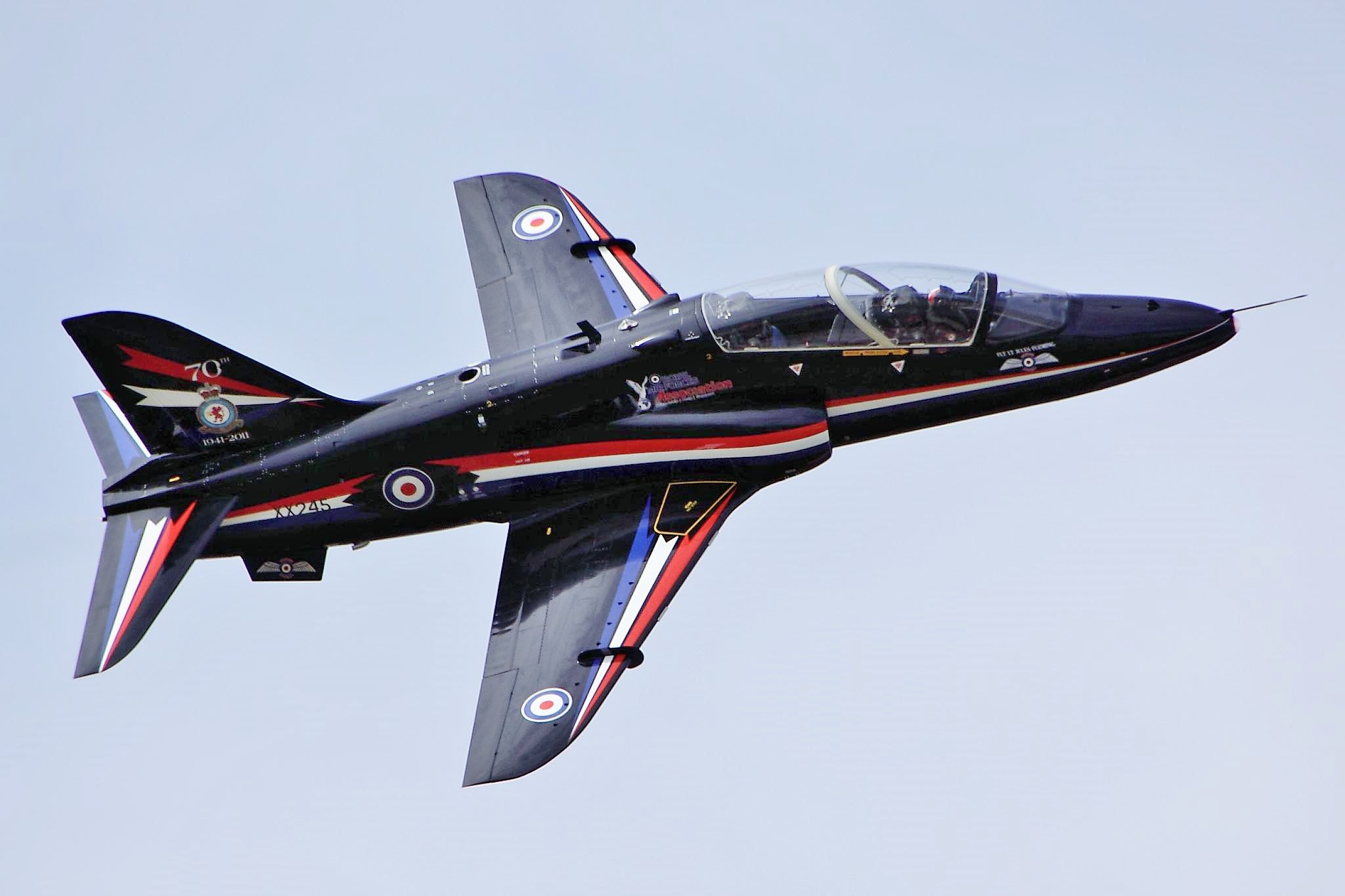
The BAE Systems Hawk T2, also designated Hawk 128, is a British single-engine, two-seat advanced jet trainer used by the Royal Air Force for advanced fast-jet training. It combines the established Hawk airframe with a modern glass cockpit, synthetic radar, data-link functions and simulated combat systems intended to prepare pilots for front-line aircraft.
The T2 is based at RAF Valley on Anglesey and forms part of the UK Military Flying Training System. Its training systems allow students and instructors to rehearse radar intercepts, electronic warfare situations and simulated weapon employment without requiring all of the sensors and weapons carried by operational fighters.
The aircraft represents a major modernization of the Hawk training concept rather than a completely new aircraft family. It retains the Hawk's tandem-seat, low-wing configuration and single turbofan engine while introducing avionics and training functions designed for pilots progressing to aircraft such as the Eurofighter Typhoon.
Development
The Hawk family originated from Hawker Siddeley's P.1182 trainer design. The original Hawk first flew in 1974 and entered RAF training service in 1976, replacing the Folland Gnat. The aircraft was developed specifically for advanced training and combined high manoeuvrability with comparatively straightforward operation and maintenance.
As front-line combat aircraft adopted multifunction displays, digital avionics and increasingly complex sensor systems, the RAF required an advanced trainer that could reproduce a more representative cockpit and tactical environment. The Hawk T2 was developed to meet this requirement.
In 2004, the UK Ministry of Defence contracted for 24 RAF-specific Hawk Mk 128 aircraft, known in service as the Hawk T2. The RAF describes the T2 as introduced in 2004 and fully operational by 2009. The first Hawk T2 deliveries also took place in 2009. The aircraft subsequently became the principal platform for advanced fast-jet training within the UK Military Flying Training System, with the type established as a central element of the training system during the following years.
The RAF ultimately operated a fleet of 28 Hawk T2 aircraft at RAF Valley. The aircraft has been used by IV Squadron and XXV (Fighter) Squadron for advanced fast-jet training of RAF and Royal Navy students.
Future replacement
By 2026, the United Kingdom was preparing for the eventual replacement of both the Hawk T2 training fleet and the remaining Hawk T1 aircraft used by the Red Arrows. The Defence Investment Plan issued in July 2026 identified replacement of the Hawk fleets as a priority. In August 2026, the Ministry of Defence issued a request for information connected with a future Jet Training System acquisition program.
Design
The Hawk T2 is a fully aerobatic, low-wing, transonic training aircraft with two seats arranged in tandem. The student normally occupies the forward cockpit and the instructor the rear cockpit. The aircraft retains the basic Hawk configuration with a single engine, wing-root air intakes and conventional tail surfaces.
The T2 uses a Rolls-Royce/Turbomeca Adour Mk 951 turbofan. The engine produces approximately 28.9 kN of thrust. The Mk 951 installation supports the performance required for advanced fast-jet training while retaining the Hawk family's single-engine layout.
Cockpit and avionics
A major distinction between the Hawk T2 and earlier RAF Hawks is its advanced glass cockpit. The cockpit and controls are intended to familiarize students with systems and operating methods similar to those encountered in modern front-line combat aircraft.
The aircraft uses a data link to support synthetic radar training. This allows pilots to conduct simulated intercept exercises and track other Hawk T2 aircraft in the training area without requiring a conventional fighter radar installation. The avionics can also simulate sensors and electronic warfare threats.
Electronic warfare training functions allow students to practise defensive reactions to simulated surface-to-air missile threats. The onboard simulation system also supports simulated air-to-ground weapon employment and other tactical scenarios. These functions allow a significant portion of tactical training to be conducted within the aircraft's avionics environment.
Airframe
The T2 retains the compact Hawk airframe but incorporates external changes associated with its upgraded systems. These include modifications to the nose and tail, additional fins, a radar warning receiver and a revised tail cone. The tail cone accommodates a brake parachute that can reduce stopping distance after landing compared with the Hawk T1.
The aircraft is 12.43 m long, 3.98 m high and has a wingspan of 9.94 m. Its wing area is 16.70 square metres and maximum takeoff weight is approximately 9,100 kg.
Operational history
The Hawk T2 operates primarily from RAF Valley in Wales as the RAF's advanced fast-jet training aircraft. It is used to prepare students for transition to operational combat aircraft by combining conventional flying instruction with simulated radar, sensor, electronic warfare and tactical training.
Before September 2026, 28 Hawk T2 aircraft were based at RAF Valley. The type was flown by IV Squadron and XXV (Fighter) Squadron as part of advanced fast-jet training.
On 23 September 2026, an RAF Hawk T2 crashed near RAF Valley after its instructor pilot and student ejected. Both crew members survived. The accident was the first loss of an RAF T2-standard Hawk. The destruction of the aircraft reduced the fleet from 28 to 27 examples.
The RAF opened an investigation into the accident. On 24 September 2026, Hawk T1 and Hawk T2 flying operations were temporarily paused as a precaution. The cause of the accident had not been established at that stage, and the RAF did not announce a technical explanation while the investigation was underway.
Operators
- Royal Air Force: Operates the Hawk T2 from RAF Valley for advanced fast-jet training. The fleet consisted of 28 aircraft before the loss of one aircraft on 23 September 2026. IV Squadron and XXV (Fighter) Squadron operate the type.
Specifications (Hawk T2 / Hawk 128)
General characteristics
- Crew: One or two pilots, normally a student and instructor during training
- Length: 12.43 m (40 ft 9 in)
- Wingspan: 9.94 m (32 ft 7 in)
- Height: 3.98 m (13 ft 1 in)
- Wing area: 16.70 square metres (179.64 sq ft)
- Maximum takeoff weight: 9,100 kg (20,000 lb)
- Powerplant: One Rolls-Royce/Turbomeca Adour Mk 951 turbofan
- Thrust: Approximately 28.9 kN (6,500 lbf)
Performance
- Maximum speed: Approximately 1,028 km/h (555 kt)
- Maximum altitude: Approximately 12,800 m (42,000 ft)
Training systems
- Cockpit: Advanced glass cockpit designed for modern fast-jet training
- Radar training: Synthetic radar functions supported by data link
- Electronic warfare training: Simulated electronic warfare and surface-to-air missile threat scenarios
- Weapon training: Onboard simulation supporting simulated air-to-ground weapon employment
- Defensive systems training: Radar warning receiver and simulated sensor functions
Related equipment
- BAE Systems Hawk T1: Earlier RAF Hawk trainer variant that preceded the T2 in the advanced fast-jet training role and remains associated with the Red Arrows.
- BAE Systems Hawk family: The wider family of British advanced trainers and light combat aircraft from which the Hawk T2 was developed.
 Argentina
 Armenia
 Australia
 Austria
 Austria-Hungary
 Belgium
 Brazil
 United States
 Brunei
 Bulgaria
 Canada
 Chile
Chile China
China Colonial America
 Colombia
 Confederate States
 Croatia
 Czech
Czech Denmark
 Egypt
Egypt Finland
 France
 Georgia
 Germany
 German Imperial
 Greece
 Holland
 Hungary
 India
India Indonesia
 Iran
Iran Iraq
Iraq Ireland
 Israel
 Italy
Italy Japan
Japan Japan (1940)
 Jordan
 Kingdom of Italy
 Malaysia
 Mexico
 Myanmar
 Nazi Germany
 Netherlands
 New Zealand
 North Korea
 Norway
 Pakistan
 Peru
Peru Philippines
 Poland
 Portugal
 Prussia
 Romania
 Russia
 Saudi Arabia
 Serbia
 Singapore
 Slovakia
 Slovenia
 South Africa
 South Korea
 Soviet Union
 Spain
Spain Sweden
 Switzerland
 Syria
Syria Taiwan
 Thailand
 Turkey
 UAE
UAE Ukraine
 Vietnam
 Yugoslavia