
History
The Aero Vodochody L-39 Skyfox Drone Hunter is a counter-unmanned-aircraft configuration of the Czech L-39 Skyfox advanced trainer and light combat aircraft. It combines the existing Skyfox platform with an electro-optical targeting system and comparatively low-cost 70 mm laser-guided rockets for engaging unmanned aircraft.
The concept is intended to provide a mobile airborne layer of counter-UAS defense without requiring supersonic fighters for routine drone interception. The conversion is designed so that training-configured Skyfox aircraft can receive the required mission equipment with limited modification and later return to their training role.
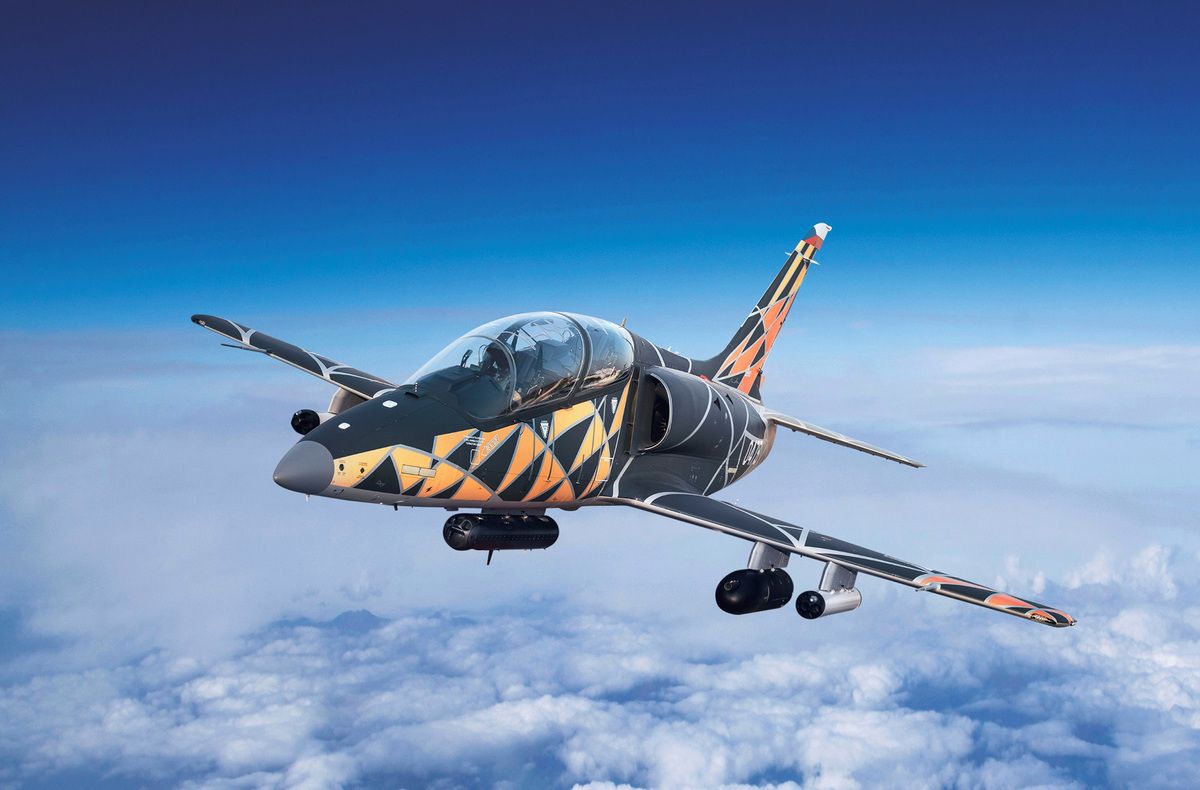
Aero Vodochody publicly demonstrated the Drone Hunter configuration in the Czech Republic in September 2026. The aircraft carried two LAU-32 70 mm rocket pods beneath the wings and a SiNAB Phoenix 10 electro-optical intelligence, surveillance, reconnaissance, and targeting pod beneath the fuselage.
Development
Aero Vodochody was already promoting a counter-UAS role for the L-39 Skyfox in 2025. The proposed configuration paired an electro-optical targeting pod with laser-guided 70 mm rockets, using the aircraft's existing payload capacity, endurance, and open-architecture avionics to support a new mission without creating a dedicated interceptor aircraft.
The counter-UAS conversion was developed around equipment that could be installed on existing Skyfox aircraft. Its primary components are an electro-optical pod and laser-guided rockets. Aero Vodochody also identified identification friend-or-foe equipment and a high-capacity data link as necessary additions before the aircraft could conduct live operational counter-UAS missions.
In July 2026, Aero Vodochody described the basic Drone Hunter configuration as carrying 14 guided rockets, with a possible future capacity of up to 28. The company expected the conversion kit to be ready for operational use by the end of 2026, although this was a planned milestone rather than confirmed operational service.
Public demonstration
In September 2026, the L-39 Skyfox Drone Hunter was presented at the NATO Days event at Leoš Janáček Airport in the Czech Republic. The demonstrated aircraft carried a pair of LAU-32 rocket pods on underwing hardpoints and a SiNAB Phoenix 10 sensor and targeting pod on the underfuselage hardpoint. The event represented the first Czech public presentation of the Skyfox in the Drone Hunter configuration.
Design
The Drone Hunter is based on the L-39 Skyfox airframe rather than a newly built dedicated counter-UAS aircraft. The Skyfox was designed with provision for five external hardpoints, allowing sensor pods, weapons, and other mission equipment to be integrated while retaining the underlying trainer and light-combat configuration.
Sensors and targeting
The primary sensor proposed for the Drone Hunter is the compact SiNAB Phoenix electro-optical pod. It is intended for target detection, identification, tracking, and weapon guidance. The pod can be fitted to the Skyfox's wing or fuselage hardpoints and is controlled by the pilot through an 8-inch touchscreen tablet.
Electro-optical sensing allows the aircraft to search for relatively small aerial targets without relying solely on an onboard radar. Aero Vodochody has also identified a more powerful sensor head, an AESA radar pod, and electronic-warfare equipment as possible future additions rather than elements of the demonstrated baseline configuration.
Armament
The principal weapon planned for the counter-UAS mission is the 70 mm FZ275 LGR laser-guided rocket. The weapon has a stated range of more than 8 km. An alternative integration path can use Hydra 70 rockets fitted with the APKWS II laser-guidance section.
The basic Drone Hunter configuration is expected to carry 14 guided rockets. A future configuration could increase this to as many as 28. Aero Vodochody has also identified a 12.7 mm gun pod as a possible later addition. A gun pod was not part of the demonstrated September 2026 configuration.
Mission systems
For operational employment, the aircraft is intended to exchange information with airborne or ground-based command-and-control elements through a high-capacity data link. An advanced identification friend-or-foe system is also required for live combat use. These systems are important for integrating an airborne interceptor into a wider air-defense network and reducing the risk of engagement errors.
Airframe and propulsion
The Skyfox uses a Williams FJ44-4M turbofan engine and an integral wing fuel tank. The aircraft can operate from unpaved surfaces, including grass airfields, allowing dispersed deployment away from major permanent bases. Its open-architecture avionics are intended to simplify the integration of additional mission equipment.
Program status
As of September 2026, the Skyfox Drone Hunter had been publicly demonstrated but had not been confirmed as an operational counter-UAS system. Aero Vodochody planned to make the conversion kit ready for operational use by the end of 2026.
The proposed engagement envelope covers aerial targets moving at approximately 150 to 600 km/h and at altitudes up to 8,000 m. The intended target set includes unmanned aircraft and potentially some types of cruise missile. These figures describe the planned capability of the configuration rather than a confirmed record from operational combat use.
The modular architecture leaves room for later additions including a 12.7 mm gun pod, decoy launcher, AESA radar pod, and electronic-warfare equipment. The same mission suite has also been considered for integration with the L-159 aircraft.
Specifications (L-39 Skyfox Drone Hunter demonstrator)
General characteristics
- Powerplant: Williams FJ44-4M turbofan engine
- External payload: 1,200 kg
- Hardpoints: provision for five wing and fuselage stations
- Counter-UAS sensor: SiNAB Phoenix electro-optical ISR and targeting pod
Performance
- Maximum speed: approximately 778 km/h (420 kt)
- Endurance: up to 4.5 hours
- Range: approximately 2,593 km (1,400 nmi)
- Service ceiling: approximately 11,600 m (38,000 ft)
- Planned counter-UAS target speed envelope: approximately 150-600 km/h
- Planned counter-UAS target altitude: up to 8,000 m
Armament
- Demonstrated rocket installation: two LAU-32 70 mm rocket pods
- Primary planned counter-UAS weapon: FZ275 LGR 70 mm laser-guided rockets
- Alternative guided rocket: Hydra 70 with APKWS II laser-guidance section
- Basic planned guided-rocket load: 14 rockets
- Future planned guided-rocket capacity: up to 28 rockets
- FZ275 LGR range: more than 8 km
 Argentina
 Armenia
 Australia
 Austria
 Austria-Hungary
 Belgium
 Brazil
 United Kingdom
 United States
 Brunei
 Bulgaria
 Canada
 Chile
Chile China
China Colonial America
 Colombia
 Confederate States
 Croatia
 Denmark
 Egypt
Egypt Finland
 France
 Georgia
 Germany
 German Imperial
 Greece
 Holland
 Hungary
 India
India Indonesia
 Iran
Iran Iraq
Iraq Ireland
 Israel
 Italy
Italy Japan
Japan Japan (1940)
 Jordan
 Kingdom of Italy
 Malaysia
 Mexico
 Myanmar
 Nazi Germany
 Netherlands
 New Zealand
 North Korea
 Norway
 Pakistan
 Peru
Peru Philippines
 Poland
 Portugal
 Prussia
 Romania
 Russia
 Saudi Arabia
 Serbia
 Singapore
 Slovakia
 Slovenia
 South Africa
 South Korea
 Soviet Union
 Spain
Spain Sweden
 Switzerland
 Syria
Syria Taiwan
 Thailand
 Turkey
 UAE
UAE Ukraine
 Vietnam
 Yugoslavia