

History
The ZALA Lancet is a loitering munition and unmanned aerial vehicle developed by ZALA Aero Group, a division of the Kalashnikov Concern, for the Russian Armed Forces. It is a further development of the ZALA Kub-BLA (KYB-UAV) loitering munition. The system was first unveiled in June 2019 at the ARMY-2019 military exhibition in Moscow.
Prior to the large-scale Russian military operation in Ukraine, the Lancet was tested in operational conditions in Syria, with the first reported combat deployment occurring in November 2020. Following the escalation of the conflict in 2022, Lancet munitions entered widespread service with Russian ground forces and became one of the most frequently employed precision strike weapons on the battlefield.
In October 2026, ZALA released footage showing a Lancet equipped with the IRRA intelligent guidance and target-recognition system destroying a Ukrainian T-72 tank near the settlement of Sliznevo in Kharkiv region. The strike was carried out by personnel of the Azimut Battalion, part of Russia’s 37th Separate Brigade of Unmanned Systems. The impact caused a fire and explosion that destroyed the vehicle, illustrating the growing role of loitering munitions as primary anti-tank weapons in the conflict.
A new disposable portable launcher allowing a single operator to launch the munition completed combat testing and entered series production in January 2026. Export authorization for the Lancet was issued in February 2026, after the Russian state arms exporter Rosoboronexport had earlier declined export requests citing high domestic demand.
Design
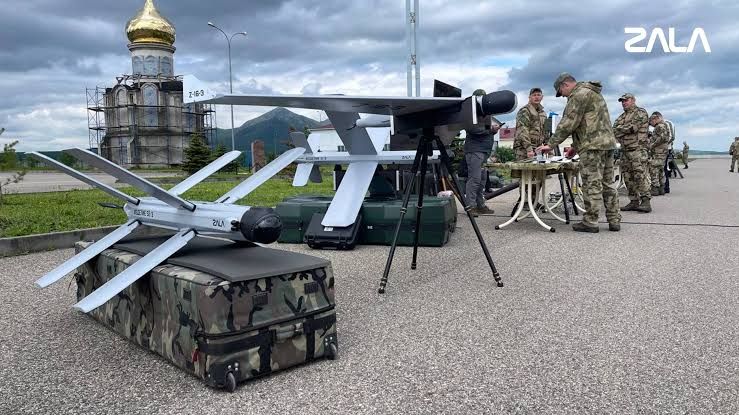
The Lancet features a cylindrical fuselage with two pairs of X-shaped wings mounted at the front and rear of the airframe. The structure is built from composite materials for a lightweight design. A rear-mounted electric motor drives a two-blade propeller in a pusher configuration. The drone is stored in a portable carrying case, carried to the launch site, unfolded, and launched via a catapult. A crew of two operators controls the system from a ground station using an antenna or mobile ground control unit. A forward-mounted camera provides visual target identification and guidance during the terminal phase.
Guidance and avionics
The Lancet carries optical-electronic and TV guidance units that allow the ground operator to control the munition during the terminal stage of flight. The IRRA intelligent guidance and target-recognition system enables autonomous target identification and engagement without continuous operator input. Onboard processing is supported by an NVIDIA Jetson TX2 module for artificial-intelligence image analysis and a U-Blox multi-GNSS navigation module with anti-jamming and anti-spoofing capabilities. The system operates on the 868–870 MHz and 902–928 MHz frequency bands, using two active channels plus a reserve frequency to complicate enemy jamming. The munition can interface with communication-relay UAVs to extend its operational reach.
Armament
In strike mode the Lancet carries a warhead in the forward section of the airframe. Available warhead types include high-explosive (HE), HE-fragmentation, shaped-charge (HEAT), and thermobaric variants. The standard configuration carries a warhead of 1 to 3 kg. The munition uses a rangefinder to detonate at a preset standoff distance from the target, a feature that allows it to defeat protective mesh cages that may disrupt impact fuses on other drone systems.
Operational history
During the Russo-Ukrainian War, Ukrainian forces developed several countermeasures against the Lancet. These included welded chain-link and wire-mesh cages erected around artillery pieces to disrupt the impact fuse, as well as inflatable and wooden vehicle decoys intended to divert munitions away from high-value targets. From 2024, Ukrainian forces also began intercepting Lancets and other Russian drones with their own FPV drones, using high-speed diving attacks to destroy the targets before they could reach their objectives.
Variants
- Izdeliye 52 (Lancet-3): Baseline variant with a 3 kg warhead, 12 kg maximum takeoff weight, and approximately 40 minutes of endurance. Upgraded with a new electro-optical guidance system and a larger warhead as of March 2023.
- Izdeliye 51: Enlarged variant with a flight duration of one hour and a warhead weighing more than 5 kg, at least 2 kg heavier than the Izdeliye 52. Introduced for enhanced strike missions against heavier targets.
- Izdeliye 53: Next-generation swarm-capable variant launchable from a four-tube pneumatic launcher that permits multiple munitions to be released in rapid succession. The design bears a resemblance to the Israeli UVision Hero-120. Russian authorities have claimed combat use, though independent confirmation of operational employment has not been established.
- Lancet-1: Smaller variant with a 5 kg maximum takeoff weight and a 1 kg payload.
Operators
- Russia: Russian Ground Forces. Primary operator. Used extensively in the Russo-Ukrainian War. Export was suspended in 2023 due to domestic demand; export authorization was issued in February 2026.
Specifications (Lancet-3 / Izdeliye 52)
General characteristics
- Type: Loitering munition / one-way attack UAV
- Crew: 2 ground operators (unmanned in flight)
- Maximum takeoff weight: 12 kg
- Payload: 1–3 kg
- Powerplant: Electric motor with two-blade pusher propeller
- Launch method: Catapult from ground or sea platform
Performance
- Cruise speed: 80–110 km/h
- Terminal dive speed: up to 300 km/h (air-mining role)
- Range: 40 km
- Endurance: 40 minutes
Armament and guidance
- Warhead: HE, HE-fragmentation, HEAT, or thermobaric; 1–3 kg (standard)
- Guidance: Optical-electronic, TV, IRRA intelligent target recognition; U-Blox multi-GNSS navigation with anti-jamming
Related equipment
- ZALA Kub-BLA (KYB-UAV): Predecessor loitering munition from which the Lancet was developed.
- UVision Hero-120: Israeli loitering munition with a design closely resembling the Lancet Izdeliye 53.
- AeroVironment Switchblade: United States loitering munition of comparable role.
- RAM-2X: Ukrainian loitering munition developed as a countermeasure response.
 Argentina
 Armenia
 Australia
 Austria
 Austria-Hungary
 Belgium
 Brazil
 United Kingdom
 United States
 Brunei
 Bulgaria
 Canada
 Chile
Chile China
China Colonial America
 Colombia
 Confederate States
 Croatia
 Czech
Czech Denmark
 Egypt
Egypt Finland
 France
 Georgia
 Germany
 German Imperial
 Greece
 Holland
 Hungary
 India
India Indonesia
 Iran
Iran Iraq
Iraq Ireland
 Israel
 Italy
Italy Japan
Japan Japan (1940)
 Jordan
 Kingdom of Italy
 Malaysia
 Mexico
 Myanmar
 Nazi Germany
 Netherlands
 New Zealand
 North Korea
 Norway
 Pakistan
 Peru
Peru Philippines
 Poland
 Portugal
 Prussia
 Romania
 Saudi Arabia
 Serbia
 Singapore
 Slovakia
 Slovenia
 South Africa
 South Korea
 Soviet Union
 Spain
Spain Sweden
 Switzerland
 Syria
Syria Taiwan
 Thailand
 Turkey
 UAE
UAE Ukraine
 Vietnam
 Yugoslavia