
History
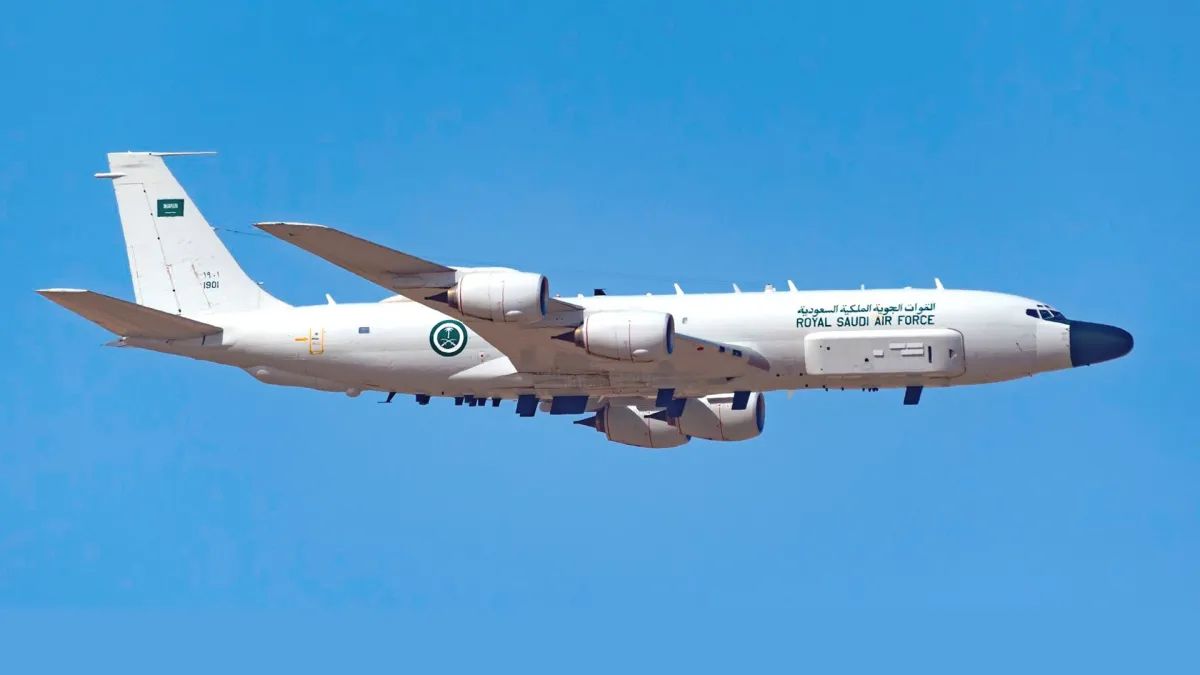
The Boeing RE-3A is a signals intelligence (SIGINT) aircraft operated by the Royal Saudi Air Force. It is derived from the Boeing 707 airframe, specifically from the KE-3A aerial refueling tanker variant that the RSAF received in 1986 as part of the “Peace Sentinel” program. One of the eight KE-3A aircraft was selected for conversion into a dedicated intelligence-gathering platform.
The conversion to the RE-3A Tactical Airborne Surveillance System (TASS) standard was carried out by Raytheon Intelligence, Information and Services at Majors Field, Greenville, Texas. The conversions were managed on the RSAF’s behalf by the U.S. Air Force 645th Aeronautical Systems Group. After the initial conversion, the aircraft underwent further upgrades in the United States in December 2001 and was re-delivered to the RSAF in January 2004.
In 2009, the United States approved a further upgrade of the RE-3 fleet as part of a program valued at 530 million USD, with L-3 Communications Integrated Systems as the main contractor. The upgrade package included installation of AN/ARC-230 HF secure voice/data systems, AN/ARC-231 or AN-ARC-210 VHF/UHF secure systems, four MIDS-LVT terminals, four LN-100GT inertial reference units, and multiple cryptographic systems, along with ground station modifications, training equipment, and technical documentation.
In March 2026, during the intensive phase of the U.S. military operation “Epic Fury,” an Iranian strike on Prince Sultan Air Base caused heavy damage to the RE-3A. Satellite imagery confirmed the extent of the damage to the aircraft, which was parked at the same base where American E-3G Sentry and KC-135R aircraft were destroyed.
Design
The RE-3A is derived from the Boeing 707 wide-body airframe and retains its general structural configuration. As a SIGINT platform, the aircraft is equipped with external antenna arrays and fairings used to intercept and analyze enemy communications, radar emissions, and other electronic signals. The initial configuration featured “cheek” fairings on the fuselage sides and ventral antennas. The upgraded configuration added a distinctive “hog nose” radome along with revised dorsal and ventral antenna farms. The aircraft is broadly comparable to the U.S. Air Force RC-135V/W Rivet Joint, though the initial RE-3A configuration did not feature the full RC-135 antenna complement.
The mission system enables the aircraft to detect, record, and geolocate enemy radio transmissions and radar emissions, contributing to the construction of an electronic order of battle.
Operational history
The RE-3A is operated by No. 19 Squadron of the RSAF 6 Wing at Prince Sultan Air Base, Al-Kharj, Riyadh Province. The squadron also operates the Beech 350ER-ISR and the Boeing RE-3B Improved TASS. The RE-3A has been employed in intelligence-gathering missions in support of regional security operations, including the conflict against Houthi rebels in Yemen. In September 2021, the RE-3A (serial 1901) made a stopover at RAF Waddington, United Kingdom, en route to the United States for maintenance and upgrade work.
In March 2026, the RE-3A sustained heavy damage during an Iranian strike on Prince Sultan Air Base. The damage was documented through satellite imagery.
Variants
- RE-3A TASS – Tactical Airborne Surveillance System configuration, the primary SIGINT variant. Two airframes are known in RSAF service, including serial 1901.
- RE-3B ITASS – Improved Tactical Airborne Surveillance System variant. One airframe (serial 1902) is known in service.
Operators
- Saudi Arabia – Royal Saudi Air Force, No. 19 Squadron at Prince Sultan Air Base. Two RE-3A TASS and one RE-3B ITASS in service.
 Argentina
 Armenia
 Australia
 Austria
 Austria-Hungary
 Belgium
 Brazil
 United Kingdom
 Brunei
 Bulgaria
 Canada
 Chile
Chile China
China Colonial America
 Colombia
 Confederate States
 Croatia
 Czech
Czech Denmark
 Egypt
Egypt Finland
 France
 Georgia
 Germany
 German Imperial
 Greece
 Holland
 Hungary
 India
India Indonesia
 Iran
Iran Iraq
Iraq Ireland
 Israel
 Italy
Italy Japan
Japan Japan (1940)
 Jordan
 Kingdom of Italy
 Malaysia
 Mexico
 Myanmar
 Nazi Germany
 Netherlands
 New Zealand
 North Korea
 Norway
 Pakistan
 Peru
Peru Philippines
 Poland
 Portugal
 Prussia
 Romania
 Russia
 Saudi Arabia
 Serbia
 Singapore
 Slovakia
 Slovenia
 South Africa
 South Korea
 Soviet Union
 Spain
Spain Sweden
 Switzerland
 Syria
Syria Taiwan
 Thailand
 Turkey
 UAE
UAE Ukraine
 Vietnam
 Yugoslavia