
History
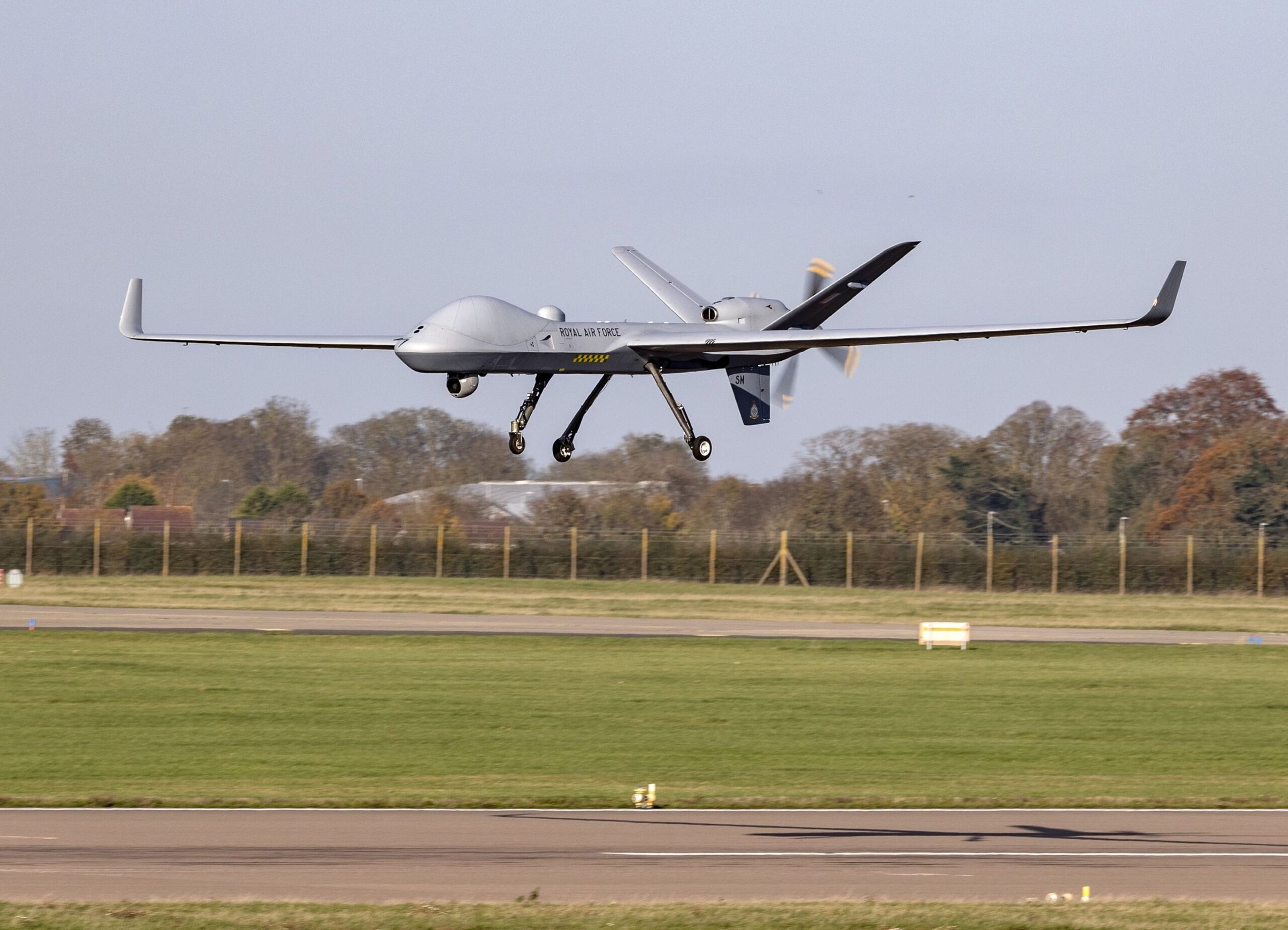
The Protector RG Mk1 programme was first announced by the British Prime Minister in October 2015. In July 2018, the prototype made its first transatlantic flight to the Royal International Air Tattoo, and No. 31 Squadron was designated as the first Protector squadron. In July 2020, the Ministry of Defence signed a
65 million contract for the initial purchase of three aircraft, with an option to acquire 13 more. The following month, the UK and Belgium formalised a Bilateral Statement of Intent to collaborate on their MQ-9B programmes. By September 2020, the UK92s first Protector completed its maiden flight. In the summer of 2021, the prototype returned to the UK for airspace integration flights, and in November 2023, the Protector achieved its first flight in UK airspace.
Flight testing in February 2025 was a key stage in preparing the aircraft for operational use. The UK Military Aviation Authority granted the Protector a Military Type Certificate on 29 April 2025, the first such certificate for a large unmanned aircraft system, based on NATO STANAG 4671. The certification permits flight without geographic restrictions, including over densely populated areas, and operation in non-segregated airspace alongside civil traffic. The aircraft entered operational service in June 2025.
In late September to mid-October 2026, the RAF flew the Protector RG1 on its first operational missions in UK airspace. Crews from No. XIII Squadron at RAF Waddington flew the unarmed aircraft, which provided more than 10 hours of continuous intelligence, surveillance and reconnaissance coverage over the English Channel. The deployment directly supported the Type 45 destroyer HMS Dauntless and the offshore patrol vessel HMS Tyne as they shadowed the Russian Navy frigate Neustrashimy between 1 and 14 October 2026. The first operational sorties marked a capability milestone: the MQ-9A Reaper, which the Protector replaces, never flew in British airspace during its career with the RAF due to certification limitations.
Specifications
The Protector RG1 is a medium-altitude, long-endurance remotely piloted aircraft based on the General Atomics Aeronautical Systems (GA-ASI) MQ-9B SkyGuardian, designed from the outset to meet NATO STANAG 4671 and UK MOD DEF STAN 00-970 airworthiness standards as well as civil airspace requirements. It is powered by a single Honeywell TPE331-10T turboprop engine producing 900 shp. The ground crew consists of one pilot, one sensor operator, and one mission intelligence coordinator.
RAF official data list a length of 11.43 m, a wingspan of 24.07 m, a height of 3.78 m, a maximum speed of 250 kt, and a maximum altitude of 50,000 ft; other technical references give a length of 11.7 m, a maximum speed of 210 KTAS (390 km/h), and an operational ceiling of 40,000 ft (12,200 m). Maximum takeoff weight is 5,670 kg (12,500 lb). Declared endurance exceeds 30 hours, with RAF data stating over 40 hours of capability.
The sensor suite comprises a Raytheon AN/DAS multi-spectral targeting system providing full-motion video and infrared imagery, a synthetic aperture radar with ground moving target indication, and a detect-and-avoid system incorporating TCAS II, ADS-B Out, and Due Regard Radar. Ordnance hardpoints are qualified for MBDA Brimstone 3A anti-armour missiles and Raytheon Paveway IV laser-guided bombs.
Program Status
The British programme calls for 16 Protector RG1 aircraft based at RAF Waddington in Lincolnshire, operated by Nos. 31 and XIII Squadrons. The first aircraft arrived at the base in 2023, and 11 airframes had been delivered by late 2026. The programme is supported by a supply chain of over 200 UK companies, with more than
400 million reinvested into UK industry. The UK and Belgium established the MQ-9B International Cooperative Program, and in July 2024 both nations became founding partners in the MQ-9 International Cooperation Support Partnership under the NATO Support and Procurement Agency.
 Argentina
 Armenia
 Australia
 Austria
 Austria-Hungary
 Belgium
 Brazil
 United States
 Brunei
 Bulgaria
 Canada
 Chile
 China
 Colonial America
 Colombia
 Confederate States
 Croatia
 Czech
 Denmark
 Egypt
 Finland
 France
 Georgia
 Germany
 German Imperial
 Greece
 Holland
 Hungary
 India
 Indonesia
 Iran
 Iraq
 Ireland
 Israel
 Italy
 Japan
 Japan (1940)
 Jordan
 Kingdom of Italy
 Malaysia
 Mexico
 Myanmar
 Nazi Germany
 Netherlands
 New Zealand
 North Korea
 Norway
 Pakistan
 Peru
 Philippines
 Poland
 Portugal
 Prussia
 Romania

 Russia
 Saudi Arabia
 Serbia
 Singapore
 Slovakia
 Slovenia
 South Africa
 South Korea
 Soviet Union
 Spain
 Sweden
 Switzerland
 Syria
 Taiwan
 Thailand
 Turkey
 UAE
 Ukraine
 Vietnam
 Yugoslavia