


History
During World War II (1939-1945), the United States Navy (USN) - like the United States Air Force (USAF) - undertook various programs to find more modern and capable solutions to meet U.S. Air Force needs. war becomes.
In addition to fighter numbers, the service also sought to increase its inventory of dive bombers and torpedo bombers as the war in the Pacific expanded. Additionally, the development of the ground attack role and many existing fighter jets were quickly converted into fighter-bombers, but they lacked the ammunition-carrying capability and the range needed to cover the vast Pacific theater.
Skyraider Origins
Douglas has attempted to sell several "large" carrier-based aircraft designs to the US Navy in order to maintain the US Navy's interest in Douglas aircraft products for as long as possible. However, many projects ended up failing or being forgotten, so the next attempt took a fresh approach.
The initiative was presented in discussions with US naval authorities in June 1944, and experienced Douglas engineers (including the famous aircraft designer Ed Heinemann) immediately got to work and produced a large fighter concept in a short period of time . The proposal submitted by Douglas was enough to persuade the US Navy to order 15 (later increased to 25) prototypes, designated "XBT2D-1", on July 21.
The speed at which the war develops also determines the development window for the fighter, and the XBT2D-1 proves that it is no different. The design team completed the mockup for review in August, emphasizing practicality, incorporating many existing components and proven design cues into the new aircraft. A lot of thought went into the design, too, based on first-hand accounts of ground pilots and company employees who brought these notes back to the United States.
A prototype was unveiled in February 1945, and the aircraft made its first flight on March 15 of that yearthe XBT2D-1 arrived underweight and about four months ahead of schedule.
Skyraider Tour
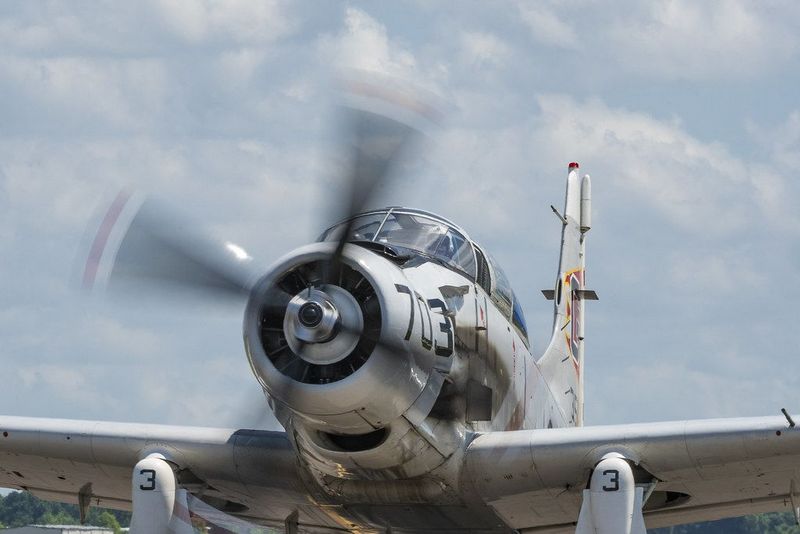
The XBT2D-1 looked like a very large fighter jet, which was usually a very conventional aircraft at the time. Engineers abandoned the idea of ??internal bomb loading to make room for fuel and other appropriate equipment. The ability to carry ordnance comes from straight-wing appendages, each of which provides seven hardpoints. In addition, a hard point is located under the hull. At least two underwing locations and fuselage centerline hardpoints are also provided for external fuel supplies, while internal fuel is contained in a single fuel tank.
A powerful 2,300 hp Wright R-3350-8 supercharged radial piston engine is mounted in the nose and drives a large four-bladed propeller unit. Immediately aft of the engine bay is the single-seat cockpit, under a bubble canopy overlooking the nose and wings. As the plane is expected to fly low to counter enemy air defenses, the cockpit is protected by over 200 pounds of armor plates. The wings were mounted amidships and propelled most of the plane's mass forward.
The hull is mostly tubular, although the profile is somewhat deep (and unwieldy looking). The lower rear side of the fuselage is the plate side, which contains the dive brake plate, and a third plate is added to the abdomen. The tail uses a rounded vertical tail and a low-set horizontal plane. A typical "trailer" landing gear arrangement was used, with the main legs folded back under the wings.
A fishing hook is mounted under the tail, and the wing main aircraft is designed to fold outward from the main legs for carrier storage.
A total of 15 hardpoints - plus massive engine power - capable of transporting up to 6,000 lbs of external supplies. Standard armament consisted of 2 x 20mm cannons (later four) mounted on the wings. Pilots could use these weapons as offensive and defensive measures (as seen in subsequent wars).
The AD-2 followed as an improved brand of the AD-1. These introduced the Wright R-3350-26W radial engine with 2,700 horsepower. 156 aircraft were built to this standard. AD-2D is a lesser-known variant used for post-nuclear data acquisition and remote manipulation. The AD-2Q was built in 21 copies of the AD-2 as a two-seat ECM aircraft.
The AD-2QU is a radar countermeasure platform in the same style as the previous AD-1U (without weapons and water injection) - only one example has been implemented.
The AD-3 became the turboprop A2D Skyshark experiment mentioned above, so the AD-3 name was later reused as a continuation of the direct AD Skyraider series, with a strengthened fuselage, longer landing gear legs and New canopy design. 125 of this brand were produced. The AD-3S became an anti-submarine warfare (ASW) platform, although only two prototypes of this model exist.
Fifteen three-seat AD-3N Night Raiders were produced. AD-3Q is another ECM model followed by 23 examples. The AD-3QU became the target turret, and the AD-3W consisted of 31 aircraft in the AEW role.
The AD-4 brings reinforced landing gear legs, navigation improvements, cockpit upgrades, new radar, underwing missile support and 4 x 20mm cannons as standard armament. The brand completed 372. The AD-4B is a special mission aircraft capable of delivering nuclear bombs and exists in 165 new builds and 28 retrofits. The AD-4L was a winter model in service with South Korea, with 63 aircraft purchased.
AD-4N 307 is an example of a three-seater night raid model. AD-4NA specifies 100 AD-4N aircraft with night mission equipment removed. The AD-4NL is a 36 modification of the AD-4N aircraft. The AD-4Q existed as a two-seat ECM aircraft, with 39 prototypes procured.
AD-4W is a three-seat AEW platform with 168 delivered. 50 of these later entered service with the Royal Navy as Skyraider AEW Mk. 1
The AD-5 model uses a unique side-by-side cockpit layout and is done without the usual dive brakes. 212 of this type are implemented. 239 examples of AD-5N, a four-seater night attack platform, were found. The AD-5Q is a four-seat ECM model converted from 54 existing airframes. The AD-5S was used as a one-off prototype for ASW device testing using a Magnetic Anomaly Detector (MAD).
The AD-5W is a three-seat model for AEW service, with 218 completed. The UA-1E is a utility variant of the AD-5 brand.
The AD-6 was built in 713 examples as a single-seat attack platform with an ammunition carrying capacity of up to 3,500 lbs. The AD-7 followed, albeit with the Wright R-3350-26WB engine and improved durability. This is the last official Skyraider production model of which 72 have been completed.
In the 1962 revision, the AD-1 Skyraider became the A-1 Skyraider, and its various brands followed. A-4D becomes A-1D, AD-5 becomes A-1E, AD-5N becomes A-1G, AD-5Q becomes EA-1F, AD-6 becomes A-1H, AD-7 becomes A-1H A-1J.
Specification
Basic
Production
Roles
- Fighter
- Ground Attack
- Close Air Support (CAS)
- Airborne Early Warning (AEW)
- Anti-ship
- Electronic Warfare (EW)
- Naval/Navigation
- Search and Rescue (SAR)
- Reconnaissance (RECCE)
Dimensions
39.37 ft (12 m)
50.00 ft (15.24 m)
15.75 ft (4.8 m)
Weight
10,470 lb (4,749 kg)
8,178 kg
Performance
Performance
321 mph (517 km/h; 279 knots)
26,001 ft (7,925 m; 4.92 mi)
1,553 miles (2,500 km; 1,350 nautical miles)
701 m/min (2,300 ft/min)
Armor
Default:
2 or 4 x 20mm wing cannons (depending on model)
6,000 lbs to 8,000 lbs of storage space spread across 15 external hardpoints to support a variety of ordnance including rockets, rocket pods, torpedoes, mine dispensers, conventional (and nuclear) drop bombs and fuel tanks.
Changes
XBT2D-1 "Destroyer II" - Prototype model name.
AD-1 - Equipped with R-3350-24W 2,500 hp radial engine; 2 x 20mm guns; 8,000 lbs of Underwing storage; 242 pieces produced.
Increased fuel capacity for AD-2 - 156 production.
AD-1Q
AD-2Q
AD-3 - 125 production; new canopy and landing gear systems.
AD-3N - Night Attack Variant
AD-3Q - Electronic Countermeasures
AD-3W - AEW radar carrying model
AD-4 - with 2,700 hp R-3350-26WA engine; implements autopilot system.
AD-4B - nuclear capable; 4 x 20mm guns; 165 produced.
AD-4L - Winter variant
AD-4N - Modified variant of the AD-4NA standard
AD-4NA - Day Attack Variant
AD-4NL - Winter variant
AD-5 - 212 anti-submarine models produced; two crew seats in a side-by-side configuration; widened hull.
AD-6 - Improved AD-4B version; improved low-altitude bombing capability; 713 production.
AD-7 - AD-6 version with R-3350-26WB and reinforced base plate, of which 73 were built this way.
A-1E - AD-5 renamed from Standard 1962.
A-1H - AD-6 renamed from Standard 1962.
A-1J - AD-7 renamed from 1962 standard.
 Argentina
 Armenia
 Australia
 Austria
 Austria-Hungary
 Belgium
 Brazil
 United Kingdom
 Brunei
 Bulgaria
 Canada
 Chile
Chile China
China Colonial America
 Colombia
 Confederate States
 Croatia
 Czech
Czech Denmark
 Egypt
Egypt Finland
 France
 Georgia
 Germany
 German Imperial
 Greece
 Holland
 Hungary
 India
India Indonesia
 Iran
Iran Iraq
Iraq Ireland
 Israel
 Italy
Italy Japan
Japan Japan (1940)
 Jordan
 Kingdom of Italy
 Malaysia
 Mexico
 Myanmar
 Nazi Germany
 Netherlands
 New Zealand
 North Korea
 Norway
 Pakistan
 Peru
Peru Philippines
 Poland
 Portugal
 Prussia
 Romania
 Russia
 Saudi Arabia
 Serbia
 Singapore
 Slovakia
 Slovenia
 South Africa
 South Korea
 Soviet Union
 Spain
Spain Sweden
 Switzerland
 Syria
Syria Taiwan
 Thailand
 Turkey
 UAE
UAE Ukraine
 Vietnam
 Yugoslavia