


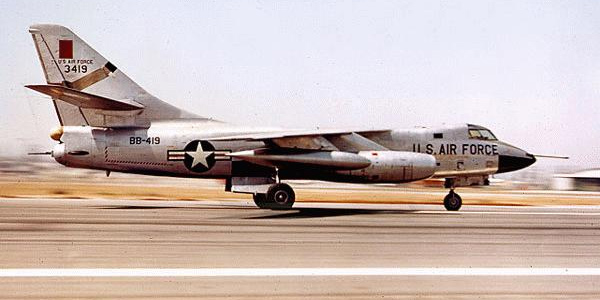
History of Destroyer Douglas B-66 / RB-66
The United States Air Force (USAF) needs a successor to its aging Douglas A-26 Raider fleet and contracts with Douglas Aerospace to procure a land-based light tactical bomber variant of the carrier-based A-3 Skywarrior into service with the U.S. Navy (USN) cooperation. The aircraft was only slightly redesigned, but included certain features required by the USAF, and was adopted as the B-66 "Destroyer". Introduced in 1956, 294 prototypes were procured.
The RB-66 became a well-known photographic reconnaissance aircraft and entered development at the same time as the B-66 bomber.
Borrowing from the A-3 Skywarrior's product line, the B-66 uses a long board-sided fuselage and a stepped cockpit cockpit. The wings were mounted high on top of the fuselage and swept back, with an engine nacelle under each wing.
As usual, the tail contains a large vertical stabilizer and a mid-mounted horizontal plane. The landing gear is wheeled and fully retractable. Propulsion is provided by 2 Allison J71-A-11 turbojet engines, each producing 10,200 pounds of thrust.
Standard armament consists of 2 x 20mm M24 series automatic cannons mounted in a remote-controlled, radar-guided rear turret for subsequent threats. An internal bomb bay allows up to 15,000 pounds of conventional ammunition to be carried. The operating flight crew consists of three people, with ejection seats in all positionsa feature not found on the U.S.
Navy's A-3 production line.
U.S. Air Force authorities bypassed the prototype development stage and began pre-production thinking, focusing on the RB-66A photographic reconnaissance platform ahead of low-altitude tactical bomber offerings.
However, USAF requirements began to significantly delay the program, and the once-simple transition process began to get bogged down in the long list of changes the industry needed. Although progress was slow, on June 28, 1954, five RB-66A pre-production versions finally materialized and took off in airworthy form for the first time.
Production of the Type A ended with the fifth surviving airframe. This paved the way for the RB-66B variant, of which 149 were produced. These were based on the RB-66A but were heavier and were fitted with Allison J71-A-13 series turbojets. The aircraft first flew in early 1955.
The form of the B-66 tactical light bomber was eventually developed to its own requirements, resulting in the production B-66B variant, 72 of which were procured by the USAF. The USAF initially envisioned a fleet of 141 of this type, but those numbers were never good for the industry. The B model eventually formed the basis for the RB-66C, an electronic countermeasures (ECM) variant that added special mission equipment and an additional crew of four in what used to be the new workspace where the internal bomb bay was located.
The brand has a total of 36 specimens, and its wingtip sleeves are easily distinguishable. The EB-66C model is the RB-66C with modern ECM equipment, while the EB-66E is a highly specialized ECM version of the RB-66B.
The WB-66D is a special weatherproof reconnaissance platform with a crew of 5. A total of 36 were produced by the brand. The WB-66D later became the basis for a pair of Northrop X-21A experimental aircraft designated by NASA for testing of laminar flow control wings.
During its service, the B-66/RB-66 served in the Cuban Missile Crisis and the Vietnam War. Much of his career has been centered on reconnaissance missions, where valuable data about enemy positions is critical to incoming offensives and air strikes. The ECM version also provides the necessary jamming of North Vietnamese air defense radar systems as well as lethal ground-based fire and surface-to-air missile (SAM) positions.
The bloodline was officially retired in 1975 when their battlefield roles were taken over by more modern mounts. Some examples experienced longer lifespans in test programs and museum exhibits.
Specification
Basic
Production
Roles
- Ground Attack
- Electronic Warfare (EW)
- Reconnaissance (RECCE)
Dimensions
75.13 ft (22.9 m)
22.1m
23.62 ft (7.2 m)
Weight
19,300 kg
38,000 kg
Performance
Performance
634 mph (1,020 km/h; 551 knots)
39,370 ft (12,000 m; 7.46 mi)
2,467 miles (3,970 km; 2,144 nautical miles)
5,000 ft/min (1,524 m/min)
Armor
Default:
2 x 20mm guns in a remote-controlled, radar-controlled stern turret.
Internal bomb bay holds up to 15,000 lbs of ammunition (regularly dropped bombs).
Changes
B-66 "Zerstorer" base series name
RB-66A - Pre-production photographic reconnaissance variant; five copies made.
RB-66B - Authoritative Photographic Scout Mark; equipped with Allison J71-A-13 engines; 149 examples.
EB-66E - Highly specialized ECM model based on the RB-66B.
B-66B - Tactical light bomber based on the RB-66B; 72 examples.
RB-66C - RB-66B-based electronic countermeasures (ECM) aircraft; bomb bay converted into a mission room for four additional operators; 36 examples.
EB-66C - Four RB-66C models with updated ECM equipment.
NB-66B - Disposable B-66B and RB-66B variants for radar testing of the F-111 program.
WB-66D - Five-person weather reconnaissance platform; 36 examples.
X-21A - A pair of WB-66D airframes used by NASA in laminar flow wing tests; Northrop work.
 Argentina
 Armenia
 Australia
 Austria
 Austria-Hungary
 Belgium
 Brazil
 United Kingdom
 Brunei
 Bulgaria
 Canada
 Chile
Chile China
China Colonial America
 Colombia
 Confederate States
 Croatia
 Czech
Czech Denmark
 Egypt
Egypt Finland
 France
 Georgia
 Germany
 German Imperial
 Greece
 Holland
 Hungary
 India
India Indonesia
 Iran
Iran Iraq
Iraq Ireland
 Israel
 Italy
Italy Japan
Japan Japan (1940)
 Jordan
 Kingdom of Italy
 Malaysia
 Mexico
 Myanmar
 Nazi Germany
 Netherlands
 New Zealand
 North Korea
 Norway
 Pakistan
 Peru
Peru Philippines
 Poland
 Portugal
 Prussia
 Romania
 Russia
 Saudi Arabia
 Serbia
 Singapore
 Slovakia
 Slovenia
 South Africa
 South Korea
 Soviet Union
 Spain
Spain Sweden
 Switzerland
 Syria
Syria Taiwan
 Thailand
 Turkey
 UAE
UAE Ukraine
 Vietnam
 Yugoslavia