


History of the EMT Luna X-2000
The EMT-Luna family of UAVs (Luna X-2000) is offered as an all-weather, short-range aerial reconnaissance and surveillance platform and is currently in service with the German Armed Forces. This unmanned aerial system, while not armed to attack enemy forces, has proven to be an essential cog in the modern war machine, providing real-time information to commanders on the ground. These systems are capable of tracking individual targets and marking them with lasers for response teams or vehicles on the ground. The Luna provides its operators with a very capable aerial 'eye in the air' and to date it has conducted extensive operations in the Balkans and Afghanistan, flying up to 6,000 sorties. Regardless of the environment, the system has proven to be a robust and high-performance drone.
Like most other drones in this class, the Luna is marketed as a military and civilian drone that can accommodate variable mission requirements beyond reconnaissance and surveillance, possibly including search and rescue and environmental impact monitoring, such as wildfires and volcanic eruptions. The Luna is manufactured by the German company EMT Penzberg, and the German military has been using EMT Luna since March 2000.
Around 40 prototypes are believed to have been procured to date.
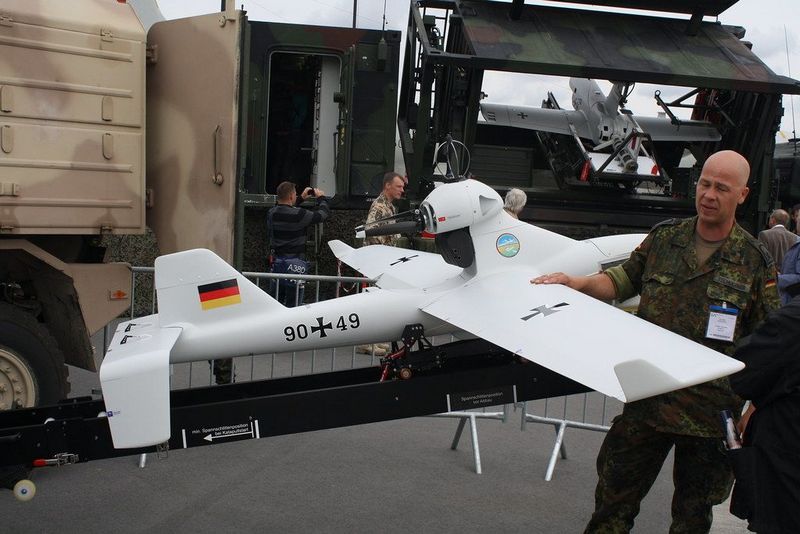
Compared to other drones in its class, the exterior design of the Luna series mixes very traditional and unorthodox shapes. The hull has a well-contoured teardrop shape with a bulge at the front and a tapering at the rear. The payload is contained in the front lower part of the fuselage design.
Wings are straight attachments attached to the sides of the fuselage, with truncated wingtips for each movement. The empennage shows a conventional vertical fin (the top is also cropped), while the horizontal plane is set aft and has an additional vertical fin that extends downwards. One of the more interesting design elements of the Luna is that the engine is mounted along the fuselage spine on a root extension behind the nose assembly.
The Luna does not have any conventional landing gear, and is launched via a catapult that can be retrieved via an integrated parachute to slow the fall.
The engine drives a three-blade propeller in a "spool valve" configuration and is a 2-cylinder, 2-stroke unit. This enables the drone to reach speeds of 43 miles per hour and reach altitudes of up to 11,500 feet, with mission durations between 6 and 8 hours. The design creates a 13.6-foot wingspan and 7.7-foot barrel length - despite its rather "light" appearance in print - the Luna is a very large drone system that requires a lot of hands to lift.
Luna can be further broken down into key components for transportation.
Like other modern drones, the heart and soul of the Luna system is its payload, which typically consists of camera and sensor equipment. To expedite changes to mission parameters, the Luna payload has been specifically designed to be modular in nature to ensure that ground crews can quickly swap out any current payload to a different configuration in a timely manner.
In addition to the conventionally available cameras and infrared systems, the Luna can be equipped with specialized sensors to monitor nuclear, biological and chemical (NBC) pollution in the atmosphere or collect data for meteorological purposes. The Luna can also be equipped with payloads designed to target enemy radio and radar transmissions, expanding its military applications for modern warfighters.
The Luna drone is designed to operate within 62 miles of a control station (it's essentially a short-range system). It is fully autonomous as it can fly to preset waypoints under its own control without input from the pilot on the ground.
The actual pilot's control station consists of a joystick and keyboard with four full-color displays for reporting the latest mission details, in-flight data monitoring and most importantly camera feeds - all in real time. The entire Luna system - including the drone, crew and command post - can be flown anywhere in the world using a mid-range military transport helicopter or similar equipment.
The EMT Penzberg entered service in 1978 and has been serving military aviation for decades. More recently, the company has developed a range of unarmed micro, small and medium-sized fixed-wing and rotary-wing drones for military use.
Specification
Basic
Production
Roles
- Reconnaissance (RECCE)
- driverless
Dimensions
7.74 ft (2.36 m)
13.68 ft (4.17 m)
Weight
20 kg
40 kg
Performance
Performance
43 mph (70 km/h; 38 knots)
11,483 ft (3,500 m; 2.17 mi)
Armor
No. The payload can consist of optics, sensors, and jamming devices.
Changes
X-2000 "Luna" - Base Series Name
 Argentina
 Armenia
 Australia
 Austria
 Austria-Hungary
 Belgium
 Brazil
 United Kingdom
 United States
 Brunei
 Bulgaria
 Canada
 Chile
Chile China
China Colonial America
 Colombia
 Confederate States
 Croatia
 Czech
Czech Denmark
 Egypt
Egypt Finland
 France
 Georgia
 German Imperial
 Greece
 Holland
 Hungary
 India
India Indonesia
 Iran
Iran Iraq
Iraq Ireland
 Israel
 Italy
Italy Japan
Japan Japan (1940)
 Jordan
 Kingdom of Italy
 Malaysia
 Mexico
 Myanmar
 Nazi Germany
 Netherlands
 New Zealand
 North Korea
 Norway
 Pakistan
 Peru
Peru Philippines
 Poland
 Portugal
 Prussia
 Romania
 Russia
 Saudi Arabia
 Serbia
 Singapore
 Slovakia
 Slovenia
 South Africa
 South Korea
 Soviet Union
 Spain
Spain Sweden
 Switzerland
 Syria
Syria Taiwan
 Thailand
 Turkey
 UAE
UAE Ukraine
 Vietnam
 Yugoslavia