

History
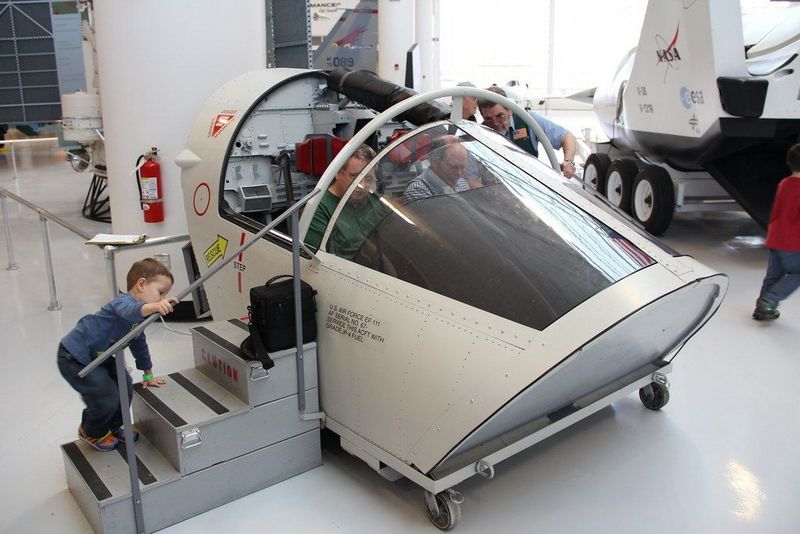
The EF-111 Raven was developed in response to the U.S. Air Forces need for an Electronic Warfare Aircraft (EWA) to replace its aging fleet of EB-66 platforms. The EF-111 was born directly from the fuselage of the existing F-111 Aardvark family of rotary-wing bombers already in service, extending the fuselage's combat use for decades. On top of the $15 million already paid for production, the EF-111, which cost $25 million to convert, became an expensive but important addition to USAF operations in the final years of the Cold War.
The system would remain in service until the late 1990s, when the Air Force was forced to rely on U.S. Navy and Marine Corps aircraft to perform the same EWA role. Regardless, the EF-111 platform proved to be versatile and reliable, and proved itself well under combat pressure.
Back in 1972, the USAF demonstrated their F-111 rotor bomber over Vietnam. Seeing the potential to replace the EB-66 conversion model, the USAF picked a few F-111A models that would themselves be converted to EF-111s, taking on the "Raven" designation in the process. These new systems will use cutting-edge technology to help other air battlefield components operate more efficiently and accurately. Grumman continued the conversion program under a new U.S. Air Force contract in 1974, with the Raven performing its maiden flight in 1977.
Delivery begins four years later.
EF-111s have been used in combat missions against Libya, Panama, the Gulf War, and Bosnia/Herzegovina without a single aircraft being shot down by enemy fire. From there, the Raven will be deployed globally close to U.S. interests for a period of time until 1998, when the EF-111 will officially enter service with the U.S.
Air Force. In every way, the EF-111 looks very similar to its Strike counterpart, save for the bulge on top of the vertical tail. About 42 F-111A Aardvark models were eventually converted to EF-111 Ravens.
EF-111 was also nicknamed "Spark Vark" during its tenure, and at one point also known as "Electric Fox".
Specification
Basic
Production
Roles
- Electronic Warfare (EW)
Dimensions
76.02 ft (23.17 m)
62.99 ft (19.2 m)
20.01 ft (6.1 m)
Weight
55,274 lb (25,072 kg)
89,001 lbs (40,370 kg)
Performance
Performance
1,855 mph (2,985 km/h; 1,612 knots)
44,997 ft (13,715 m; 8.52 mi)
2,000 miles (3,218 km; 1,738 nautical miles)
3,353 m/min (11,000 ft/min)
Armor
2 x AIM-9 Sidewinder short-range air-to-air missiles (AAM).
2 x 600 gallon external disposable fuel tanks.
Changes
EF-111 "Raven - Name of the base series.
EF-111A - A single-series conversion model of the F-111A model for electronic warfare roles.
 Argentina
 Armenia
 Australia
 Austria
 Austria-Hungary
 Belgium
 Brazil
 United Kingdom
 Brunei
 Bulgaria
 Canada
 Chile
Chile China
China Colonial America
 Colombia
 Confederate States
 Croatia
 Czech
Czech Denmark
 Egypt
Egypt Finland
 France
 Georgia
 Germany
 German Imperial
 Greece
 Holland
 Hungary
 India
India Indonesia
 Iran
Iran Iraq
Iraq Ireland
 Israel
 Italy
Italy Japan
Japan Japan (1940)
 Jordan
 Kingdom of Italy
 Malaysia
 Mexico
 Myanmar
 Nazi Germany
 Netherlands
 New Zealand
 North Korea
 Norway
 Pakistan
 Peru
Peru Philippines
 Poland
 Portugal
 Prussia
 Romania
 Russia
 Saudi Arabia
 Serbia
 Singapore
 Slovakia
 Slovenia
 South Africa
 South Korea
 Soviet Union
 Spain
Spain Sweden
 Switzerland
 Syria
Syria Taiwan
 Thailand
 Turkey
 UAE
UAE Ukraine
 Vietnam
 Yugoslavia