
History
The UVision HERO 120 is an Israeli-designed loitering munition for reconnaissance and precision attack. It can search for targets after launch, transmit imagery to its operator, and remain airborne for up to 60 minutes.
The system combines an electro-optical and infrared sensor with a 4.5 kg warhead. A human operator retains control of the engagement and can interrupt an attack before impact, return the munition to a loitering pattern, or select another target.
UVision is the design authority for the HERO 120, while Mistral Inc. serves as the prime contractor and systems integrator for the United States. The system is intended to provide tactical formations with an organic weapon for engaging armored vehicles, fortifications, air-defense equipment, artillery, command posts, logistics vehicles, and personnel beyond direct-fire range.
Early evaluation
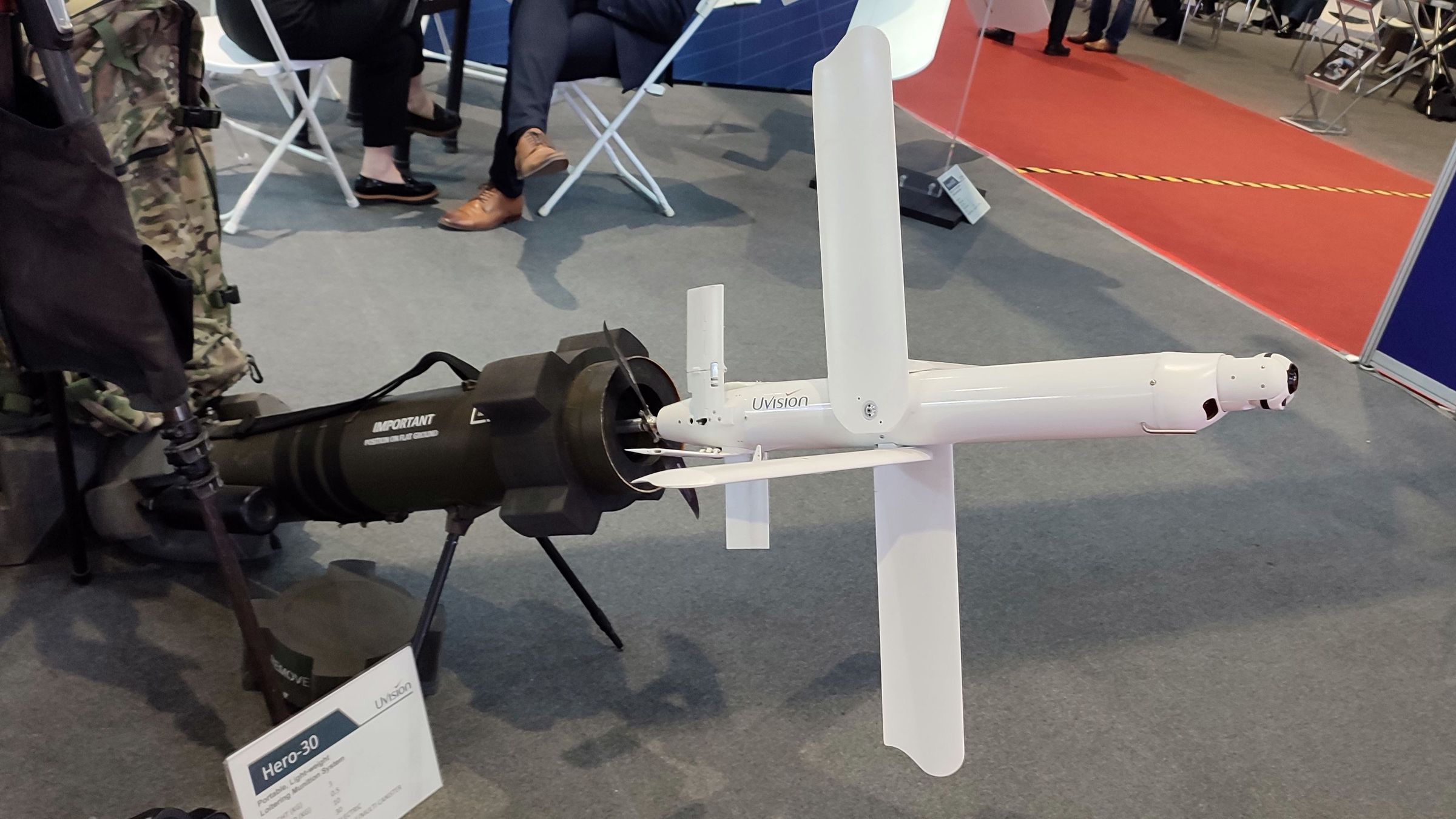
By October 2017, the HERO 120 had been publicly presented as the larger anti-armor member of a pair that also included the HERO 30. Contemporary reporting described the HERO 120 as a pneumatically launched weapon with one hour of endurance, day-and-night capability, operation in GPS-constrained environments, and the ability to transfer control between users. U.S. Army Special Forces had conducted extensive testing of UVision systems by that time, according to Army Times.
U.S. Army procurement
In October 2025, the U.S. Army awarded a multi-year indefinite-delivery, indefinite-quantity contract with a ceiling of $982 million for the HERO 120 under the Lethal Unmanned System program. The contract framework covers munitions, launch and fire-control equipment, software, mission-planning tools, batteries, spare parts, training, engineering support, logistics, and sustainment.
On 4 August 2026, Mistral and UVision completed the first Lot Acceptance Tests for production-standard HERO 120 munitions. The tests evaluated whether serially manufactured systems consistently met the Army's operational specifications and acceptance criteria. Successful completion allowed the Army to accept production lots and issue further delivery orders under the existing contract framework, as reported by Army Recognition.
Design
The HERO 120 is an electrically powered, fixed-wing loitering munition launched from a pneumatic canister. Pneumatic launch avoids the exhaust plume associated with rocket-assisted launch, while electric propulsion reduces the system's acoustic and thermal signatures in flight.
The complete munition has a launch weight of 24 kg. It can be deployed from man-portable, vehicle-mounted, maritime, and rotary-wing launch installations using single or multiple canisters. Its interfaces are described as compliant with Modular Open Systems Architecture principles to support integration with external command-and-control and intelligence, surveillance, and reconnaissance systems.
Guidance and control
A gimballed electro-optical and infrared payload provides day and thermal imagery for reconnaissance, target identification, tracking, and terminal guidance. The datalink transmits full-motion video and associated information to the control station. The system is designed to operate in environments with disrupted satellite navigation and uses encrypted communications.
The operator remains in the control loop through the terminal phase. After launch, the HERO 120 can search an area, observe a selected target, follow a moving or stationary target, or begin an attack. The operator can interrupt the attack and return the munition to loiter if the situation changes. Control may also be transferred between compatible users during flight.
Warhead
The HERO 120 carries a warhead weighing up to 4.5 kg. Reported payload options include anti-tank, anti-personnel, multipurpose, and enhanced-blast warheads. Selectable impact, proximity, and delayed-action modes allow the munition to be configured for different target types.
Operational history
The U.S. Army selected the HERO 120 for its Lethal Unmanned System program, which is intended to provide tactical units with reconnaissance and precision-strike capability below the level of heavier artillery, aviation, and long-range missile support. Completion of the first production-lot acceptance tests in August 2026 marked the transition toward recurring acceptance and fielding of production-standard systems.
The HERO 120 has also been demonstrated in maritime applications. In 2023, HERO 120 munitions were installed on a U.S. Marine Corps Long-Range Unmanned Surface Vessel based on a 12.2 m Defiant monohull. A demonstrated configuration carried eight rounds and allowed control from an accompanying vessel or transfer to another compatible operator.
Variants
- HERO 120: Medium-class loitering munition designed for anti-armor and precision-strike missions, with 60 minutes of endurance and a warhead of up to 4.5 kg.
Operators
- United States Army: HERO 120 customer under the Lethal Unmanned System program. Production-lot acceptance testing was completed in August 2026 under a multi-year procurement framework.
- United States Marine Corps: HERO 120 munitions have been demonstrated from the Long-Range Unmanned Surface Vessel.
Specifications (HERO 120)
General characteristics
- Type: Loitering munition
- Launch weight: 24 kg
- Propulsion: Electric motor
- Launch method: Pneumatic canister
- Sensor: Gimballed electro-optical and infrared payload
- Control: Human-in-the-loop guidance through the terminal phase
Performance
- Operational range: Up to 60 km
- Endurance: Up to 60 minutes
Armament
- Warhead weight: Up to 4.5 kg
- Reported warhead options: Anti-tank, anti-personnel, multipurpose, and enhanced blast
- Fuzing modes: Impact, proximity, and delay
 Argentina
 Armenia
 Australia
 Austria
 Austria-Hungary
 Belgium
 Brazil
 United Kingdom
 United States
 Brunei
 Bulgaria
 Canada
 Chile
Chile China
China Colonial America
 Colombia
 Confederate States
 Croatia
 Czech
Czech Denmark
 Egypt
Egypt Finland
 France
 Georgia
 Germany
 German Imperial
 Greece
 Holland
 Hungary
 India
India Indonesia
 Iran
Iran Iraq
Iraq Ireland
 Italy
Italy Japan
Japan Japan (1940)
 Jordan
 Kingdom of Italy
 Malaysia
 Mexico
 Myanmar
 Nazi Germany
 Netherlands
 New Zealand
 North Korea
 Norway
 Pakistan
 Peru
Peru Philippines
 Poland
 Portugal
 Prussia
 Romania
 Russia
 Saudi Arabia
 Serbia
 Singapore
 Slovakia
 Slovenia
 South Africa
 South Korea
 Soviet Union
 Spain
Spain Sweden
 Switzerland
 Syria
Syria Taiwan
 Thailand
 Turkey
 UAE
UAE Ukraine
 Vietnam
 Yugoslavia