


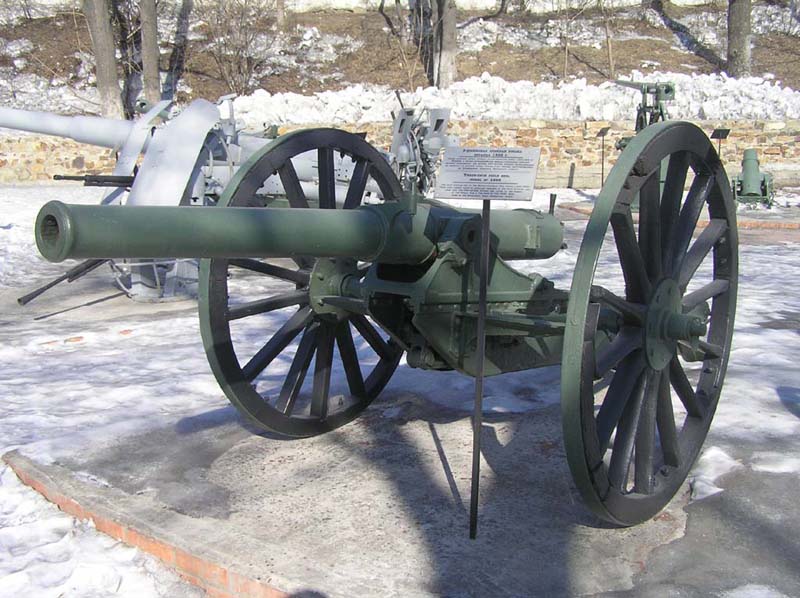


History of the 76mm Gun Model 1900 (M1900)
At the end of the 19th century, the Imperial Russian Army was trying to upgrade an increasingly outdated stock of field artillery that was lagging behind contemporary products. Various foreign designs were reviewed, but the decision was made to focus on local components supplied by the Putilov factory - which itself may have been heavily influenced by the design of modern German Krupp artillery pieces.
This particular field gun was developed in 1900 and officially adopted under the rather aptly named "M1900" ("Type 1900"). The M1900 became Russia's first 76.2mm gun, a popular standard in the Soviet Army during World War II (1939-1945), and the first gun system in Russian military history to feature an integrated recoil mechanism, enabling more accurate repeaters Function.
Many aspects of the M1900 were traditional at the timeit used a two-wheeled stationary trailer with solid rubber tires and a multi-spoke rim design. The gun's mounting bracket contained a recoil system using an oil/rubber ring, and the breech was an interrupted bolt.
Mounting hardware on the bottom of the barrel allows an elevation range of -6 to +11 degrees and a centerline of 2.5 degrees to traverse from left to right. Combat weight is 2,200 pounds and requires moving animals or vehicles for long hauls.
The effective range is 4.6 miles, while the maximum range may be 5.28 miles.
Serial production should come from St. Petersburg. In 1904, the Russo-Japanese War began and lasted until 1905, forcing available M1900 supplies into combat. These weapons work well in conflict, often outcompeting adversaries.
Despite this advantage, the war was a humiliating defeat for the Russians and ended with the Treaty of Portsmouth.
The M1900 was in front-line service until Russia was involved in World War I (1914-1918), although the gun itself is now increasingly surpassed by its contemporaries. In any case, the Russian army needed all kinds of war supplies, and the supply of the M1900 series met the demand, although as the war progressed, the stockpile gradually dwindled - especially due to the arrival of the more modern M1902 series.
During its front-line service, the M1900 was considered an effective weapon with little publicity. The Russians went to war with the Germans in 1914, but that ended in 1917 due to growing internal conflict - the communist revolution culminated in the collapse of the Russian Empire, and the M1900 series weapons were used specifically by both sides in the conflict.
With the rise of the Soviet Empire in the early 1920s, guns eventually flowed to supported countries through donations or direct sales. This period ended widespread use of the M1900 as major powers now sought to upgrade ageing weapons in the interwar period leading up to World War II - now allowing smaller global players to have weapons that were once front-line quality.
Specification
Basic
Roles
- fire support/attack/damage
Dimensions
1 ton (1,000 kg; 2,205 lb)
Performance
Performance
5 miles (9 km)
Armor
1 x 76.2 mm (3") barrel
Depends on the ammunition carrier.
Changes
76mm gun model 1900 - name of the basic series
 Argentina
 Armenia
 Australia
 Austria
 Austria-Hungary
 Belgium
 Brazil
 United Kingdom
 United States
 Brunei
 Bulgaria
 Canada
 Chile
Chile China
China Colonial America
 Colombia
 Confederate States
 Croatia
 Czech
Czech Denmark
 Egypt
Egypt Finland
 France
 Georgia
 Germany
 German Imperial
 Greece
 Holland
 Hungary
 India
India Indonesia
 Iran
Iran Iraq
Iraq Ireland
 Israel
 Italy
Italy Japan
Japan Japan (1940)
 Jordan
 Kingdom of Italy
 Malaysia
 Mexico
 Myanmar
 Nazi Germany
 Netherlands
 New Zealand
 North Korea
 Norway
 Pakistan
 Peru
Peru Philippines
 Poland
 Portugal
 Prussia
 Romania
 Saudi Arabia
 Serbia
 Singapore
 Slovakia
 Slovenia
 South Africa
 South Korea
 Soviet Union
 Spain
Spain Sweden
 Switzerland
 Syria
Syria Taiwan
 Thailand
 Turkey
 UAE
UAE Ukraine
 Vietnam
 Yugoslavia