
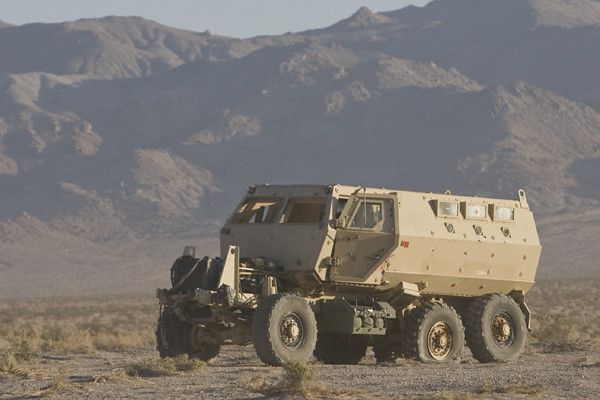
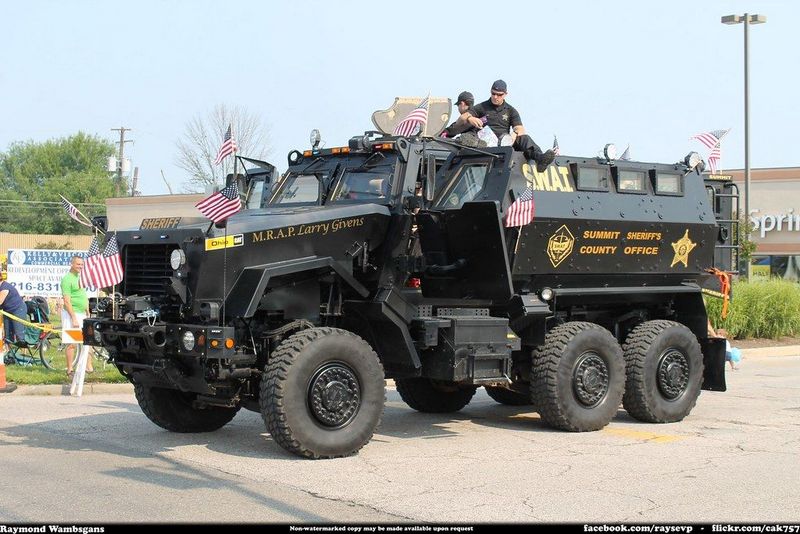


BAe Caiman Story
Before the U.S.-led invasions of Afghanistan and Iraq brought renewed attention to them, mine-resistant vehicles had become an integral part of militaries like South Africas. These incursions have shown painfully that only a limited number of durable armored vehicles can withstand blasts and rocket-propelled grenade (RPG) shelling from turrets and ambush enemies. In addition to tracked armored vehicles like the M2 Bradley IFV, the U.S.
Army was forced to rely on lightly protected HUMVEE trucks and standard military transports, resulting in poor early performance.
This ushered in the era of the Mine Resistant Ambulance (MRAP) vehicle, a new US military classification covering a design capable of detonating concealed mines, explosive devices, RPG fire and other battlefield hazards. The product of this period became the BAe Caiman MRAP, which formed part of a new family of US military vehicles called FMTV ("Family of Medium Tactical Vehicles"). Its improved form became the Caiman Multi-Terrain Vehicle (MTV) or (CMTV).
In total, the FMTV Group owns approximately 56,000 vehicles (2015).
The initial development of the product was led by Stewart & Stevenson, a manufacturing company founded back in 1902 that was eventually acquired under the Armor Holdings brand name (founded in 1996). Its parent company then became BAe Systems and Armaments, which Armor Holdings acquired in 2007.
The Caiman has evolved from the original Stewart & Stevenson design to the new BAe model seen on the modern battlefield.
The Caiman MTV is an evolution of the original Caiman MRAP with increased survivability, a 10-passenger seating arrangement, an automatic transmission system and a central tire inflation system (CTIS). The vehicle adopts a traditional automotive layout, with the engine at the front, the passenger compartment at the rear, and the driver's seat at the front center. Ground clearance is excellent, offering great off-road capability as well as good overhead visibility from the hood.
Panels with windows are kept to a minimum and panels with viewing windows use thick bulletproof glass. Overall, the vehicle is protected from small arms, shrapnel, improvised explosive devices (IEDs) and mines (up to Category II).
Its V-shaped fuselage helps deflect some incoming blasts, while blast-resistant seats increase crew survivability. Run-flat tires allow crews to leave contested areas under fire.
The Caiman MTV marks a new standard in the Caiman range of vehicles. In addition to the new armor protection scheme, there are improved engine performance/reliability, improved comfort through an improved HVAC arrangement, new absorbing seats, and reinforcement of the existing underlying chassis.
The upgrade program is targeting approximately 1,700 trucks for the work.
Variants of the Caiman series currently on sale include the original Caiman MRAP, the updated Caiman MTV, the Caiman MTV Combat Ambulance with rear ramp and additional armor blocks, and the Caiman Cargo Truck (C2T) with a rear flat section. Versions can be fitted with roof turrets for mounting small arms, as well as additional armor blocks.
Specification
Basic
Roles
- Infantry Support
- Anti-mine/improved survivability
- Reconnaissance (RECCE)
- Security / Defense / Law Enforcement / Escort
- Troop Transport
Dimensions
7.5m
2.6m
9. 84 feet (3 m)
30 tons (27,600 kg; 60,848 lb)
Performance
Performance
110 km/h
401 miles (645 km)
Armor
Variable: 1 x 7.62mm General Purpose Machine Gun (GPMG) or 1 x 12.7mm Heavy Machine Gun (HMG) or 1 x 40mm Automatic Grenade Launcher (AGL); and any personal weapons carried by the crew.
Depends on weapon (armed variant).
Changes
Caiman - Base Series Names
Caiman MRAP - Mine Protection Standard Vehicle
CAIMAN MTV - Improved Caiman MRAP
Caiman MTV (MED) - Armoured ambulance; rear loading ramp.
Caiman Cargo Truck (C2T) - Cargo truck variant with a flatbed rear.
 Argentina
 Armenia
 Australia
 Austria
 Austria-Hungary
 Belgium
 Brazil
 United Kingdom
 Brunei
 Bulgaria
 Canada
 Chile
Chile China
China Colonial America
 Colombia
 Confederate States
 Croatia
 Czech
Czech Denmark
 Egypt
Egypt Finland
 France
 Georgia
 Germany
 German Imperial
 Greece
 Holland
 Hungary
 India
India Indonesia
 Iran
Iran Iraq
Iraq Ireland
 Israel
 Italy
Italy Japan
Japan Japan (1940)
 Jordan
 Kingdom of Italy
 Malaysia
 Mexico
 Myanmar
 Nazi Germany
 Netherlands
 New Zealand
 North Korea
 Norway
 Pakistan
 Peru
Peru Philippines
 Poland
 Portugal
 Prussia
 Romania
 Russia
 Saudi Arabia
 Serbia
 Singapore
 Slovakia
 Slovenia
 South Africa
 South Korea
 Soviet Union
 Spain
Spain Sweden
 Switzerland
 Syria
Syria Taiwan
 Thailand
 Turkey
 UAE
UAE Ukraine
 Vietnam
 Yugoslavia