


History
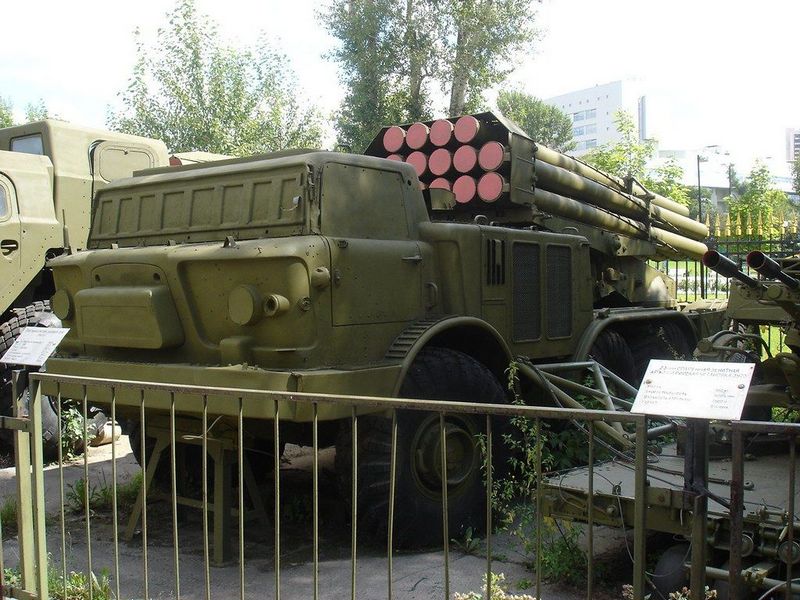
BM-27/9P140 "Uragan" ("Hurricane") is a large multi-wheeled self-propelled missile launcher consisting of an enclosed crew compartment, launcher unit and a heavy eight-wheeled chassis. The Soviet Union relied heavily on the inherent firepower of "rocket launchers" throughout WWII (through the extensive use of the "Katyusha" system) to avoid defeat at the hands of Hitler's Germany, and inevitably brought this tactical doctrine into the Cold War era against the West . Rocket launchers have the uncanny ability to suppress areas while having a powerful psychological effect on enemy forces unfortunate enough to be found within their "range".
This missile system can saturate the target area in front of the main force consisting of main battle tanks, armored vehicles and infantry.
Developed in the 1970s, the BM-27 officially entered service with the Red Army at the end of the decade. This large 8x8 wheeled vehicle is equipped with rockets no smaller than 16 x 220 mm and can be launched to targets approximately 22 miles away. The chassis is nothing more than an improved version of the ZiL-135 series wheeled 8x8 trucks, complete with an armored cab for the crew.
The massive vehicle is powered by two petrol engines placed side by side. As a result, each wheel drives the wheel along its own side of the chassis, resulting in a full 8x8 assist. The wheels are arranged in a rather unique way, with the front and rear axles moving away from the second and third axles inside. Therefore, only the front and rear axles are steerable in the design. The BM-27 system has an operational range of up to 311 miles, and less when traversing long rough terrain.
Despite its Cold War origins, the BM-27 is still in service today.
The BM-27 usually consists of six people, including the vehicle commander and full-time driver. The crew compartment is fully enclosed and provides standard nuclear, biological and chemical (NBC) protection for its occupants. This allows the crew to be relatively safe from their own missiles during launch and provides protection against enemy fire or incoming NBC threats where applicable.
While the car is large, weighing in at over 44,000 pounds, it's designed to be quickly set up and removed while filming. The recoil struts are lowered in preparation for launch and help absorb the strong recoil inherent in large rockets exiting the tube at high speed. The 16-round payload can be emptied from the launch tube within 20 seconds of launch, while a special version of the eight-wheeled ZiL-135 vehicle called the 9T452 -- which looks very similar to the BM-27 without the missile launcher -- is then used to reload new rockets into reusable launch tubes.
Aiming is achieved with a simple aiming device that allows only indirect fire. BM-27s are usually painted in the standard Soviet/Russian Army dark green scheme, while those on the parade are more detailed.
The BM-27's 16 x 220mm rocket payload allows the use of different warheads to meet mission requirements. These include the High Explosive Fragmentation (HE-FRAG) tipped version, which is the standard missile available.
A chemical weapons version has also been developed to deliver lethal doses consistent with the NBC payload. One of the more unique forms of the 220mm missile is the mine-dropping submunition version, which sprays electrically-timed mines at the target area with truly catastrophic consequences.
Each massive 220mm rocket is 15.8 feet long and weighs nearly 800 pounds.
The BM-27 has seen combat action since the bloody Soviet occupation of Afghanistan from 1979 to 1989. Perhaps as many as 18 BM-27s were captured by Afghan forces and eventually reused, although it is believed that their current condition is mostly dilapidated.
This was followed by engagements during the first and second Chechen wars in 1994-1996 and 1999-2000. When the BM-27 was last seen fighting Georgian troops in the 2008 South Ossetia war, its long-range capabilities were put to good use.
USSR/Russia is by far the largest operator of the BM-27 series, with up to 800 deployed at peak usage. Kazakhstan has about 180 in stock, while Ukraine has no less than 140. Belarus can operate up to 84 copies.
Other operators were (or may continue to be) Guinea, Iran, Moldova, Myanmar, North Korea, Tajikistan, Tanzania, Turkmenistan, Uzbekistan and Yemen. The totals for Iran and North Korea are unknown.
Specification
Basic
Roles
- fire support/attack/damage
- Support/Special Purpose
Dimensions
24 tons (22,040 kg; 48,590 lb)
Performance
Performance
65 km/h
311 miles (500 km)
for everyone else in our database)
Armor
16 x 220 mm rocket in a separate tube inside the trainable launch vehicle.
Depends on the ammunition carrier.
Changes
BM-27 "Uragan" (Hurricane) - the name of the basic series.
9P140 - Alternative name
9T452 - A supply vehicle developed on the ZiL-135 chassis.
 Argentina
 Armenia
 Australia
 Austria
 Austria-Hungary
 Belgium
 Brazil
 United Kingdom
 United States
 Brunei
 Bulgaria
 Canada
 Chile
Chile China
China Colonial America
 Colombia
 Confederate States
 Croatia
 Czech
Czech Denmark
 Egypt
Egypt Finland
 France
 Georgia
 Germany
 German Imperial
 Greece
 Holland
 Hungary
 India
India Indonesia
 Iran
Iran Iraq
Iraq Ireland
 Israel
 Italy
Italy Japan
Japan Japan (1940)
 Jordan
 Kingdom of Italy
 Malaysia
 Mexico
 Myanmar
 Nazi Germany
 Netherlands
 New Zealand
 North Korea
 Norway
 Pakistan
 Peru
Peru Philippines
 Poland
 Portugal
 Prussia
 Romania
 Russia
 Saudi Arabia
 Serbia
 Singapore
 Slovakia
 Slovenia
 South Africa
 South Korea
 Spain
Spain Sweden
 Switzerland
 Syria
Syria Taiwan
 Thailand
 Turkey
 UAE
UAE Ukraine
 Vietnam
 Yugoslavia