

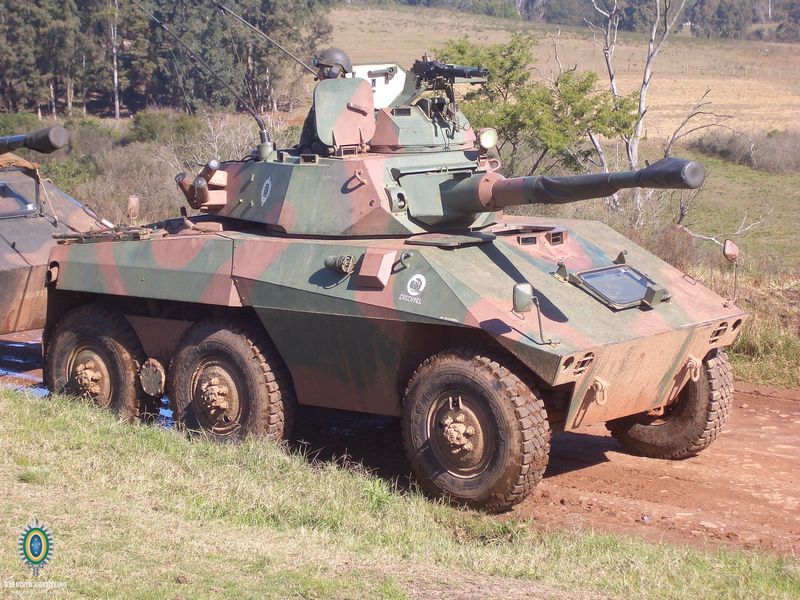

History of the Engesa EE-9 Cascavel (Diamondsnake)
The Brazilian Army, recognizing the need to replace its old stock of American-made WWII-era (1939-1945) M8 Greyhound armored vehicles, chose a 6x6 wheel design from local firm Engesa as its successor. This car became an EE-9 "Cascavel" ("Rattlesnake") in service and was exported to customers throughout South America and the Middle East. Modernization programs help move EE-9 products forward in the new millennium and adapt them to modern challenges.
About 2,500 units have been produced since it entered service in 1974.
The final product of Engesa became a 12-ton vehicle, 6.2 meters long (main gun in front), 2.6 meters wide and 2.7 meters high. The standard operator - consisting of the driver, commander and gunner - consisted of three people, with the driver sitting in the front left of the hull and the turret supporting the remaining two.
Armor protection is up to 12mm thick, made of steel and fitted with a fire detection system to increase crew survivability.
The standard armament eventually became a 90mm main gun mounted on the front of the turret. There is also a coaxial 7.62mm machine gun for anti-infantry service. The main gun is linked to a Fire Control System (FCS) for fire support and a laser rangefinder to improve accuracy and reaction time.
Later models introduced an external turret top mount for mounting an additional 7.62mm Medium Machine Gun (MMG) or a 12.7mm Heavy Machine Gun (HMG) for local defense, also fired from inside the vehicle.
The line's performance is primarily a 212-hp American Detroit Diesel 6V-53N water-cooled 6-cylinder diesel engine, but a 190-hp German Mercedes-Benz diesel is also seen. The engine and drivetrain are mounted to the rear of the body, providing mid- and front interior space for the crew and various mission-critical components. The 6x6 wheel configuration features significant spacing between the first and second axles, as well as large wheels that aid in towing and off-road driving.
Suspension is a unique 'boomerang' dual-axle arrangement developed by Engesa and each wheel has a 'run-flat' function as standard. The maximum speed on the road reaches 100 km/h, and the cruising range on the road reaches 880 kilometers.
The first pilot vehicles appeared in 1970 and pre-production form between 1971 and 1972. After acceptance by the Brazilian Army, production quality vehicles have been seen since 1974.
In addition to the EE-9 model, Engesa also built another locally similar 6x6 wheeled armored vehicle, such as the EE-11 "Urutu", which resulted in the two machines sharing many of the same auto parts for logistical reasons.
The earliest EE-9 lines were armed with a turret-mounted 37mm main gun from a discontinued stockpile of American-made WWII M3 Stuart light tanks. The model was called the Cascavel I and was nicknamed "Cascavel Magro" ("The Rattlesnake"). It was followed by the Cascavel II, which featured an enlarged turret ring to accommodate a transverse assembly for the French-origin 90mm DEFA D921 tank gun. The car was equipped with a full H90 series turret and earned the nickname "Cascavel Gordo" ("Fat Sidewinder") when it was mainly used for export. The Cascavel III brand brings a turret system designed in-house by Engesa and mounts Belgian-origin 90mm Cockerill Mk 3 series tank guns (these guns are manufactured locally under license).
The Cascavel IV has since been introduced with an all-new engine and transmission pairing that improves performance. It also comes with a useful 7.62mm MMG/12. 7mm HMG mount for local air defense and updated optics with laser rangefinder for improved day/night service and accuracy.
The most successful of the Cascavel models listed is the Cascavel III, with operators ranging from Bolivia and Brazil to Uruguay and Zimbabwe. A modernization program is underway to bring EE-9 and EE-11 vehicles to new operational standards for service in 2020 and beyond.
The EE-9 has been in service since the Colombian Civil War (1964-present) and the Chad-Libyan War (1978-1987). It also became the Iran-Iraq War (1980-1988), the Gulf War (1991), the Second Congo War (1998-2003) and most recently the Libyan Civil War (2011).
Specification
Basic
Roles
- Reconnaissance (RECCE)
- Security / Defense / Law Enforcement / Escort
Dimensions
6.2m
2.65m
2.7m
12 tons (11,000 kg; 24,251 lbs)
Performance
Performance
100 km/h
547 miles (880 km)
for everyone else in our database)
Armor
1 x 90mm Cockerill Mk 3 gun
1 x 7.62mm coaxial machine gun
1x7.62mm/12. 7mm machine gun on top of turret (optional)
44 x 90mm bullets
2,200 x 7.62mm ammo
Changes
Cascavel - name of the base series
Cascavel I - 1974 original production model; 37mm gun.
Cascavel II - 90mm DEFA D921 gun in H90 turret
Cascavel III - The 90mm Cockerill Mk III main gun in the Engesa turret.
Cascavel IV - Updated engine and transmission; roof mount 7. 62mm/12. 7mm machine gun mount; laser rangefinder; day/night optics support.
 Argentina
 Armenia
 Australia
 Austria
 Austria-Hungary
 Belgium
 United Kingdom
 United States
 Brunei
 Bulgaria
 Canada
 Chile
Chile China
China Colonial America
 Colombia
 Confederate States
 Croatia
 Czech
Czech Denmark
 Egypt
Egypt Finland
 France
 Georgia
 Germany
 German Imperial
 Greece
 Holland
 Hungary
 India
India Indonesia
 Iran
Iran Iraq
Iraq Ireland
 Israel
 Italy
Italy Japan
Japan Japan (1940)
 Jordan
 Kingdom of Italy
 Malaysia
 Mexico
 Myanmar
 Nazi Germany
 Netherlands
 New Zealand
 North Korea
 Norway
 Pakistan
 Peru
Peru Philippines
 Poland
 Portugal
 Prussia
 Romania
 Russia
 Saudi Arabia
 Serbia
 Singapore
 Slovakia
 Slovenia
 South Africa
 South Korea
 Soviet Union
 Spain
Spain Sweden
 Switzerland
 Syria
Syria Taiwan
 Thailand
 Turkey
 UAE
UAE Ukraine
 Vietnam
 Yugoslavia