
History
Iveco has been designing, developing and manufacturing military vehicles since its establishment in Turin, Italy in 1975. When the Italian Army needed a new multi-role armored utility vehicle to keep pace with the modern battlefield using its 8x8 wheeled "Centaur" tank killer (detailed elsewhere on this site), the company set out to adopt a new driving design.
The first pilot vehicle was completed in 1988, and the fleet grew to five by the end of 1990. From there, the Italian Army commissioned six "special mission" vehicles (mortars, anti-tank missile platforms, etc.).
For further evaluation, finally, in 1999, Iveco placed a long-awaited order for a total of 540 Puma - they would come in 240 4x4 wheel shapes and 300 6x6 wheel shapes.
The Cougar has been in service since 2001 and is manufactured under the Iveco-OTO-Melara brand. Production From 2001 to 2004, the operator expanded to Argentina, Djibouti and Libya.
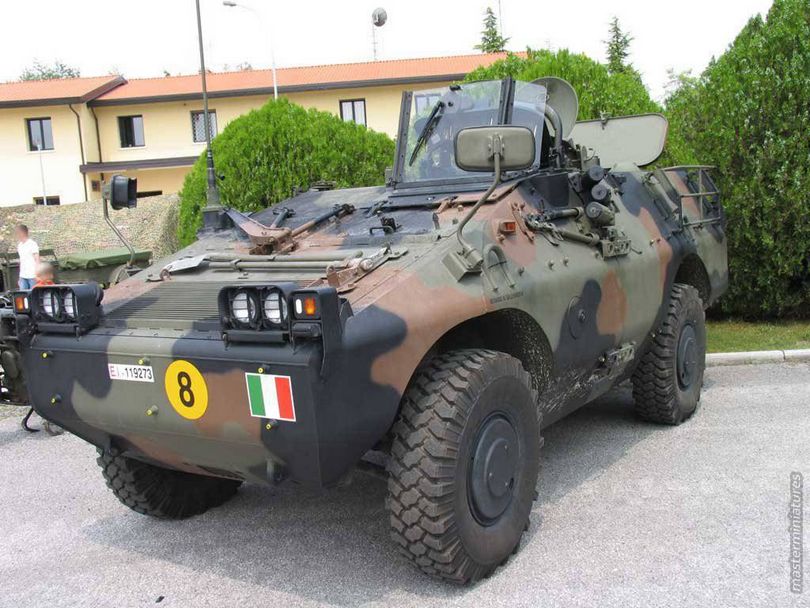
The vehicle weighs 8 tons, has a total length of 5 meters, a width of 2 meters and a height of 1.67 meters. The operator consists of two people and can accommodate four passengers. Weaponry is versatile, with a full set of pivot-mounted 7.62mm and 12.7mm machine guns, as well as a 40mm automatic grenade launcher (AGL) on top of the fuselage.
Remote Weapon Stations (RWS) can replace manned positions. Carrying a smoke grenade launcher is self-defense. Power comes from a 160 hp IVECO 4-cylinder turbo diesel engine.
This, combined with a 5-speed automatic transmission system, gives the vehicle a road speed of 110 km/h and a range of up to 700 km.
The vehicle has a power pack installed inside the front right. This moves the rider forward to the left side of the hull. The passenger area is therefore located in the rear of the fuselage, and the boarding points are located on the sides and rear of the fuselage. There are also access openings along the hull roof line.
The driver has his own roof hatch, and the vehicle commander (sitting directly behind the driver) also manages his own hatch.
As mentioned earlier, the Puma is available in two different wheelbases - 4x4 and 6x6 models. The latter saw an increase in hull length and the addition of another pair of axles/wheels.
This model looks more like an armored personnel carrier (APC), and the 4x4 shape looks a lot like an armored vehicle. The two molds share the same automotive components, simplifying the logistics of supporting both products.
The Argentine Army acquired two Puma vehicles for peacekeeping training, followed by Djibouti with three of its own troops. After Muammar Gaddafi was ousted in the 2011 uprising, the Libyan National Army (Libya is a former Italian colony) received 20 cougars (4x4) directly from the Italian army to strengthen its ranks against insider threats .
Specification
Basic
Roles
- Reconnaissance (RECCE)
- Security / Defense / Law Enforcement / Escort
Dimensions
5.07m
2.1m
5.48 ft (1.67 m)
7 tons (6,350 kg; 13,999 lbs)
Performance
Performance
110 km/h
435 miles (700 km)
Armor
Variable: 1 x 7.62mm machine gun or 1 x 12.7mm machine gun or Remote Weapon Station (RWS); smoke grenade launcher.
Depends on weapon.
Changes
Puma - name of the base series
Puma 4 - 4x4 wheel variant
Puma 6 - 6x6 wheel variant
 Argentina
 Armenia
 Australia
 Austria
 Austria-Hungary
 Belgium
 Brazil
 United Kingdom
 United States
 Brunei
 Bulgaria
 Canada
 Chile
Chile China
China Colonial America
 Colombia
 Confederate States
 Croatia
 Czech
Czech Denmark
 Egypt
Egypt Finland
 France
 Georgia
 Germany
 German Imperial
 Greece
 Holland
 Hungary
 India
India Indonesia
 Iran
Iran Iraq
Iraq Ireland
 Israel
 Japan
Japan Japan (1940)
 Jordan
 Kingdom of Italy
 Malaysia
 Mexico
 Myanmar
 Nazi Germany
 Netherlands
 New Zealand
 North Korea
 Norway
 Pakistan
 Peru
Peru Philippines
 Poland
 Portugal
 Prussia
 Romania
 Russia
 Saudi Arabia
 Serbia
 Singapore
 Slovakia
 Slovenia
 South Africa
 South Korea
 Soviet Union
 Spain
Spain Sweden
 Switzerland
 Syria
Syria Taiwan
 Thailand
 Turkey
 UAE
UAE Ukraine
 Vietnam
 Yugoslavia